Eric Metaxas and David Barton: Show Me the Miracles

Barton Metaxas picOn Tuesday, I posted an audio clip of David Barton on Eric Metaxas’ radio show talking about the two times when Thomas Jefferson cut up the Gospels to create an extraction of the morals of Jesus. During Jefferson’s first term, he revealed his beliefs about Christianity to some of his closer friends and in the process decided to cut out of the Gospels portions which Jefferson believed were actually from Jesus, leaving the rest behind.
On the program, Barton told Metaxas a made up story about what Jefferson did and mixed in a little truth with some error to create a flawed picture. Metaxas took it in without question. In my Tuesday post, I debunked Barton’s story about how Jefferson got the idea to cut up the Gospels and today I want to set the stage for what is a more difficult aspect of this story: identifying the verses Jefferson included in his first effort to extract the true teachings of Jesus from the Gospels.
The reason it is more difficult to know what Jefferson included in his 1804 effort is because the original manuscript has been lost. There isn’t a copy we can look at. The version completed sometime after 1820 is the one commonly known as the Jefferson Bible. That version can be purchased from the Smithsonian and viewed online.
Do We Know What Jefferson Cut Out of the Gospels?
Reproductions of the 1804 version exist but for reasons I will address in this series, there are some disputed verses which Jefferson may or may not have included. There really is no way to be sure.
Jefferson mentioned both versions in a letter to Adrian Van Der Kemp in 1816, Jefferson wrote about both extractions:

I made, for my own satisfaction, an Extract from the Evangelists of the texts of his morals, selecting those only whose style and spirit proved them genuine, and his own: and they are as distinguishable from the matter in which they are imbedded as diamonds in dunghills. a more precious morsel of ethics was never seen. it was too hastily done however, being the work of one or two evenings only, while I lived at Washington, overwhelmed with other business: and it is my intention to go over it again at more leisure. this shall be the work of the ensuing winter. I gave it the title of ‘the Philosophy of Jesus extracted from the text of the Evangelists.’

The “work of one or two evenings only, while I lived in Washington, overwhelmed with other business” is a reference to his 1804 effort which was done for his “own satisfaction.” When he referred to “his intention to go over it again at more leisure” in an “ensuing winter,” he referred to the version he later completed sometime after 1820. It should be obvious from this letter that Jefferson viewed the second project as a completion of the 1804 work which was “too hastily done” while attending to his presidential duties. Jefferson does not refer to them as two separate projects with separate purposes. Rather, the 1804 version was more like a trial run and the latter was the product of more time and concentration.
How Do We Know What Verses Jefferson Included?
There are two primary sources for our knowledge of what verses Jefferson included. First, ever meticulous and organized, Jefferson prepared a listing of texts he planned to include. Michael Coulter and I included images of the originals (housed at the University of VA) in our book Getting Jefferson RightThe second source is the cut-up Bibles Jefferson used to cut out the verses he pasted together to form the 1804 version. In contrast to Barton’s claim, Jefferson didn’t cut out only Jesus’ words and he certainly didn’t cut them all out and paste them end to end.
Although these sources are critically important, they are not sufficient to be sure about what Jefferson included. A major barrier to certainty is that Jefferson cut out some verses which were not listed in his table of texts. This can be discerned by reviewing the parts of the Gospels which were cut out. What can never be known for sure is why Jefferson cut out more verses than he intended. We cannot assume that he intended to cut out any verse other than what he listed in his table of verses. However, we cannot assume he didn’t decide as he was doing it that he wanted to include something on the fly.
There are good arguments to be made for both possibilities. Jefferson said he did the 1804 version “too hastily.” Thus, he may have made some errors in cutting and cut too many verses or simply cut some in error from the wrong page. Anyone who has literally cut and pasted any kind of craft project can probably relate to that possibility.
On the other hand, it is certainly plausible to think that Jefferson changed his mind as he read through the Gospels again. He may have decided he wanted a particular verse that he didn’t include in the table. Nothing would have stopped him from clipping it.
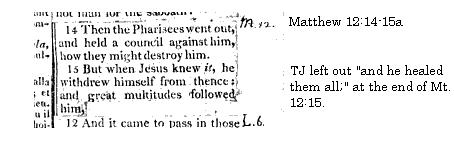
Another possibility exists for the 1804 version which we know is true for the 1820 version. At times, Jefferson surgically extracted miraculous content from within a verse. In other words, he cut out a verse from the Gospels but when he included it in his manuscript, he only included a part of the verse.  For instance, Jefferson included Matthew 12:15 in his 1820 version, but he left out the end of the verse where the healing took place.*
jefferson bible mt 12
Mt. 12:15 in entirety reads:

But when Jesus knew it, he withdrew himself from thence: and great multitudes followed him, and he healed them all.

Jefferson intentionally left out the healing (“and he healed them all”) even though he included the verse. Clearly, it is not enough for us today to know what Jefferson cut out of those Gospels in 1804. For a perfect reconstruction, we would have to know what parts of the verses he included. A few disputed verses do have some miraculous content but that is no guarantee that Jefferson included that content in his compilation. We know he used partial verses in his second attempt; it is very plausible that he did the same thing the first time around.
Barton’s story to Metaxas completely glosses over these facts. If we really want to get inside Jefferson’s thinking about Jesus in the Gospels in 1804, we should first look at the table of texts he constructed (click here to examine those tables). Then we can look at the verses which Jefferson cut out but didn’t list. However, we must approach those disputed verses carefully. We don’t know why he cut them out and we don’t know what parts, if any, he actually included.
Barton Also Uses a Flawed Secondary Source
In The Jefferson Lies, Barton links to two secondary sources for his information about what is in the 1804 version. In at least one case, the source has a major error which we point out in Getting Jefferson Right. In the next post, I will address that secondary source error.
 
I challenge Eric Metaxas to bring on an actual historian and/or me to discuss the issues raised recently about his book, If You Can Keep It or this series.
*Jefferson Bible, ch 1:59-60.

Evangelical Trump Supporters: Why Do You Trust Trump When He Breaks His Promises?

During the primary season, Donald Trump told the press he would release his tax returns when his IRS audit was complete. The IRS then said nothing prevented him from releasing them just as other presidential candidates have done for decades.
Now Trump through his spokesman Paul Manafort has again said he will not release them. This statement comes in light of allegations that Trump has a financial connection to Russian power brokers.
For me, this raises an important question for evangelicals who support Trump because he promised to name conservative Supreme Court justices. Why do you trust him? There is absolutely no basis for trust.
Releasing tax returns is something candidates have done for decades. It is not a novel act of transparency. Not releasing them is a significant red flag. This is especially true because he promised to do it. Now he says he won’t do one of the basic things presidential candidates do.
At some point, I hope evangelical supporters of Trump wake up and recognize that they are being played. The alternative is not to vote for Hillary Clinton. The alternative is to get behind a third party option. According to Better for America, a third party candidate will be announced at the end of July. Evangelicals should at least wait to see who is tapped to lead a third (or fourth or fifth I guess when one considers the Libertarians and Greens) party run.

David Barton Told Eric Metaxas an Untrue Story about the Jefferson Bible

Barton Metaxas picLast week, Eric Metaxas had David Barton on his radio show and told the audience that he loved Barton and his work. He also said he used some of Barton’s work to help write his new book If You Can Keep It. That book has been the subject of many critical reviews.

They also briefly discussed Barton’s pulled-from-publication book, The Jefferson Lies. In particular, Barton claimed to enlighten the audience about what is commonly known as the Jefferson Bible. Metaxas started to ask Barton a question about Jefferson’s editing of the Gospels, and Barton jumped in to explain.

I have addressed this story before but want to write a series of posts to show that Barton’s story is mostly fiction. Today, I start with the audio, the transcript and address a few of the key claims. First, the audio segment:

Transcript (the words in bold print are either untrue or highly questionable):

Metaxas: Jefferson is perceived as being rather secular, that he excised the Bible, rather the New Testament to remove the miracles and the…

Barton: Can I jump in on that one for a second because that is the one that Christians will repeat the most often?

Metaxas: Right, of course.

Barton: And I say Jefferson cut out all the supernatural, the stuff he didn’t like? And they say, Yeah. What are you talking about? They say, the Jefferson Bible. I say, really? Yeah, the Jefferson Bible. I say, which one? First off, they didn’t know there were two. And I say, yeah there’s the 1804 and an 1820 so which one so which one are you talking about? And so then I say, have you read either one of them? Well, no. How do you know he cuts it out? Well, that’s what they always say. Well, let me tell you about the 1804 and then go to 1820.

In 1804, Jefferson was given a sermon by a friend named, excuse me 1803, he got a sermon by a friend named Edward Dowse and the sermon was by William Bennet an evangelical in Scotland that says if you want to reach the American Indians do not give them the Bible because they might read Leviticus, they might read the genealogies, he said give them excerpts out of the Bible.

So Jefferson read that sermon, he then goes to the White House and takes two White House Bibles and he cuts out the teachings of Jesus, what we would call the red letters of Jesus. He pasted them end-to-end. He gave that to a missionary friend and said look, this is a lot cheaper than printing the Bible and its got the teachings. In that, he has the dead being raised, Jesus is raising the dead, Jesus healing the sick, Jesus cleansing lepers, Jesus is the son of God, resurrection, heaven, hell, angels. But wait! I thought he cut out all that sp__, no, it’s there.

The second one he did was in 1820. And he said, and by the way, every University in America back then required you to take a course in moral philosophy, every theological school, same thing. And so he [Jefferson] lists nearly 20 writers where he read their moral writings and he concluded that Jesus was better than all of them.

So he went through in 1820 and found 81 moral teachings of Jesus, he compiled them end to end. He called the book the life and morals of Jesus of Nazareth, and it was the stuff like the great commandment, love God with all your heart soul and mind. It was turning the other cheek, it was forgiveness, it was the good Samaritan, it was the Golden Rule, and that’s what he did in four languages. Nobody knew that existed until 1886, and Cyrus Adler the Secretary of the Smithsonian found it from Jefferson’s grandson, they bought it , they got it to Congress and in 1902, US representative John Lacey said you know this is so great, if we could just live by the teachings of Jesus. So Congress printed 9,000 copies and for 50 years if you were a Freshman in the House or Senate, they gave you the life and morals of Jesus, read this and you’ll stay out of trouble.

Metaxas: Unbelievable.

Barton: Now wait a minute what happened to this stuff about hating. Let me point out that Jefferson was a lifetime member of the Virginia Bible Society, the third largest contribution he gave in his life was to the Virginia Bible Society, when his kids and grandkids learned to read, he gave them a Bible to read, he’s a funder of the John Thompson Bible, the largest Bible ever done in America, he’s a funder of the Thomas Scott Bible, he tried to fund the Charles Thomson Bible. If Jefferson hates the Bible, why does he keep doing this stuff? See that’s one of the seven lies we’ve been told about Jefferson. And everybody repeats what they’ve heard. Read it for yourself. It doesn’t cut out the miraculous, or the supernatural. Read it for yourself.

William Bennet’s Sermon
The first false claim is that William Bennet’s sermon gave instructions about how to reach the Indians with the Gospel. I don’t know why Barton keeps making this claim. He made it in the first edition of The Jefferson Lies and often repeats in his media appearances (e.g., Jesse Peterson show) but he walked it back in the recently published second edition. Furthermore, Mark Beliles, an writer used by both Barton and Metaxas as an authority, told me that Barton is wrong about the content of that sermon. In an email, Beliles said:

Yes, Barton overstated the case about that sermon itself. But the sermon clearly promoted the importance of getting Jesus’ morals found in the gospel into the hands of missionaries of the society, and they of course were going to Indians as well as other groups.

Barton did more than overstate the case. Bennet in his sermon didn’t mention mission work to Indians and certainly didn’t tell readers to withhold a Bible from Indians because they might read Leviticus or the genealogies. He didn’t encourage readers to cut up the Gospels and give the Indians a resurrection-free version of the Gospels. Barton just made that up. Don’t believe me? Click the link and read the sermon for yourself.

Why Did Jefferson Cut Up the Gospels?
Barton makes it sound like Jefferson read this sermon and then immediately went to the White House Bibles with knife in hand. One must pause to understand the timing. Edward Dowse sent Bennet’s sermon to Jefferson in April 1803 (read the entire correspondence here). Jefferson didn’t make his first extraction from the Gospels until March 1804.

In this case, we have Jefferson’s own words about why he cut up the Gospels. To Adrian Van Der Kemp in 1816, Jefferson wrote about his extraction:

I made, for my own satisfaction, an Extract from the Evangelists of the texts of his morals, selecting those only whose style and spirit proved them genuine, and his own: and they are as distinguishable from the matter in which they are imbedded as diamonds in dunghills. a more precious morsel of ethics was never seen. it was too hastily done however, being the work of one or two evenings only, while I lived at Washington, overwhelmed with other business: and it is my intention to go over it again at more leisure. this shall be the work of the ensuing winter. I gave it the title of ‘the Philosophy of Jesus extracted from the text of the Evangelists.’

Jefferson referred to this extraction to John Adams, Benjamin Rush and others. In no place, did he refer to the sermon from Bennet or the letter from Dowse as having anything to do with his desire to cut up the Gospels. Jefferson said he selected only those texts “whose style and spirit proved them genuine, and his [Jesus’] own.” Jefferson said the real words and deeds of Jesus were “as distinguishable from the matter in which they are imbedded as diamond in dunghills.”

Regarding the 1804 effort, Jefferson refers to it as a text “of his [Jesus] morals.” In both efforts, Jefferson was going for a compendium of the moral teachings of Jesus which Jefferson believed to be the actual teachings (diamonds) and not material added by the disciples and Gospel writers (dunghill). Let that sink in a minute. Jefferson presumed to know what parts of the Gospels were really true and which were added and not genuine.
Barton is correct that there were two efforts but because of his story about Bennet’s sermon, he artificially makes Jefferson have two purposes. This is misleading.

Relevant to that point, I challenge Barton or Metaxas to identify the missionary who received Jefferson’s 1804 version. No primary source evidence exists that Jefferson ever gave the extraction to anybody.

What Is In The Jefferson Bible?
In fact, when Barton tells Metaxas’ audience to go read the 1804 version, he knows they can’t. There is no actual copy in existence. We have the tables of texts Jefferson wrote to help guide him in his work and we have the cut up Bibles as well. However, we don’t know for sure what ended up in the version since we don’t have it. We do have the 1820 (in the neighborhood of 1820, it is not known exactly when he finished it) which you can read here.
In the next post on Barton’s story on the Metaxas show, I will take up the question about miracles in the 1804 version. We can’t be as sure what was in that one as in the 1820 version but we aren’t completely in the dark as I will discuss in that post. In the mean time, one can see the following posts on that topic, or get my book with Michael Coulter, Getting Jefferson Right: Fact Checking Claims about Our Third President.

Is the Jefferson Bible All the Words of Jesus? Part One

Is the Jefferson Bible All the Words of Jesus? Part Two

Are the Miracles of Matthew 9 in the Jefferson Bible?

K-LOVE First Promises Answer to Listener about Executive Compensation Then Fails to Follow Through

Back in May of this year, I published information about the finances of radio giant K-LOVE’s CEO and other executives. Several K-LOVE listeners who also read the blog thanked me for the information and also contacted K-LOVE to ask why the CEO made so much and why K-LOVE represented their financial picture as being precarious.

One couple, Bill and Sandra Ford, was promised a reply from K-LOVE. First, here is the Ford’s letter followed by K-LOVE’s reply.

From: Bill Ford [mailto:[email protected]]
TO: [email protected]
Sent: Sunday, May 01, 2016 11:01 PM
To: KLOVE
Subject: Mike Novak’s pay (KLOVE Comments, General Questions)

Dear Klove,  I’m writing you today due to a recent discovery. I recently found out that Mike Novak’s compensation is over five hundred thousand dollars a year. This is completely inappropriate for a man who is paid by people sacrificially giving each month. How can you go on the radio during pledge drives and ask people to support the ministry when the president is making more money than many medical doctors?  For years my wife and I supported a Christian/Jewish ministry until we found out that the head/founder of they ministry makes over a million dollars a year-disgusting when you consider where you think your money is going, and where it is going in reality. Please pray about this.
Sincerely,
Bill Ford, RN

K-LOVE’s reply:

From: President – KLOVE [email protected]

Date: May 3, 2016 at 3:10:59 PM PDT
To: “‘[email protected]'” <[email protected]>
Subject: RE: Mike Novak’s pay (KLOVE Comments, General Questions)

Dear Bill,

Thank you for reaching out with your concerns about the KLOVE pledge drive and specifically the salary for our CEO. Due to the nature of your concerns, your email has been forwarded to the chairman of our board, Mr. Darrell Chambliss. He will be responding as quickly as he is able.

We do appreciate you taking the time to share your thoughts. Please let me know if you do not receive a response after two weeks. I do not know Mr. Chambliss’ schedule so am not sure what his time-table will be, but will follow-up if needed.
Have a blessed day!
Jill Graves
Correspondence Assistant to the President
KLOVE Radio

Mr. Ford never heard from Ms. Graves or anyone from K-LOVE. Ford contacted me and gave me permission to approach K-LOVE with his correspondence. I told K-LOVE that I hoped they would answered Mr. Ford and that via the email I requested an on-the-record to his questions justifying the CEO’s compensation. Mr. Ford wrote a second time in June and I wrote to K-LOVE on June 30. To date, no one from K-LOVE has replied.
Mr. Ford told me that he is very dismayed with the stonewalling and is considering other giving options. I don’t blame him.

I predict that K-LOVE will not reply to these inquiries until major media attention comes their way. It now seems clear to me that K-LOVE’s leaders plan to avoid issues raised by listeners and will pursue business as usual as long as a majority of listeners allow it. If you feel so inclined as a K-LOVE listener, you can use the contact information above to contact the station with your questions.

GOP Platform Members: What Happened to Arms Help for Ukraine?

This WaPo article said Trump intervened in one issue during the week of putting together the GOP platform: Ukraine.
Specifically, the Trump camp did not want the platform to call for providing arms to Ukraine to defend themselves against Russian aggression.
Most conservatives want to help defend Ukraine. Why doesn’t Trump? Perhaps, his advisors and his own view of the world is that Putin isn’t a threat or that Ukraine isn’t our problem.
Ukraine watchers are worried and I believe Trump supporters among the committee should provide an explanation for their vote.