Every Gospel for Asia Donor Should Read This Federal Court Document

On February 16, 2018 a hearing was held in Fayetteville AR before federal Judge Timothy Brooks in the case of former GFA donors Garland and

Admirer kissing the hand of K.P. Yohannan. From his 2017 birthday video.

Phylliss Murphy v. Gospel for Asia, K.P. Yohannan, Gisela Punnose, David Carroll, and Pat Emerick. The Murphy’s complaint accuses GFA and named defendants of conspiring to defraud donors and misrepresent the way donated funds have been spent.

This hearing was convened to resolve an ongoing dispute regarding the discovery of evidence in the case. While the transcript is long (over 90 pages), if you donate to Gospel for Asia or are considering it, you should read it.

The context for the hearing is the claim by former GFA donors Garland and Phylliss Murphy that GFA diverted funds away their intended purpose. At this point in the case, the Murphys and their attorneys have requested documents which would demonstrate a link between donations and expenditures. Over several months, GFA attorneys have promised such evidence but have not provided it. The reason Judge Brooks called the hearing was to resolve the situation.

My goal now is to outline two high points of this hearing in the context of many months of reporting on the GFA scandal.

Groundhog Day

Judge Brooks actually asked the following question in the hearing:

I’ve next got a question for everyone. Will you please raise your hand if you’ve ever seen the movie “Groundhog Day.”

He explained:

I feel like I am Phil Connors who was portrayed by Bill Murray in the movie “Groundhog Day” in dealing with this discovery dispute; and I am of the view, having read the motion and the response, that the defendants, at least in their answers — their answer to these requests for admissions, and in their response to the motion for sanctions, are like all of the people that Phil Connors was dealing with in the movie “Groundhog Day.”
He woke up every day repeating February 2nd, over and over again, but the people that he was interacting with in the plot of this movie didn’t realize that; and I feel like when I read the defendants’ answers and when I read their response that it is as if this Court had not already addressed and ruled on some of these same issues at least twice, if not more and, yet, here we are again.

Judge Brooks had already ruled twice that GFA needed to produced documents in response to questions from the Murphys about where money was spent. They have failed to do so. By this hearing, Judge Brooks summarized the situation:

Plaintiffs now once again seek answers to the same questions that they’ve been asking for months: Was donated money diverted to other causes and do defendants have information or documents that would prove how the money was spent.

This is the crux of the case. If GFA defendants would like to clear their name, they could produce evidence which shows how donations were spent. They haven’t done so. As I pointed out in December of last year, GFA is dragging this out. Anyone who says differently simply isn’t dealing with the case documents.

Donors should ask GFA why a federal judge is exasperated over GFA’s inability to document how donations are spent.

GFA Staff Authorized Transfer of Money from Canada to India to the U.S.

Source TT Architects website

A stunning revelation in this transcript is the disclosure that GFA’s former Chief Operating Officer David Carroll and CEO K.P. Yohannan allegedly had wire authority to move $20 million dollars from India to Texas, presumably for the completion of GFA’s headquarters. Staff were initially told that an anonymous donor gave those funds. Then in May 2015, Carroll told staff that one of GFA’s field partners in India took out a loan for nearly $20 million and sent it to Texas. Carroll and Yohannan told staff that the decision to give the funds was made by the Indian leadership without any influence from Yohannan. According to Yohannan, he had no authority over the decision.

In the February hearing transcript, plaintiffs’ attorney Mark Stanley presented evidence which contradicts this narrative. Here is the relevant portion of Stanley’s testimony.

MR. STANLEY: They [GFA’s attorneys] say that the defendants [GFA] don’t control these third-party entities. I have two documents, if I might — let me find them — showing just the opposite. Here’s one. This document is 2015, April 2015, produced by them from Reverend Dr. K. P. Yohannan, president, asking them to transfer Canadian dollars, or CAD — I don’t know. CAD, those are cash deposits — for Gospel For Asia (India), for further credit to Gospel For Asia (India). These are from — remitting it to the state bank of India in Canada, and I can show you that account number is Gospel For Asia (India). I have the accounts for that. That’s K. P. Yohannan doing that.
David Carroll says he has no control over it. I’ve got David Carroll requesting a document — sorry. There it is. This is David Carroll who says, “I have no control over the field partners,” right? “We have no control; we have nothing to do with them”; yet, David Carroll sends a letter to Sarah Billings from the Royal Bank of Canada asking them to transfer $20 million from Gospel For Asia (India) to GFA’s account in the United States, signed David Carroll, CEO, Gospel For Asia. How could he authorize money coming out of a Gospel For Asia (India) account? We know it’s a Gospel For Asia (India) account because it’s account number — 489 is the last four digits. Here it is. There’s a statement from the Royal Bank of Canada, Gospel For Asia (India), care of Teresa Chupp, in Carrollton — that’s their old address before they moved to Wills Point — for Gospel For Asia (India), and there’s the account number.
So clearly the spin that they have been told that these folks have no control over the field partners is simply not true. They have control over it. They have wire instructions, wire authority. K. P. Yohannan is the metropolitan of that. You read the constitution from prior hearings. It talks about all of his roles in the constitution.

All of these folks, Mr. Carroll, Reverend Carroll, Mr. Emerick, the Reverend Emerick, all the others have sworn total loyalty to K. P. Yohannan. His niece, Siny Punnose also have sworn loyalty to K. P. Yohannan. They have absolute control of that.

According to Stanley, he has documentation that K.P. Yohannan authorized the movement of funds from the Canadian GFA to GFA-India. He also claims documentation of David Carroll authorizing a transfer of $20 million from the India field partner back to the United States organization. If Stanley’s representations are as they seem, this information contradicts what the Evangelical Council for Financial Accountability said they were told by GFA’s leaders and it contradicts what GFA leaders told staff in 2015.

What Did GFA Tell ECFA?

Beginning in May 2015, the ECFA began talking to GFA leaders, some of whom are now defendants in this fraud case, about alleged violations of financial management policies. In contrast to the evidence presented in the February 16, 2018 hearing, GFA told ECFA representatives that GFA leaders in the U.S. had no control over the field partners in India.
From the ECFA letter to GFA:

During our review on June 3, ECFA staff raised questions regarding GFA’s oversight and control of funds sent to foreign field partners. GFA’s staff indicated that the foreign field partners are completely independent organizations and therefore GFA did not exercise any direct control over field partners. GFA staff also indicated that they did not have a foreign grant process in place to oversee the use of funds.

The ECFA letter specifically refers to the near $20-million transfer of cash. From the letter:

GFA’s financial statements do not appropriately report transactions with foreign partners. During our review on June 3, GFA staff indicated that funds transferred to GFA India were actually transferred to a number of related entities instead of the single entity reflected in the 2013 audited financial statements. Additionally, on August 24 we learned that GFA received a $19,778,613 donation from GFA India, which was classified as a related party elsewhere on the 2013 audited financial statements (also see #8 below). On August 27, GFA staff confirmed that this donation was neither disclosed in the footnotes of the 2013 financial statements as a related-party transaction nor to the GFA board of directors. This inconsistency within the financial statements and lack of disclosure to the GFA board of directors about a significant related-party transaction appears to violate ECFA Standards 2, 3, and 6. On July 20, ECFA was informed that GFA engaged a new audit firm and they are in the process of reviewing related-party transactions.

The ECFA report letter then pointed out the impropriety of moving funds from India which had been given originally as donations exclusively for mission work in Asia.

Use of funds restricted for the field for other purposes. On June 3, ECFA discussed GFA’s claim that 100 percent of field funds are sent and used in the field. GFA staff confirmed that this was accurate. On August 24, ECFA was informed that GFA India made a gift to GFA of $19,778,613 in 2013 to complete GFA’s new office. On August 27, GFA’s staff confirmed that the funds relating to this donation were originally received by GFA as gifts restricted for the field and GFA transferred to field partners to fulfill donor restrictions.

Two important issues are raised:

A. Reallocating gifts donated for field purposes and using them to pay for headquarters construction appears to be a violation of ECFA’s Standards 7.2. GFA staff stated in a recorded GFA staff meeting that you approached the field partner and explained that GFA could borrow the funds in the U.S., at less than desirable terms, for the headquarters construction. However, a gift from the field partner, in lieu of GFA borrowing the funds, would allow GFA to complete the new headquarters and thereby save interest. Therefore, GFA would be able to send more money to the field in future years. ECFA believes that the potential savings resulting from the GFA India gift is an inadequate basis to reallocate gifts donated for field purposes.

B. Reallocating gifts donated for field purposes contradicts GFA’s claim that 100 percent of funds are sent to the field. In fact, a significant amount of donations restricted for the field made a circuitous trip back to GFA and were used for the headquarters construction, as though they had never gone to the field. This appears to be a violation of Standard 7.1.
In a GFA staff meeting, GFA indicated the field partner took out a loan to cover the use of the $19,778,613 gift and GFA staff confirmed on August 27 that India-generated income was used to repay the loan. Our review of the board minutes did not indicate the GFA board had approved, or even been notified, of the $19,778,613 reallocation of donor-restricted gifts.

Now we learn from attorney Stanley that the funds may have simply been transferred by GFA leaders in the U.S. from GFA-India’s Royal Bank of Canada account. Was the office complex finished via a gift from GFA-India? Or did GFA defendants simply transfer $20-million of donor money from one account to another? In either case, plaintiffs attorney presented evidence to allege that GFA leaders had sufficient control to authorize the transfer of funds which were not subsequently spent as intended by donors.

Other Misrepresentations Revealed

There are other revelations in this transcript which I will detail in future posts. For now, I will conclude by repeating my advice to donors to read this document as well as the ECFA report. Some of the same issues which led to the removal of GFA from the ECFA membership are still current today and have come to the attention of the presiding federal judge in this case. Although the trial isn’t slated until next year, consumers and donors can use the evidence available to make their own judgments now.

SEE THIS 2019 UPDATE

K.P. Yohannan Blesses and Consecrates Holy Oils for Believers Eastern Church

In another sign that Believers’ Eastern Church continues to move away from evangelical roots, the church celebrated a “sacred ceremony” using specially prepared and blessed holy oils on the Thursday before Easter. While common in Catholic, Anglican and Lutheran services, use of anointed oils is less common among evangelicals who deny that the oil has any special properties.
From the church Facebook page:

This year’s #MaundyThursday was a historical day for the Believers Eastern Church. Following the Biblical and Eastern Church traditions, we had the sacred ceremony of the Blessing and Consecration of the Holy Oils, which were consecrated by Metropolitan Dr. KP Yohannan in the presence of our Bishops, selected priests, deacons and laity representing the entire church. The process of making these oils started several weeks ago and has been done in a complete atmosphere of prayer and fasting. These holy oils which are known as ‘Myron’ or ‘Chrism’ will be used for the sacraments such as baptism and also dedication of churches, church altars and utensils for the Eucharist and to anoint and pray for the sick.


K.P. Yohannan in his Metropolitan garb. From Believers Church Facebook page.

Believers Church Validates Claims Made by Former Staff

Gospel for Asia’s public problems began when a large group of former staff members, known as the GFA Diaspora, approached GFA leaders and board members in 2014 with five concerns about the organization. At the top of the list was this:

GFA leadership practices and teaches a false view of spiritual authority

As evidence that K.P. Yohannan had inappropriately elevated himself to that they considered to be an unbiblical level of authority, the former staff pointed to the practice of requiring followers in India to kiss Yohannan’s ring as well as church practices which appeared to reflect a Catholic hierarchy of authority.
To me, the issue here isn’t the correct view of hierarchy.* It is the credibility of GFA’s statements. In response to criticism of Yohannan’s ring kissing and other practices, GFA insisted that such practices didn’t exist and that GFA was thoroughly evangelical in practice. However, this does not appear to be the case, as indicated by photos of followers kissing Yohannan’s ring, and now this use of holy oil in a special manner by Yohannan.
 

*I mean no criticism of any religious tradition. I have my own views but what is at issue is the accuracy of statements by GFA’s leaders over the years. GFA’s leaders have at various times portrayed Believers’ Church as evangelical in practice. However, on the ground the church operates in a manner which places all power within the hands of the K.P. Yohannan, the Metropolitan Bishop. He is a papal figure with veto power over all church actions. The church celebrates his birthday as a holiday.

Happy Birthday to Thomas Jefferson

Thomas Jefferson was born on April 13 1743 at Shadwell, Virginia.
In honor of our third president, I can suggest a worthy gift for anyone given in his name.
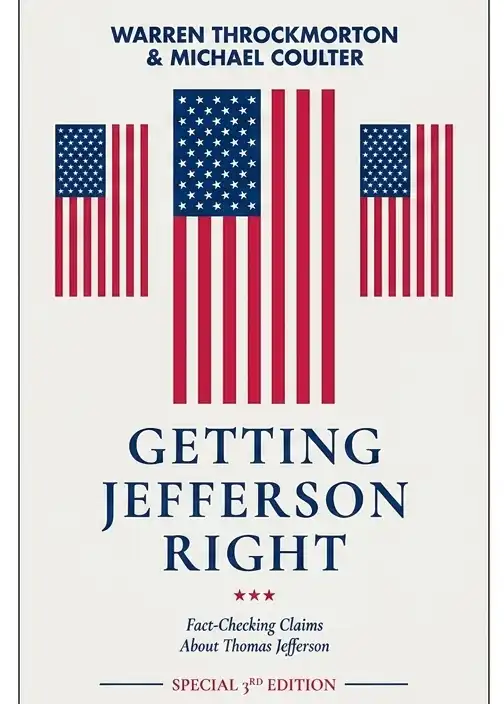
jeffersonbookcover
Written mostly to debunk self-styled historian and Christian nationalist David Barton’s The Jefferson Lies, our book Getting Jefferson Right: Fact Checking Claims about Our Third President stands on its own as an examination of Jefferson’s views on religion, the Bible, and slavery.
 

The Jefferson Lies

After Barton’s book was pulled from publication in 2012, he claimed Simon & Schuster would republish it. That never came to pass. Then WorldNetDaily put it out claiming that Christian publisher Thomas Nelson pulled the book due to “political correctness.” Barton’s buddy Glenn Beck claimed that “liberal bastards” were behind the effort to discredit the book. These claims came even though most of the recent critics were Christian college professors. In short, none of these excuses hold water.
Thomas Nelson said at the time that they lost confidence in the books facts and pulled the book due to historical errors. I outlined what I know about the situation in a previous post. In fact, philosopher and college professor Jay Richards recruited 10 Christian scholars, mostly historians, to read our book and then Barton’s. On the whole, the scholars came back to Richards with the feedback that Barton had turned Jefferson into a figure unrecognizable to them. It wasn’t long afterwards that Thomas Nelson took the extremely rare step of pulling the book from publication.

Additional reading:

The David Barton Controversy – WORLD – Thomas Kidd (2012)
Doubting Thomas – WORLD – Thomas Kidd (2012)
Publisher Pulls Controversial Thomas Jefferson Book – NPR – Elise Hu (2012)
Citing Lost Confidence, David Barton’s Publisher Pulls Book on Jefferson – TPM – Casey Michel – (2012)
Barton’s Jefferson Book Yanked – Eric Marrapodi and Dan Gilgoff – CNN (2012)
Christian History: How David Barton is Doing it Wrong – Gospel Coalition – Justin Taylor (2017)
 

Uganda: Members of Parliament Call for Another Anti-Homosexuality Bill

Yesterday members of Uganda’s Parliament called for legislation akin to the failed Anti-Homosexuality Act 2014. Beginning in 2009, Uganda had the world’s attention as the nation’s Parliament debated a bill which would have implemented the death penalty for repeat instances of same-sex behavior between consenting adults. A slightly modified bill finally passed in 2013 only to be struck down by a Ugandan court in 2014.

In protest, nations around the globe cut off aid to Uganda and President Obama and Secretary of State Hillary Clinton denounced the bill at the 2010 prayer breakfast. Evangelicals were divided over the bill with some giving quiet support to the evangelical parliamentarians in Uganda. Others, like Rick Warren, criticized the bill and urged Ugandan pastors to come out against it. See the end of this post for more reading on the issue. I wrote scores of articles about the bill and came out strongly against it.

A New Anti-Homosexuality Bill?

After speaking out against same-sex marriage at the March Inter-Parliamentary Union conference, members of Parliament passed a commendation of Speaker Rebecca Kadaga.


Here is Kadaga at the IPU meeting:

The recognition of Kadaga Wednesday led to other members of Parliament making statements about a need for a new law against homosexuality.


That homosexuality spreads “like a wild fire” is just one of many misconceptions which members of Parliament use to generate support for their efforts. As a response to a request from President Museveni for scientific information relating to homosexuality, Jack Drescher and I wrote a scientific consensus letter in 2014 which was signed by over 200 scholars and sex researchers. I would like to think it helped but he signed the bill anyway. Furthermore, when I read these statements from the Parliament, I can see we have more work to do.

Additional Reading

Scientific Consensus Statement

History of Uganda’s Anti-Gay Bill – NPR

Uganda Anti-Homosexuality Bill Inspired by American Evangelicals  – Daily Beast

My Salon series about a Nevada church who dropped support of a Uganda missionary over the bill

Straight Man’s Burden – Harpers

The Bill Inspired by American Evangelicals – The Atlantic

All posts about Uganda

On This Day in 1945, Dietrich Bonhoeffer was Executed

On April 9, 1945 Dietrich Bonhoeffer was hanged in a Nazi concentration camp at Flossenburg Germany. He had been involved in getting Jews out

Dietrich Bonhoeffer

of Germany and resistance to the Nazi regime.  Arrested by the Gestapo in 1943, Bonhoeffer was killed along with his brother and other conspirators. A brief but helpful summary of Bonhoeffer’s work against the Nazis can be found at the Holocaust Museum website.

The Church and the Jewish Question

Setting the stage for his resistance activities was a paper written in 1933 titled, “The Church and the Jewish Question.” I can’t find it online but you can see it in Google books preview of The Bonhoeffer Reader and Dietrich Bonhoeffer Works.  In it, Bonhoeffer sets forth a relationship between church and state which might seem foreign to modern day evangelicals who support Christian nationalism. Even though Bonhoeffer, as a churchman, did intervene in his government, it was a last resort under the most extreme of circumstances. According to the Bonhoeffer, “There is no doubt that the church of the Reformation is not encouraged to get involved directly in specific political actions of the state. The church has neither to praise nor to censure the laws of the state.” He added that there is a “radical separation between the place of the gospel and the place of the law.” According to Bonhoeffer, the “true church of Christ, which lives by the Gospel alone and knows the nature of state actions, will never interfere in the functioning of state actions in this way. by criticizing its history-making actions from the standpoint of, say, any humanitarian ideal.”
Rather, according to Bonhoeffer, the church may critique the state as either creating too much or too little law to fulfill the governmental function. The church may rightly complain if the state uses “force to such a degree as to rob the Christian faith of its right to proclaim its message.” On the other hand, if the state doesn’t create enough law and as a result a group is deprived of rights, the church may also speak. “There is too little law and order wherever a group of people are deprived of its rights,” he wrote. In such cases, there are three actions which the church may take.

First, (as we have said) questioning the state as to the legitimate state character of its actions, that is, making the state responsible for what it does. Second is service to victims of the state’s action. The church has an unconditional obligation toward the victims of any societal order, even if they do not belong to the Christian community…The third possibility is not just to bind up the wounds of the victims beneath the wheel but to seize the wheel itself. Such an action would be direct political action by the church itself.

In his essay, Bonhoeffer cited a threat of too little law when a group of citizens is deprived of rights. On the other extreme of too much law, his example was the church being told that baptized Jews must be excluded from Christian congregations or banning missions to Jews. Bonhoeffer asserted that “the church cannot allow the state to prescribe for it the way it treats its members.”
Bonhoeffer did not say that the state cannot create laws which touches the religious beliefs of individuals. He distinguished between the church as an entity and individual Christians when he wrote the following:

At the other extreme from too little law and order, there can be too much law and order. This would mean the state developing its use of force to such a degree as to rob the Christian faith of its right to proclaim its message. (This does not apply to restriction of free conscience — that would be the humanitarian version, which is an illusion, since every state in its life impinges on the so-called free conscience).

As a possible case in point, I have a sense that Bonhoeffer would reject the state making pastors officiate at gay weddings, but he might not have a problem with anti-discrimination laws regarding Christians providing services in the marketplace.
Bonhoeffer’s essay provides a useful foundation for considering how Christians today could consider religious liberty and church and state relationships. In his day, he chose to intervene because there was too much law. My reaction is that many religious liberty issues which occupy Christians politically today don’t rise to the level of “too much law” as framed by Bonhoeffer. I would like to see the church spend more time and money on fulfilling Bonhoeffer’s second point. As for his third point, in America, in my opinion the essential Christian message is in no danger of government restriction.
Additional reading:
The Bonhoeffer Quote That Isn’t Bonhoeffer’s