David Barton and Wallbuilders Double Down on The Jefferson Lies Accusations

In his new edition of The Jefferson Lies, David Barton claimed that I recruited Jay Richards to find Christian historians who would engage in a campaign against him. That charge is still false.
I denied the charge in a post here and in a review on The Jefferson Lies Amazon page.
Today someone at Barton’s organization, Wallbuilders, replied to my review with an accusation that I told one story in the review and another story to some undisclosed persons. See below:
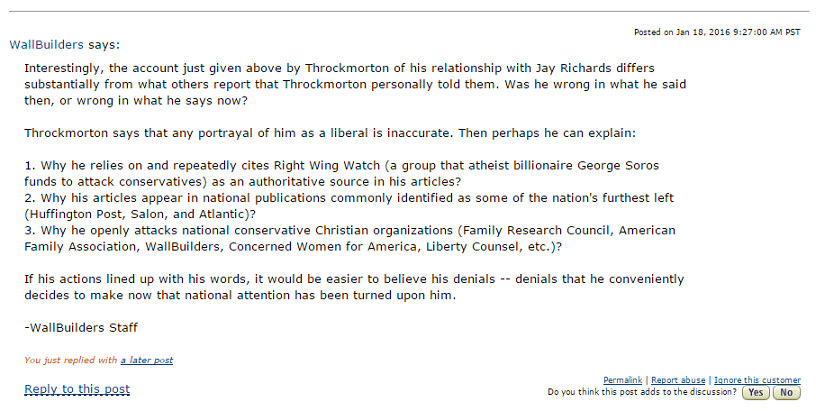
WBAmazonComment
 
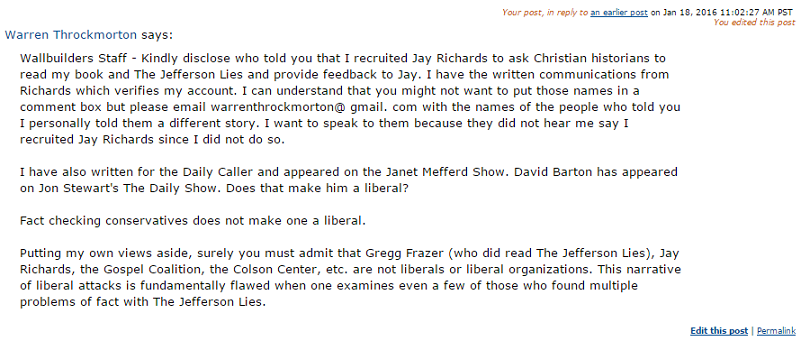
I then replied:
WTAmazonCom
 
 
At one point in November 2013, Barton claimed that “secular guys” recruited Christian professors to attack Barton. At the time, I wrote:

Barton claims his Christian critics were recruited by “secular guys.” Of course, this is flatly false, at least in my case and anyone I know. No one recruited Michael Coulter and me to critique Barton’s book. Furthermore, there are dozens of Christian professors who have critiqued Barton’s work simply because it is the right and honest thing to do.

Jay Richards is a Fellow at the Discovery Institute who recruited 10 scholars to read our book and The Jefferson Lies. None of these scholars were recruited by secular people to critique Barton.

Even the Family Research Council recognized flaws in Barton’s presentations and pulled his Capitol Tour video from view. Also, Focus on the Family edited Barton’s talks to remove two major historical errors. Perhaps Barton is going to include FRC and Focus on the Family among those recruited by the unnamed “secular guys.”

I don’t know if Barton, Wallbuilders or WND will ever admit it, but it is undeniable that numerous conservative Christians have come forward with major academic critiques of the claims presented by Wallbuilders.

To support his claim that I recruited Richards, Barton wrote this footnote in the new edition of The Jefferson Lies.

The publisher of another of my works, The Founders Bible, released after The Jefferson Lies, reported to me some unexpected and unsolicited contacts he had with Warren Throckmorton, explaining: “About a month ago, I started to get hounded by Throckmorton via email and on our website. He even called my former publishing partner and ended up issuing a warning and a threat. Warren ‘warned’ that he had assembled a coalition of people, supposed conservative Christians, who were mounting a campaign against David. If we intended to publish The Founders’ Bible, anyone associated with Barton was likely to suffer financially, because they were going to come against him. Sort of hit me blindside.” I received this email from the publisher of The Founders Bible on August 16, 2012.
Barton, David (2015-12-22). The Jefferson Lies: Exposing the Myths You’ve Always Believed About Thomas Jefferson (Kindle Locations 4669-4675). WND Books. Kindle Edition.

On July 3, 2012, I wrote to a friend who once was involved with the publisher of The Founders Bible with a heads up about the issues relating to The Jefferson Lies. The email was not a threat but rather a concerned personal alert to a friend. As I understand it, that email was forwarded to the publisher of The Founders Bible. I also made attempts to contact the publisher directly for comment about various aspects of the Founders Bible (for instance, I wondered if The Founders Bible was really going to include a favorable reference to a defender of Southern slavery). In my contacts with my friend and with the publisher I recollect describing the emergence of critiques from Christian conservatives.

Jay Richards contacted me in May 2012. He told me he had been commissioned to contact Christian historians to explore fact claims in The Jefferson Lies. While I was happy to hear that Richards was involved, I did not recruit him. Later, I made contacts with my friend and the publisher of The Founders Bible in July 2012, months after Richards first contacted me.

I have yet to hear from Wallbuilders about their claims but will update this post if I do.
No, David Barton, I Did Not Recruit Jay Richards

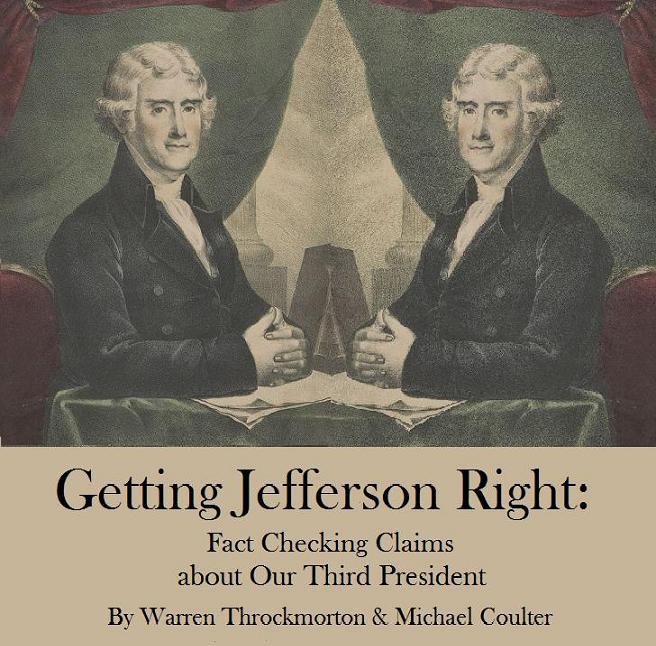
Cover of Getting Jefferson Right, used by permission

Although World Net Daily lists January 12 as the release date for the second edition of David Barton’s book The Jefferson Lies, it is now available on Amazon. I ordered the Kindle version and found a serious flaw within minutes of reading Barton’s response to our book Getting Jefferson Right.

Barton claims that I recruited Jay Richards to in turn recruit Christian historians to begin a campaign against Barton. That claim is not true. After reading Getting Jefferson Right, Richards approached me via Facebook message on May 14, 2012. Before that message, I did not know Richards. Here is what Barton says in The Jefferson Lies:

Throckmorton admitted that he had recruited scholars for this purpose, led by Jay Richards, a philosopher/theologian with the Discovery Institute, who, according to media outlets had asked “10 conservative Christian professors to assess Barton’s work.” Although he reported that their responses were “negative,” several of them actually refused to participate in his quest.
Barton, David (2015-12-22). The Jefferson Lies: Exposing the Myths You’ve Always Believed About Thomas Jefferson (Kindle Locations 133-137). WND Books. Kindle Edition.

Later in the book’s preface, Barton claims:

In fact, when Jay Richards (the speaker from the Discovery Institute who was enlisted by Throckmorton to find and recruit critics to attack my works) confronted me about what he claimed were errors in The Jefferson Lies, I repeatedly asked him if he had read the book. He refused to answer. But it was clear from his mischaracterization of my arguments that he had not read it (or at least all of it). For instance, he repeatedly asserted that I said that Jefferson was an evangelical, but as is clear in the chapter on Jefferson’s faith, I do not make that claim.

Barton, David (2015-12-22). The Jefferson Lies: Exposing the Myths You’ve Always Believed About Thomas Jefferson (Kindle Locations 613-617). WND Books. Kindle Edition.

In fact, Richards wrote to Michael Coulter and me on May 14, 2012 via the Getting Jefferson Right Facebook page. He thanked us for the book and offered to contact Christian journalists on our behalf. Then, on May 23, Richards wrote to say that he had spoken to two of Barton’s supporters about the historical problems in Barton’s book (see below for the identity of one of them which was revealed by Barton). The next day, Richards alerted me that he had been “commissioned” (it was unclear who did the commissioning, but it wasn’t me) to find six Christian historians to read Barton’s book, our book, and Barton’s DVD lecture America’s Godly Heritage. Richards then approached six scholars who then agreed to provide feedback. Richards did not tell me the identity of the scholars and I still don’t know all of them. The number providing some level of feedback eventually grew to ten.

According to Richards, Barton was also going to be informed that this process was happening.

Barton’s attempt to make me the one pulling all the strings is false and I think he knows it. I say this because on his Wallbuilders’ website, he tells the story differently. About one of the scholars recruited by Richards — The Masters’ College history professor Gregg Frazer — Barton says (see footnote 2):

From a hostile written review of David Barton and WallBuilders written by Gregg Frazer at the request of Jay Richards. That written critique was subsequently passed on to David Barton on August 13, 2012, by the Rev. James Robison, to whom Jay Richards had distributed it.

From Barton, we learn that Gregg Frazer was one of the historians recruited by Richards. Richards then gave the critique to Robison (co-author with Richards of the book Indivisible). Then, if Barton’s timing is correct, Robison gave Frazer’s critique to Barton on August 13, 2012, a few days after Thomas Nelson’s move to pull The Jefferson Lies from the shelves became public.

Not only is Barton’s claim about me false, the narrative he constructs appears to be designed to obscure what really happened. The Jefferson Lies was not doomed by political correctness, but rather by the deficiencies identified by conservative critics and reviewers. Conservative scholar Jay Richards came to us due to the merits of our work, not because we recruited him. In turn, Richards did not act alone in the effort to bring peer review to The Jefferson Lies. 

For some reason, those who commissioned Richards apparently did not follow through in a vigorous manner on the information they received. This is a part of the story as yet untold although the removal of The Jefferson Lies from publication was influenced by Richards’ efforts.

This misrepresentation of recent history is just the first of many issues from the second edition of The Jefferson Lies I will explore in the coming months.

The Great Confrontation of 2012: David Barton and the Evangelical Historians

In August 2012, Thomas Nelson (now part of Harper Collins Christian) pulled David Barton‘s book The Jefferson Lies from publication. This rare move by Thomas Nelson took place in the midst of efforts by several people to confront Barton with his errors. While I cannot tell the whole story (in part because I don’t know it and in part because the main players are not willing to discuss it completely), I can provide a little more insight into the situation. The door was opened to this by a footnote on David Barton’s website and other vague references to a series of meetings that took place in 2012. The footnote is on the page where Barton claims to explain false quotes from his first book. Barton says this:

Although many people, including several respected academics, have told David that they admire his honesty and transparency, others have attempted to use this practice against him. For instance, in a recent critique of David’s work, Professor Gregg Frazer of The Master’s College writes:

“Having been confronted over the use of false quotes, Barton was forced to acknowledge their illegitimacy in some way on his website. There, he describes them as “unconfirmed” – as if there is some doubt about their legitimacy. In a computer age with search capabilities, we know that these quotes are false – the fact that they are listed as “unconfirmed” reflects a stubborn attempt to hold onto them and to suggest to followers that they might be true. That is made worse by the fact that under these “unconfirmed” quotes are paragraphs maintaining that the bogus quote is something that the person might have said.” 2

What an interesting reward for trying to be honest and transparent.

Barton’s claim to be “honest and transparent” requires much more attention, but for the purpose of this post, let me move on to Barton’s description of the source of Gregg Frazer’s words. In the footnote, Barton explains the source of Frazer’s quote:

From a hostile written review of David Barton and WallBuilders written by Gregg Frazer at the request of Jay Richards. That written critique was subsequently passed on to David Barton on August 13, 2012, by the Rev. James Robison, to whom Jay Richards had distributed it. 

After Jay Richards read my book with Michael Coulter, Getting Jefferson Right: Fact Checking Claims about Our Third Presidenthe asked ten Christian historians to read both The Jefferson Lies, and then our book. Richards wanted to get expert opinions on the facts in each book. He also asked Gregg Frazer to review Barton’s DVD, America’s Godly Heritage (which is still for sale on Barton’s website).

With Frazer’s permission, the complete review of America’s Godly Heritage is now available here.

As is clear from an examination of the paper, Frazer did not look at each one of the quotes in Barton’s first book. He specifically examined the DVD series America’s Godly Heritage. Even though the DVD is still for sale, Frazer found faulty quotes in it.

As Barton says in his footnote, this paper was presented to Barton by James Robison surrounding the time when his book was pulled by Thomas Nelson (August 2012). Robison is an apostolic elder at Gateway Church and host of the television show Life Today. As this footnote reveals, Robison was in on the confrontation as was Richards and the Christian historians. While I don’t know specifics, some met with Barton at his ranch where he rejected their advice and counsel. Furthermore, Barton met with at least one leader at the Family Research Council in August 2o12. In that meeting, Barton’s errors were confronted with promises from Barton to provide corrected material. However, nothing happened on Barton’s end until the Family Research Council was confronted by numerous Christian historians in the Spring of 2013.

Despite numerous clear factual errors, FRC continues to have Barton involved in their presentations to pastors. As Politico documented in 2013 (Sen. Ted Cruz defends Barton in this article), Barton has been accepted back into the good graces of the political arm of the Christian right (e.g., this apologetics conference).

The awareness of Barton’s systematic distortion of the nation’s founding is well known at the highest levels of the Christian political right and yet many such groups continue to promote Barton as an exemplary historian.  Because the Christian right is aware of the problems but continues to feature Barton as an historian, the “great confrontation of 2012” has turned into the “great cover-up of the present.”

Gregg Frazer’s review of America’s Godly Heritage is a devastating critique of this popular DVD program. It has been read by high level decision makers on the Christian right and ignored. I urge readers to read it and pass it around. I intend to give it more attention by focusing on various highlights in upcoming posts. Here is a follow up post on Frazer’s review.

Point/Counterpoint with David Barton at World Magazine

This morning, World Magazine is featuring an excerpt of Getting Jefferson Right: Fact Checking Claims about Our Third President along with a lengthy rebuttal from David Barton.  Our section is here and Barton’s article is here.
I have not read Barton’s response yet. I wanted to get the links up in order for readers to have some time to wade through the material.  I suspect some of what Barton has to say will be the subject of separate posts. We will have an opportunity from World to post a rebuttal to Barton in a couple of weeks.
So I invite you to comment at the World site and here.
UPDATE: I have read through Barton’s commentary. Although it may take a month, Michael and I will write a response to it for World.  It is hard to know where to start when there is so much to address.
Do I start with Barton’s claim that he welcomes appraisal of his work? Barton did not seem welcoming when he called Michael and me academic elitists and allowed without comment his Wallbuilder’s staffer Rick Green to say that his critics were using tactics of Hitler and Alinsky.  All that nastiness aside, his tone has improved for this rebuttal.
One of the clearest impressions I have after the first read is how Barton simplified our critique on most of the points. For instance, on the slavery question, we never said Jefferson could free his slaves at any time during his life with ease. We said there was a window from 1782-1806 when the laws had been relaxed to allow voluntary manumission of slaves. Jefferson indeed did free two slaves during that period. In that section, Barton gives a lot of dates for other slave laws but he gives no quotes from them.  Also, he cites examples (e.g., Coles leaving the state to free his slaves) that were outside of the window we identified. Throughout that section, Barton does not provide dates to place the requirements within context.
More to come…