The Family: A Documentary Series on the Fellowship Foundation Starts August 9 on Netflix

On August 9, Netflix will roll out a documentary series based on Jeff Sharlet’s book The Family: The Secret Fundamentalism at the Heart of American Power. I was interviewed for this series and will appear in one of the episodes. My part of the picture relates to my work against Uganda’s Anti-Homosexuality Bill from 2009 to 2015. You can watch a trailer of the series below:

As part of my efforts against the Ugandan legislation, I attended the 2010 National Prayer Breakfast at the invitation of The Family (Fellowship Foundation). While there, I conducted one of four interviews with Fellowship Foundation leader, the late Douglas Coe. It was published in 2010 in Christianity Today.

Coe died last year and there has been some struggle for leadership. The Fellowship has been in the news  to due to their connection Russian agent Maria Butina. I will add  on the series as it progresses.

Prior articles on the Uganda Anti-Homosexuality Bill can be viewed here. 

More recent articles on the Fellowship Foundation, including the case of Russian agent Maria Butina can be viewed here and here.

High Crimes or Misdemeanors?

For me, this is enough.

Is There a Limit for Evangelical Trump Supporters?
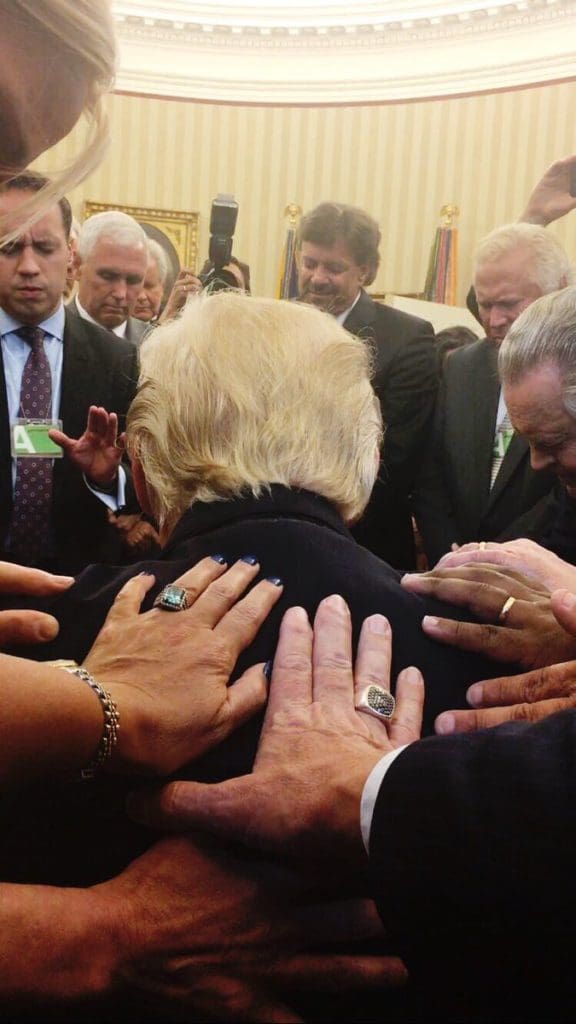
Reading an op-ed by Michael Brown, I thought of this question: Is there anything Donald Trump could do to lose evangelical support?

Brown’s column acknowledges some of Trump’s flaws, including the recent attacks on four Democratic minority congresswomen. Brown says he has no desire to defend any of Trump’s inappropriate behavior but given the choice of Trump and a Democratic candidate, he will choose Trump.

So this prompted me to wonder what would it take to cause Brown and/or other evangelical supporters to abandon Trump. What would Trump have to do? If he murdered someone, would that be enough? Attended a gay wedding? Or would all of those far right judge appointments make that worth it?

Trump has been credibly accused of numerous crimes and immoral acts. It will take years to investigate them all. But for Brown and those who think like him, it doesn’t matter. Our American institutions, principles, and other matters of law are secondary to judges and abortion. Brown ended by saying:

And then ask yourself this question: If we can save the lives of babies who were being slaughtered in the womb, do you think they will care if the man who helped save them was sometimes vulgar and crude? And do you think they’ll find us un-Christian if we voted for him?

So then, is there no limit? Is there no crime or evil deed Trump could do that would make Brown and those of like mind think twice? Trump is not just vulgar and crude. Among many other things, he regularly deceives the public, is presiding over one of the most corrupt administrations in American history, and has been credibly accused of assaulting numerous women (and has bragged about doing so). Is there no bottom?

What High Crime or Misdemeanor Would it Take?

I leave it as an open and public question for Michael Brown and/or any other evangelical Trump supporter. What would make you support impeachment? What high crime or misdemeanor would it take? The ones we know about aren’t enough, so what would it take? Be specific, name something Trump could do which would end your support.

Brown thinks those opposed to Trump are not really worried about Christian witness. For the most part, I agree with him that Christian witness isn’t the real issue. Obviously, Trump supporters don’t care about their Christian witness. That is the last thing they care about. They now trust in Trump and not God.  Being unsatisfied with the results of virtue as a means of reaching public policy goals, they have gone in for raw political power. In the short term, this seems to be working out better. Virtue was so difficult and didn’t really get the job done.

As an aside, I don’t understand the attachment to Trump. If Trump was impeached, they would have Mike Pence who is less erratic but just as committed to their public policy goals. In any case, evangelicals have fallen on their sword for Trump and one doesn’t often survive falling on one’s sword.

Donald Trump recently told a Turning Point USA crowd that “I have article two where I have the right to do what I want as president.” Trump also has a court full of evangelicals who let him do whatever he wants.


A Reminder That Eric Metaxas Loves Katie Hopkins
In what may be the greatest mixed message I have ever seen, Donald Trump tweeted that he didn’t approve of a North Carolina crowd chanting “send her back” (referring to Congresswoman Ilhan Omar) by retweeting nativist Katie Hopkins praising the crowd for chanting it.

Trump frequently asks his followers to disbelieve their own eyes. He does nothing to discourage the crowd from chanting the slogan. It is obvious that he didn’t come across negatively since his follower Hopkins revels in the moment and congratulates “Team Trump” on their new slogan.

Eric Metaxas Loves Katie Hopkins

This is old news by now but I post on it to remind my evangelical readers that Bonhoeffer author Eric Metaxas just loves Katie Hopkins. He had her on his show again and praised her rhetoric as recently as June. Watch:

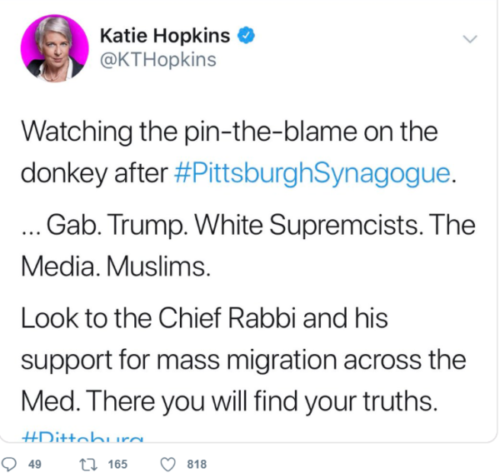
Hopkins is well known for her quaint ways of promoting bigotry. More recently, she pointed to Jewish leaders for the shooting in Pittsburgh.

This is ridiculous. This is the person Metaxas told his listeners he wanted to put before them.  I often wonder if Metaxas forgets that his parents were immigrants, but in this segment he acknowledged it. In this segment, Hopkins speaks of immigrants as “them” and about native Brits as “us.” Obviously, Metaxas likes his status as “us.”

In this segment, Hopkins expresses worry that immigrants take away services from older people in the UK. I don’t really think she means it. At least, in the past, she hasn’t cared much for older Brits. Here is what Metaxas’ hero had to say about old people in a 2015 interview:

“We just have far too many old people.” Did I know that one in three NHS beds was being blocked by the elderly and demented? A third of our hospitals filled up by people who don’t even know they’re there? She’d soon put a stop to that. “It’s ridiculous to be living in a country where we can put dogs to sleep but not people.” Her solution? “Easy. Euthanasia vans – just like ice-cream vans – that would come to your home.” After they’d finished in the hospitals, presumably. “It would all be perfectly charming. They might even have a nice little tune they’d play. I mean this genuinely. I’m super-keen on euthanasia vans. We need to accept that just because medical advances mean we can live longer, it’s not necessarily the right thing to do.”

Why didn’t Metaxas ask her about that social program? I feel sure Bonhoeffer would approve, right Eric?

Lindsey Graham on Trump: Is He a Racist or a Narcissist?

This is a question Trump supporter and Senator from SC Lindsey Graham sought to address in his defense of Trump today. Here is a series of tweets from Frank Thorp, NBC news reporter with Graham’s thoughts.

I really do believe that if you’re a Somali refugee who likes Trump, he’s not going to say ‘go back to Somalia.’ A racist says go back to Somalia because you’re a Somalian or you’re a Muslim or whatever, that’s just the way he is. More narcissism than anything else.

The main line of defense is that Trump likes who likes him even if that person is a person of color. According to Graham, race alone does not determine the disliking. Trump says nasty things about people who insult him even if they are white. Witness his treatment of Paul Ryan. It is true that he cuts down anybody who points out the president’s flaws. Furthermore, he has surrounded himself with minorities who gush his praise. It is less than clear what he says about them behind closed doors but he has not avoided his minority supporters.

As I thought about this, it occurred to me that a check on this would be to assess the types of insults he makes against various disliked people. I haven’t checked this, but I don’t think he has ever told Bernie Sanders or Nancy Pelosi to go back to their countries of origin.

The Nature of Prejudice

The work of Gordon Allport on prejudice seems relevant. Allport wrote in 1954 that humans find it very easy to fall into prejudices but very difficult to abandon them. A foundation for prejudice according to Allport is personal values. For Trump there appears to be no higher value than loyalty to himself. Allport wrote:

…negative prejudice is a reflex of one’s own system of values. We prize our own mode of existence and correspondingly underprize (or actively attack) what seems to us to
threaten it The thought has been expressed by Sigmund Freud, “In the undisguised antipathies and aversion which people feel towards strangers with whom they have to do, we recognize the expression of self-love, of narcissism.”

The process is especially clear in time of war. When an enemy threatens all or nearly all of our positive values we stiffen our resistance and exaggerate the merits of our cause. We feel — and this is an instance of overgeneralization — that we are wholly right. (If we did not believe this we could not marshall all our energies for our defense.) And if we are wholly right then the enemy must be wholly wrong. Since he is wholly wrong, we should not hesitate to exterminate him. (p. 26)

Allport also argued prejudices are maintained by placing exceptions to the negative prejudgment into subcategories. Allport described the process this way:

There is a common mental device that permits people to hold to prejudgments even in the face of much contradictory evidence. It is the device of admitting exceptions. “There are nice Negroes but . . ” or “Some of my best friends are Jews but. . . .” This is a disarming device. By excluding a few favored cases, the negative rubric is kept intact for all other cases. In short, contrary evidence is not admitted and allowed to modify the generalization; rather it is perfunctorily acknowledged but excluded. (p. 23)

So in response to Lindsey Graham, it certainly is possible that President Trump is motivated by both negative racial stereotypes and narcissism. I am not making a diagnosis but I am saying that the work of Allport demonstrates that one may maintain negative prejudice while claiming one does not have negative judgments by using an exception as proof — as Graham did for Trump. What may move minorities (or a member of any other group Mr. Trump doesn’t like) into the good or — more cynically — useful category is that they praise him. He appears to dislike many whites but doesn’t appear to have a group prejudice toward them. What is at issue is the evidence that keeps coming up that he may have prejudices toward certain minorities as a group which can be overcome principally by obsequious praise for him.