In St Louis, Dr. Nicolosi said during the session titled, “The Condition of Male Homosexuality” that he has never seen an exception to the following family dynamic: if a gay man has an older brother, the older brother is always hostile and feared by the younger gay brother. He quoted Freud as having theorized this and Nicolosi said he has never seen an exception. Well, I have seen exceptions but I would like to take an informal poll on this question. Friends and foes and inbetweeners, is this accurate? A trend? Or just another overgeneralization from a few cases?
Month: February 2006
Love Won Out St. Louis: A crowd picture
 FYI
FYI
The picture to the left shows just a little of the crowd in front of the Evangelical Free Church. I count about 40 people in this picture in the space of about half a block. This was at 7:48am CST. I think there were about 4 blocks about like this at that time with lots of people walking up and down the street.
Love Won Out St. Louis: View inside and out

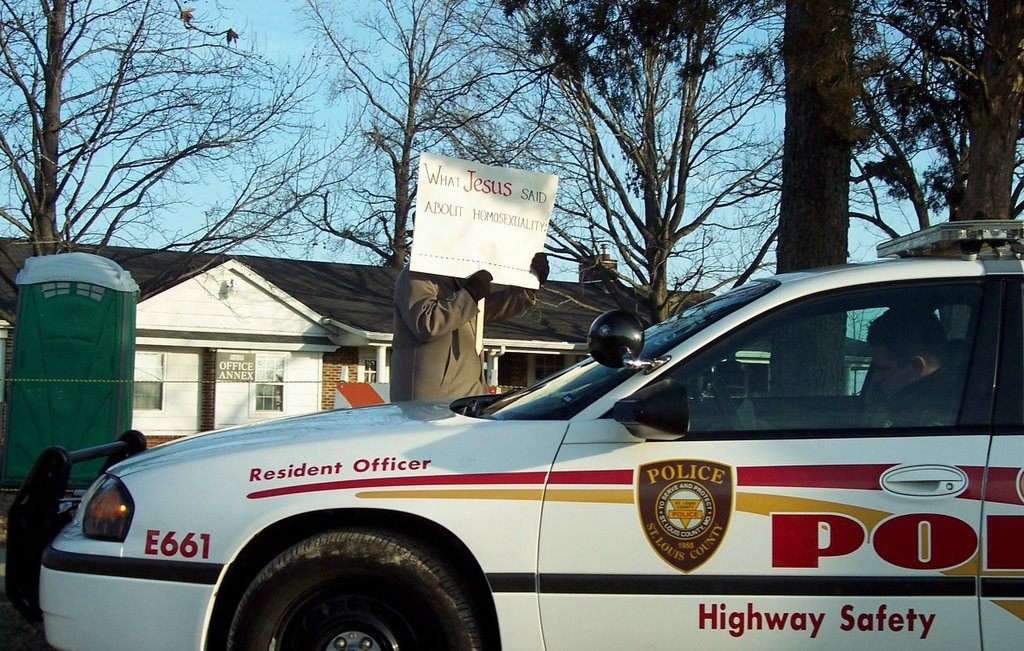
[To the left is a protestor, the police (they were everywhere, and a portajohn supplied by (as I understand it) the church.]
I went to the Love Won Out in St. Louis this weekend as an observer. I will post more about the inside view later, but not tonight as I am nearing sleep. Instead I’ll post more pics than comments. I will say that I would guess the estimates of 400 at the protest are pretty accurate, maybe more. It was indeed peaceful when I saw it. It was a pleasure to run into Colleen (CK) who posts here now and then. I was very glad she ran over to my car where I was taking pics of the crowd. I will have more to say about the conference itself in due time.

[To the right: Colleen is asking herself: “who is that weirdo with the camera?”]


Warning: Understatement alert! Reparative therapy was not popular among the crowd.
Thinking out loud: Gay and straight pride is just pride
Vague post I suspect.
Working with evangelical families who have same-sex attracted members is among the most difficult clinical work I do. Many evangelicals make SSA the unpardonable sin (“thank God I am not like those sinners”) and the SSA member wants to pursue a scorched earth, take no prisoners approach (“if you don’t accept my truth, then you don’t love me and I will never speak to you again”). Both sides wants a change of belief to occur and accuses the other of disloyalty and hatred if the change is not forthcoming. It appears to me that both sides want to fight and win the culture war within my office and within the context of their family. My efforts to normalize disagreement by making it analogous to other behavioral and social issues about which people disagree often fail initially. While most families do gradually grasp on to that concept, living and letting live is like brokering a peace treaty. I think at the moment that I write this that pride in the direction of one’s sexual attractions is not healthy self-esteem nor assertively standing up for one’s beliefs, it is just pride (or narcissism, if you speak english with a psychological accent).
My work is practically done for me when I speak to a less common set of parents who understand “there but for the grace of God, go I” and gay identified member who says, “I know this is difficult for you, it is difficult for me, remember I didn’t ask for these feelings.” These families seem to understand quickly that one cannot argue anyone into heterosexuality.
Sexual orientation and genetics: X marks the spot
Here is the abstract of a new report from Human Genetics about a link between some moms and the sexual orientation of sons. This kind of stuff is interesting of course but the conclusions drawn by the researchers is speculative: “The research “confirms that there is a strong genetic basis for sexual orientation, and that for some gay men, genes on the X chromosome are involved,” said study co-author Sven Bocklandt, a postdoctoral researcher at the University of California at Los Angeles.” The findings I read in the abstract do not “confirm” anything. Furthermore, the study as described could not provide any pathway from a putative genetic mechanism to behavior. All they have shown is there are group differences.
As I look at it, none of this is very enlightening unless the temperament and environment of the sons is also taken into consideration. There are potential intervening variables that are not even considered by these researchers (e.g., gender atypical temperaments). GAT may be related to these changes in the X chromosome but I doubt this was taken into account.
ABSTRACT
Human Genetics
Issue: Volume 118, Number 6
Date: February 2006
Pages: 691 – 694
Extreme skewing of X chromosome inactivation in mothers of homosexual men
Sven Bocklandt, Steve Horvath, Eric Vilain and Dean H. Hamer
Abstract Human sexual preference is a sexually dimorphic trait with a substantial genetic component. Linkage of male sexual orientation to markers on the X chromosome has been reported in some families. Here, we measured X chromosome inactivation ratios in 97 mothers of homosexual men and 103 age-matched control women without gay sons. The number of women with extreme skewing of X-inactivation was significantly higher in mothers of gay men (13/97=13%) compared to controls (4/103=4%) and increased in mothers with two or more gay sons (10/44=23%). Our findings support a role for the X chromosome in regulating sexual orientation in a subgroup of gay men.