A historian’s analysis of The Pink Swastika, part 1

(Editor’s note: This guest post is authored by Jon David Wyneken, Associate Professor of History at Grove City College.)

Back in March, Warren asked me (a colleague of his in the Department of History here at Grove City College) if I had any opinion on the validity of arguments made by Scott Lively and Kevin Abrams in their book The Pink Swastika: Homosexuality in the Nazi Party. I told Warren that the book had not been well-received by academic historians for a number of reasons, and at his request I did some research to illustrate this as clearly as I could. In the interest of full disclosure, the reader should know that I have a PhD in Modern German history with a focus on the period 1933-1955, so I have studied the Nazis extensively and am very familiar with their policies against those they considered “undesirables.” I have also done research and worked at seminars at the United States Holocaust Memorial Museum and have done research on the Nazis in numerous archives in Germany, France, the United Kingdom, and the United States.

However, there are a number of scholars who have done more in-depth work on the issue of homosexuality in Nazi Germany than I have, so I looked into a some articles by such scholars that provide a number of effective and convincing counterarguments to Lively / Abrams. Historians like Geoffrey Giles and Gunter Grau have done a great deal of work on this (Lively does cite Grau a few times in The Pink Swastika, but I encourage readers here to examine Grau’s book of documents entitled The Hidden Holocaust? to see just how wrongly selective Lively was in his use of that text), and the most recent edition of Jeremy Noakes’ four-volume collection, Nazism: A Documentary Reader provides revealing material from Grau that Lively left out of his book. I have given Warren all of this material and I know he will be making use of it on this site. I know he will also provide the titles of complete articles/books that readers should examine, and I will continue to make Warren aware of any other materials I come across that will help him and readers better understand why Lively’s book is simply not good history and is, in fact, not really history at all. Instead, in my view, it is a book that uses history as a weapon in a contemporary political battle, completely outside the historical context of Nazi Germany.

Fortunately, there are other scholars who have made this point much better than I can here. In particular, Arlene Stein’s 1998 article from Sociological Perspectives (Vol. 41, No. 3 [1998], pp. 519-540) entitled “Whose Memories? Whose Victimhood? Contests for the Holocaust Frame in Recent Social Movement Discourse” makes a strong case against Lively and against all groups—whether Christian or secular, from the political Right or Left—who try to revise the historical record of the Holocaust for their own contemporary political (and hence, in my opinion, ahistorical) ends. Stein in my view rightly criticizes a number of groups and individuals in her article, and she is very careful and balanced in her conclusions. While I encourage all readers to read her entire article (those of you with JSTOR access can find a full-text copy there), I have provided below a few selections from her article that illustrate what she thinks (and I agree) is behind Lively’s book/arguments [in part two]. I have presented the quotes below sequentially as they appear in the article in order to give the reader a better sense of the entire piece. The first series of quotes present her arguments about how some gay/lesbian organizations have misused the history of the Holocaust for their own ends—I have done this so as to provide for the reader a more balanced view than is provided by Lively on these issues. First, Stein indicates two levels of appropriation:

Uses of Holocaust memory by those who lack a direct connection to the historical events are, in effect, acts of appropriation. But all acts of appropriation, I will argue, are not equivalent. Against the post-structuralist belief that texts, such as stories, take their meaning relationally within a global universe of interacting texts, an ethical approach to the appropriation of historical memories, particularly atrocity memories such as the Holocaust, distinguishes among claims on the basis of the social contexts within which texts are produced, and the uses to which they are put (Plummer 1995; Lamont 1997). Hence, I distinguish between two different types of appropriation: revisionism (efforts to rewrite the history of the Holocaust which make claims about a historical event) and metaphor creation (efforts to compare present events or experiences to those of the Holocaust). The distinction between these two rhetorical strategies, I will argue, is best understood in relation to the social contexts, such as contemporary social movements, in which Holocaust memories are deployed (Stein, 520-521).

Then she describes the type of appropriation by GLB groups:

The Holocaust frame appeared in lesbian/gay rhetoric at three different moments: the early 1970s, in relation to the rise of the gay liberation movement; the early to mid 1980s, in response to the twin threats of the New Right and the AIDS epidemic; and the 1990s, in response to anti-gay ballot measures sponsored by Christian conservative organizations in several states. Gay activists have sought to revise the historical record to reflect the extent of gay victimhood during the Nazi period; they have also used the Holocaust as metaphor, comparing the plight of homosexuals today to the plight of victimized minorities during the German Reich. Through the use of the Holocaust frame, lesbians and gay men have positioned themselves as victims and situated their opponents-garden variety homophobes, negligent AIDS bureaucrats, and Christian right anti-gay campaigners-as perpetrators. Invoking the history of the Third Reich, contemporary lesbian and gay activists recall that the Nazi Party sought to “cleanse” German society of those groups that violated the tenets of Aryan purity and that were believed to pose a threat to national unity: Jews, gypsies, homosexuals, communists, and the disabled. Though the “final solution” targeted Jews for annihilation above all else, other marginalized groups were caught in the frenzy of purification. Among them were homosexual men, who were seen as a threat to the patriarchal family idealized by Nazism. A 1928 Nazi Party statement proclaimed: ‘Anyone who thinks of homo-sexual love is our enemy. We therefore reject any form of lewdness, especially homosexuality, because it robs us of our last chance to free our people from the bondage which now enslaves it.’2 Between 1933 and 1945, tens of thousands of homosexual men were sent to concentration camps, and perhaps 10,000 of them perished.3 (Stein, 523)

In summary, the spectre of a Holocaust has been utilized by lesbians and gay men to dramatize their plight as an oppressed group in American society. Lesbians and gay men engaged in a form of revisionism, adjusting the historical record to reflect the historical oppression of homosexuals during the Nazi reign of terror. They also used the frame as metaphor, drawing parallels between contemporary homosexuals and the victims of Nazism fifty years earlier. In relation to the AIDS epidemic, lesbian and gay activists invoked the memory of the Holocaust to suggest that government inaction is tantamount to genocide. In response to the anti-gay campaigns of the Christian right, they suggested that homosexuals, a relatively powerless group, are being used as a convenient scapegoat for widespread social anxieties (Stein, 527).

Stein illustrates how a scholar approaches a topic. She is even handed and fair in her analysis. I encourage readers to carefully consider her points.

(Editor’s note – Due to length, I am dividing Dr. Wyneken’s analysis into two parts. Although readers might come to the conclusion that Drs. Stein and Wyneken have found some agreement with Lively and Abrams, this would not be an accurate perception. Tomorrow’s post will provide Stein’s assessment of The Pink Swastika and Dr. Wyneken’s reasons for agreeing with her significant criticisms of the book. Please look for the conclusion tomorrow.)

Other posts in this series:

May 28 – Scott Lively wants off SPLC hate group list

May 31 – Eliminating homosexuality: Modern Uganda and Nazi Germany

June 3 – Before the Pink Swastika

June 4 – Kevin Abrams: The side of The Pink Swastika

June 8 – A historian’s analysis of The Pink Swastika

June 9 – A historian’s analysis of The Pink Swastika, part 2

June 11 – American Nazi movement and homosexuality: How pink is their swastika?

June 15 – Nazi movement rallies against gays in Springfield, MO

June 17 – Does homosexuality lead to fascism?

June 23 – The Pink Swastika and Friedrich Nietzsche
June 29 – The Pink Swastika and the The Hidden Holocaust?

List of posts on Uganda and the Pink Swastika

A major study of child abuse and homosexuality revisited

The role of child sexual abuse in sexual orientation has received some attention lately. In January of this year, a prospective study demonstrated that child sexual abuse was associated with ever engaging in adult homosexual behavior for males but not for females. The study by Widom and Wilson demonstrated that physical abuse or neglect did not associate with homosexuality, nor did sexual abuse predict same-sex cohabitation or current sexual partner. In other words, measures of behavior (living with a same-sex partner ever, or living with one in the last year) that would be more reflective of orientation were not associated with histories of child sexual abuse. For males, ever engaging in homosexual behavior, however, was associated with sexual abuse. Many observers are not surprised by this finding which indicates that sexual behavior is associated with past abuse but enduring orientation may not be.

Prospective studies are quite valuable since they help control for loss of memory, reconstructed memories, self-report issues relating to abuse and other sources of bias. This study used court records and followed up the abused persons 30 years after the fact.

In evangelical circles, sexual abuse is frequently offered as a major cause of homosexuality, if not the major cause. NARTH often points to the traumatic experience as an important factor. Recently, Focus on the Family promoted a paper by Jeff Johnston on the topic. Cited by Dean Byrd in that paper and often cited in this context is a study based on a 2000 doctoral dissertation by Marie Tomeo, titled “Sexual Orientation Development” and conducted at the California School of Professional Psychology. The journal article based on the dissertation was published by the Archives of Sexual Behavior in 2001 with the following reference:

Tomeo, M. E., Templer, D. L., Anderson, S., & Kotler, D. (2001). Comparative data of childhood adolescence molestation in heterosexual and homosexual persons. Archives of Sexual Behavior, 30, 535–541.

The study compared people at a gay pride parade with a straight sample drawn primarily from a university. The abstract reports the highlights:

In research with 942 nonclinical adult participants, gay men and lesbian women reported a significantly higher rate of childhood molestation than did heterosexual men and women. Forty-six percent of the homosexual men in contrast to 7% of the heterosexual men reported homosexual molestation. Twenty-two percent of lesbian women in contrast to 1% of heterosexual women reported homosexual molestation. This research is apparently the first survey that has reported substantial homosexual molestation of girls. Suggestions for future research were offered.

Demonstrating a difference between gay and straight groups on sexual abuse is not novel. Numerous studies have reported at least some difference with only a few reporting no difference in abuse frequency between groups. However, Tomeo did something that was relevant to her overall dissertation topic. She was interested in exploring sexual abuse as a potential causal factor. Tomeo’s prime research hypothesis was that homosexuals would report more sexual abuse than heterosexuals. She also wanted to know when a person identified as gay and when the abuse occurred. This is an important question for studies which seek to attribute cause to abuse. With some people being aware of same-sex attraction at very early ages, one cannot say any subsequent abuse caused their SSA. Simply finding a significant difference between gay and straight groups cannot tell you anything definitive about cause. Here are the first nine questions Tomeo asked her participants:

1. Do you regard yourself as predominantly a heterosexual person or predominantly a gay/lesbian person?

2. If predominantly of heterosexual orientation, at what age did you begin to regard yourself as heterosexual?

3. If predominantly of homosexual orientation, at what age did you begin to regard yourself as homosexual?

4. Before you were 16 years old, did you ever have sexual contact with a woman or girl 5 or more years older than yourself and at least 16 years of age? (YES NO)

5. IF YES, at what age did this first occur?

6. What was your relationship to the person with whom this sexual contact occurred?

7. Before you were 16 years old, did you ever have sexual contact with a man or boy 5 or more years older than yourself and at least 16 years of age? (YES NO)

8. IF YES, at what age did this first occur?

9. What was your relationship to the person with whom this sexual contact occurred?

For a study of causation, these questions clearly have their limitations. For one thing, when one regards oneself as homosexual probably occurs later (sometimes much later) than awareness of same-sex attraction. Perhaps one could offer a theory of identity formation which includes sexual abuse but such a theory would not of necessity be a theory of how one’s attractions take the direction they do.

In Tomeo’s reporting of her study in both the dissertation and the journal article, however, there is a much larger concern. There are contradictions in the paper and the dissertation between the results sections and the discussion sections. A crucial problem is the inability to be certain about when the abuse occurred – before or after awareness of same-sex attraction. In the Archives of Sexual Behavior article, the following statement is made on pages 540-541 (this same statement is identical to her closing discussion in the dissertation):

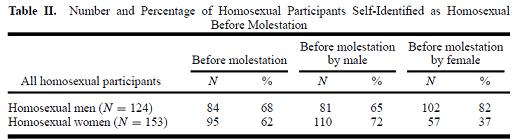
Sixty-eight percent of the present homosexual male participants and 38% of the present homosexual female participants (68 and 36%, respectively, if including just the homosexual fair participants) did not identify as homosexual until after the molestation. This suggests that if molestation resulted in homosexuality, this phenomenon occurs in a greater proportion of male homosexuals. It may not, however, be a casual factor in either gender. Perhaps children or adolescents with a higher potential for homosexual behavior are more likely to enter a situation that leads to same-sex molestation. It must also be borne in mind that the present homosexual participants may not be representative of homosexual persons. The overwhelming preponderance of homosexual participants was in the gay pride group. There were only three homosexual men and seven homosexual women in the college group.

The clear implication in this discussion section is that the frequency of homosexual identification was a consequence of the abuse. However, in the table which reported the data regarding timing of identification, the authors report the same percentage of males who reported identification as gay before the abuse. Table II on page 538 reports (click the link for a clearer view):

Tomeo et al 2001

Something is not right here.  If the table is correct, then the case for causation from this study is somewhat compromised. The table indicates that 68% of men identified as homosexual before their molestation experience.

My colleague Gary Welton and I first discovered this discrepancy nearly three years ago while preparing a scholarly article on the effects sizes of various suggested correlates of homosexuality (one which will be published later this year or early next year). At that time, I contacted Donald Templer, one of the co-authors and advisor to first author Marie Tomeo. I then contacted him again recently in preparation for this post. He has been unable to locate Dr. Tomeo to get clarification. I hope Dr. Tomeo can at some point clarify these matters.

Recently, I ordered the dissertation to check the original study. However, there are discrepancies in this document as well. First, here are the relevant research questions with results.

From page 36 of Marie Tomeo’s dissertation:

The 10th research question addressed, of homosexual women who were molested, what percentage were molested before self-identification as a homosexual woman and what percentage were molested after self-identification as a homosexual woman? Of homosexual women who were molested, 62% were molested before self-identification as a homosexual woman, and 38% were molested after self-identification as a homosexual woman.

On page 37, the other relevant result relates to men.

The 13th research question addressed, of homosexual men who have been molested, what percentage were molested before self-identification as homosexual men, and what percentage were molested after self-identification as homosexual? Of homosexual men who were molested, 68% were molested before self-identification as homosexual, and 32% were molested after self-identification as homosexual.

These results are at odds with the discussion sections of the dissertation and the journal. They are also at odds with the Table from the journal article. For what its worth, Dr. Templer thinks the correct data are in the Table from the journal article.

The bottom line is that the study should not be cited until a follow up correction can be made. The main results — gays report more abuse than straights — may indeed be correct, given the similarity to past studies. However, I do not believe any inferences about causation should be made. Without the actual surveys, there is no way a reader can figure out the results from the journal article and/or the dissertation.

One final thought, the research on sexual abuse among GLBT populations is often misused to make inferences about causation. There are many reasons why this line of research is important but causation is not at the top. Sexual abuse is a profoundly disruptive experience for many people and may contribute to a variety of negative outcomes in adulthood. Finding appropriate clinical and ministry responses may be clouded by focusing on the trauma as a cause of same-sex attraction.

Kevin Abrams: The other side of The Pink Swastika

This title is a play on a 1994 article by Kevin Abrams, published in Peter LaBarbera’s Lambda Report, titled, “The Other Side of the Pink Triangle.” Abrams is co-author of The Pink Swastika and organizer of an organization called the International Committee for Holocaust Truth. This organization produced three reports with the same message as The Pink Swastika. As noted in the first paper, the group believes,

Hitler’s plans for a “1000 Year Reich,” is a “Homofascist” Conspiracy which still thrives today disguised as “gay” rights. Today’s Holocaust memorial museums are being co-opted as part of a broader homosexualist strategy.

Current American Nazis would violently take issue with this view, but that is a topic for another post.

The ICHT seems to consist of Howard Hurwitz, Judith Reisman, Christopher Barder, Scott Lively and Kevin Abrams. Hurwitz is a former school principal and heads a small group called the Family Defense Council. As far as I can tell, the FDC does not have a website but has various writings and descriptions scattered on the web (e.g., here and here).

As noted yesterday, the attempt to link Nazis and gays (as a movement) seems to have been triggered by outrage over the “gay holocaust” metaphor and a desire to prevent that metaphor from generating public support for gays in in the 1990s. Abrams piece on the pink triangle was circulated among activists during this period and brought at least one scholarly refutation. Christine Mueller of Reed College wrote a piece which examined and refuted the essential claims of the Abrams’ article. Abrams then replied with a rebuttal.

Mueller points out the massive leaps of logic and fact required to make National Socialism an invention of a cohesive homosexual plot. Here is one example:

The abuse to which he subjects Heiden’s Der Fuehrer [a book about Hitler] is particularly flagrant. To suggest Hitler’s homosexuality, for example, Abrams changes Heiden’s text: “With Roehm and Heines, Stennes helped to impose the rule of the homosexuals over the SA” to: “with Roehm and Heines, Hitler helped to impose the rule of Roehm’s exclusively homosexual clique over the SA.” (58) Abrams has Roehm writing from Bolivia that he intended “to spread the culture,” whereas in the original, he spreads “culture,” i.e. Kultur. (59) In another example, Heiden describes a factional feud inside the party, during which Goebbels, taking sides against Hitler, called him a “vain operetta queen” (60) — a play on Hitler’s popular title, “The King of Munich.” In Abrams’ rearrangement of the text, Goebbels is referring to Roehm and appears to be complaining about his homosexuality (61). Since in German the word queen (Koenigin) has

no reference to homosexuality whatsoever, this error speaks volumes for the quality of Abrams’ scholarly credentials. These selected instances must suffice to show how assiduously Abrams has doctored his quotations; it would be tedious to list them all.

What makes The Pink Swastika and other materials like it difficult to critique for the casual reader is this kind of revisionism. Quotes are slightly altered; or even given properly but then the meaning is altered out of historical context. Readers interested in the details should read Abrams’ initial article, the Mueller critique and then Abrams’ rebuttal. The essence of Abrams arguments comes back to the quote above:

Hitler’s plans for a “1000 Year Reich,” is a “Homofascist” Conspiracy which still thrives today disguised as “gay” rights. Today’s Holocaust memorial museums are being co-opted as part of a broader homosexualist strategy.

Mueller’s response points out the errors of fact and context which are driven by confirmation bias and apparent outrage over a perception that another undeserving group was appropriating the holocaust metaphor.

Prior posts in this series:

May 28 – Scott Lively wants off SPLC hate group list

May 31 – Eliminating homosexuality: Modern Uganda and Nazi Germany

June 3 – Before The Pink Swastika

June 4 – Kevin Abrams: The other side of The Pink Swastika

June 8 – A historian’s analysis of The Pink Swastika, part 1

June 9 – A historian’s analysis of The Pink Swastika, part 2

June 11 – American Nazi movement and homosexuality: How pink is their swastika?

June 15 – Nazi movement rallies against gays in Springfield, MO

June 17 – Does homosexuality lead to fascism?

June 23 – The Pink Swastika and Friedrich Nietzsche

List of posts on Uganda and The Pink Swastika

Before The Pink Swastika

To set a stage for an examination of The Pink Swastika, I want to review a bit the context for Lively’s arguments regarding gays and Nazism. In 1998, Arlene Stein, sociologist at the University of Oregon published a paper in Sociological Perspectives which pointed out the use of the Holocaust metaphor by both the right and the left. She noted that some gay activist groups have appropriated the victim status associated with the Holocaust and that far right groups have attempted to brand gays with the bad brush of the Nazis. Who is right?

Over the next month, I will be posting information which I hope will shed light on the issues. With the expert help of history professor and Grove City College colleague, Jon David Wynekin, I hope to demonstrate that gays were indeed victims of the Nazi ideology, even though some of the early Nazis were themselves quite likely homosexuals. Hitler used them as long as they served his evil purposes. They were not victims to the degree the Jews and other groups were but as Gunter Grau says about homosexuals in the book, Hidden Holocaust?,

They were all victims, whether they were interned in a concentration camp, imprisoned by a court or spared actual persecution. For ultimately, the racist Nazi system curtailed the life-opportunities of each and every homosexual man and woman. (p. 7).

It is worth pointing out that the book by Grau cited above is also cited by Scott Lively in The Pink Swastika. Lively cites the Grau book six times by my count. However, there are 104 documents in the Hidden Holocaust? Lively had to skip over sections which demonstrated clear victimization of homosexuals to get to the parts he cited. In uncoming posts, I will quote more from Grau’s book.

According to Stein’s 1998 paper, references to the holocaust theme appeared at various times starting during the 1970s gay liberation movement. Eventually, anti-gay Christian right advocates flipped the metaphor accusing gays of seeking to corrupt society and impose sexual lawlessness. In the early 1990s, anti-gay rights ballot measures were placed before citizens in various states. At the time, Scott Lively was Communications Director for the Oregon Citizens Alliance. According to Stein, both sides traded charges of Nazism. When gays accused the OCA of Nazi intent, the OCA turned it around and made similar claims. Stein documents instances, writing

During these initiative campaigns, the Christian right at times deployed rhetoric and imagery that echoed European anti-Semitism. The Oregon Citizens Alliance film, The Gay Agenda, closely resembled the 1940 Nazi propaganda film The Eternal Jew. Echoing traditional anti-Semitic propaganda which deliberately inflated the power of Jewish bankers, international Jewish conspiracies, and so forth, conservatives suggested that lesbians and gay men have higher incomes than others. A cartoon published by the Oregon Citizens Alliance showed a gay man manipulating the strings of the government and the economy. It was, one gay writer pointed out, “a virtual copy of a Nazi cartoon,” one that replaced “the stooped, hooknosed puppeteer with a fresh-faced gym boy (Solomon 1997:7).” At the same time, the OCA challenged the right of lesbians and gay men to align themselves with the victims of the Holocaust. In the 1994 campaign for ballot measure 13, which sought to deny civil rights to lesbians and gays, a rightwing group calling itself “Jews and Friends of Holocaust Victims” purchased space in the Official Oregon Voters Pamphlet (1994:79) arguing in favor of the ballot measure:

Who’s a Nazi? Americans are watching history repeat as homosexuals promote the BIG LIE that everyone who opposes them is harmful to society. It’s nothing new. They used this tactic in Germany against the Jews…Don’t buy the BIG LIE. Opponents of minority status for homosexuals are not “Nazis” or “bigots”. And homosexuals aren’t “victims” of your common sense morality. Protect our children!

Oregon in the early 1990s is the immediate context for The Pink Swastika. The arguments and misuse of history in that book were used in the political battles in Oregon. Here is the text of Ballot Measure 9 which failed in 1992:

1) This state shall not recognize any categorical provision such as “sexual preference,” and similar phrases that include homosexuality, pedophilia, sadism or masochism. Quotas, minority status, affirmative action, or any similar concepts shall not apply to these forms of conduct, nor shall government promote these behaviors.

2) State, regional and local governments and their properties and monies shall not be used to promote, encourage, or facilitate homosexuality, pedophilia, sadism or masochism.

3) State, regional and local governments and their departments, agencies and other entities, including specifically the state Department of Higher Education and the public schools, shall assist in setting a standard for Oregon’s youth that recognizes homosexuality, pedophilia, sadism and masochism as abnormal, wrong, unnatural, and perverse and that these behaviors are to be discouraged and avoided.

On that same day in Colorado, a similar measure passed which was later ruled unconstitutional in Romers vs. Evans. The Ballot Measure 9 link above is to a website for a documentary regarding the initiative. Below is the trailer for the video (Scott Lively is at 53 seconds into the clip).

In my opinion, the arguments used in The Pink Swastika were in direct response to victimization rhetoric used in the late 1980s and early 1990s. Specifically, in Oregon, the OCA needed a counterpoint to their ideological opponents. As I noted before this rhetorical situation is being played out in Uganda now with Scott Lively as an instigator.

Next, I will discuss Kevin Abrams, Scott Lively’s co-author and his work in revising the historical record regarding homosexuality and Nazism. Before The Pink Swastika, Abrams published a paper in Peter LaBarbera’s now extinct Lambda Report called “The other side of the pink triangle” which generated a flurry of activity at the time. Although I cannot find that article, there was a lengthy rebuttal and counterpoint from Abrams that I will provide. Along the way, look for contributions from Dr. Wynekin and a page devoted to this topic.

Other posts in this series:

May 28 – Scott Lively wants off SPLC hate group list

May 31 – Eliminating homosexuality: Modern Uganda and Nazi Germany

June 3 – Before The Pink Swastika

June 4 – Kevin Abrams: The side of The Pink Swastika

June 8 – A historian’s analysis of The Pink Swastika, part 1

June 9 – A historian’s analysis of The Pink Swastika, part 2

June 11 – American Nazi movement and homosexuality: How pink is their swastika?

June 15 – Nazi movement rallies against gays in Springfield, MO

June 17 – Does homosexuality lead to fascism?

June 23 – The Pink Swastika and Friedrich Nietzsche

List of posts on Uganda and The Pink Swastika

Kevin Jennings appointed to Department of Education post

Big surprise, you elect a liberal president, you get liberal cabinet secretaries who in turn appoint liberal people to their departments. I can’t say I was surprised that Education Secretary Arne Duncan appointed Kevin Jennings, founder of GLSEN and co-chair of LGB fundraising for Barack Obama to be the assistant deputy secretary of the Office of Safe and Drug-Free Schools inside the Department of Education.

That said, I am concerned about this appointment. While in recent years I have warmed to the reasonable objectives of GLSEN which include violence prevention, I am not convinced that Mr. Jennings is the guy for this position. As a backdrop for my concerns about his views, readers should read the 2005 paper, Remembering Brewster.

In this paper, I note that Jennings told two different stories about an encounter with a student, Brewster, at Concord Academy in Massachusetts. In 2004, Mr. Jennings was accused by then chair of the NEA Republican Educators Caucus, Diane Lenning, of failing to report a potential abuse situation involving Brewster. At the time, Mr. Jennings denied the allegation and demanded via detailed letter from his lawyer that Mrs. Lenning retract the accusations. On point, the letter read:

Nowhere in the book does Mr. Jennings state he understood that the student was being abused or victimized, or that he suffered injury from any abuse, or indeed that the student was even having sex.

She never retracted and he never sued.

Later, I was given a tape of a 2000 lecture by Mr. Jennings discussing Brewster. He was speaking to a GLSEN rally in Iowa. In that lecture, he indicated that Brewster was involved in sexual behavior of some kind. After being informed that Brewster was not in class, Jennings went to find him in his room. Here is the relevant part of the talk (click link for the mp3 – you might have to turn up the volume):

And I said, “Brewster, what are you doing in there asleep?” And he said, “Well, I’m tired.” And I said, “Well we all are tired and we all got to school today.” And he said, “Well I was out late last night.” And I said, “What were you doing out late on a school night.” And he said, “Well, I was in Boston…” Boston was about 45 minutes from Concord. So I said, “What were you doing in Boston on a school night Brewster?” He got very quiet, and he finally looked at me and said, “Well I met someone in the bus station bathroom and I went home with him.” High school sophomore, 15 years old. That was the only way he knew how to meet gay people. I was a closeted gay teacher, 24 years old, didn’t know what to say. Knew I should say something quickly so I finally said, “My best friend had just died of AIDS the week before.” I looked at Brewster and said, “You know, I hope you knew to use a condom.” He said to me something I will never forget, He said “Why should I, my life isn’t worth saving anyway.”

If Jennings did not believe he was sexually active, then why advise him to use a condom? His handling of this incident, subsequence defense and alternate stories about it concern me. I have posted this story twice before on this blog and most commenters gay, straight, conservative or liberal agree that such an incident should be reported. I watched him refuse to answer reporter George Archibald’s question about the incident on the floor of the NEA exhibit hall. I do not think he has ever addressed the discrepancies in the accounts. I emailed GLSEN to ask for a comment in 2005 with no reply.

I may be misunderstood with this post. Let me be clear: the sexual orientation of the teacher and/or the student are not relevant to the need to get the parents, school and possibly the authorities involved in helping a troubled student in the situation Jennings described. Also, I am not disputing that GLSEN has appropriately raised awareness about bullying of GLB students; a problem which needs ongoing attention. However, I do wish the point person for school safety was someone with an unambiguous record on school-parent communication. If Mr. Jennings had said something like – ‘hey, that was a rookie mistake, I should have alerted someone about a depressed 15 year old boy being 45 minutes away from his boarding school without permission having sex, perhaps with an adult,’ then I would not have quite the same reaction. Instead, he denied what he earlier acknowledged and threatened to sue.

UPDATE: Some have asked me to verify Jennings position as fund raiser for Obama. Here is a video with Jennings and co-chair Joan Garry introducing Bill Clinton at an Obama fundraiser.

UPDATED POST:

Jennings refers to Brewster as Robertson in his 2006 memoir. In it he acknowledges the young man was in need of safe sex advice.