Usual suspects out in opposition to New Jersey Anti-Bullying Bill of Rights

New Jersey is very close to passing what may be the most comprehensive bullying prevention law in the nation. In the works, for about a year, the “Anti-Bullying Bill of Rights” would amend current law and establish a “Week of Respect” as well as require districts to keep track of bullying incidents and provide penalties for school staff who ignore bullying. 

Sadly, the New Jersey Family Policy Council has expressed opposition to the bill because it retains a list of characteristics often associated with bullying behaviors. More precisely, New Jersey law prohibits bullying based on sexual orientation. In this Christian Post article, NJFPC staffer and PFOX board member Greg Quinlan elaborates:

Greg Quinlan of family advocacy group New Jersey Family Policy Council praised the effort, proclaiming, “We need to put a culture of dignity and respect in schools.”

But he lamented that the bill has some holes that may limit its effectiveness. Quinlan, a director of government affairs for NJFPC’s legislative arm, Family First, said the bill is “segregated” to prevent and treat bullying of particular groups.

The bill enumerates classifications such as race, color, religion, ancestry, national origin, gender, gender identity and expression as it relates to homosexuality, and mental, physical and sensory disability as characteristics that generally cause bullying, harassment and/ or intimidation.

Quinlan pointed out, “Obesity is not on the list. Ex-gays like myself are not on the list.”

He stressed that “bullying is bullying” and all forms of bullying should be recognized in the bill language.

Staff of the bill sponsors pointed out that the detailed list of bullied characteristics is simply stated as examples. The bill also carries catch all language which includes “any other distinguishing characteristics.”

Nevertheless, Quinlan is worried that the bill will censure teachers and students from exercising their first amendment rights to express their beliefs for fear that it may lead to disciplinary action. He noted that a teacher who might say, “There is no gay gene,” may be written up as a expressing a bullying comment. Also, expressions of faith may be construed as excluding or berating other faiths.

You can read the bill here (A-3466). The list of characteristics are reproduced below. Note that the discrepancy between the list in NJ law and what Quinlan describes in the article. Homosexuality is not mentioned anywhere in law or A-3466. Bracketed words will not be kept in law; underlined words are what is added by A-3466.

“Harassment, intimidation or bullying” means any gesture, any written, verbal or physical act, or any electronic communication that is reasonably perceived as being motivated either by any actual or perceived characteristic, such as race, color, religion, ancestry, national origin, gender, sexual orientation, gender identity and expression, or a mental, physical or sensory [handicap] disability, or by any other distinguishing characteristic, that takes place on school property, at any school-sponsored function or on a school bus and that:

a. a reasonable person should know, under the circumstances, will have the effect of physically or emotionally harming a student or damaging the student’s property, or placing a student in reasonable fear of physical or emotional harm to his person or damage to his property; [or]

b. has the effect of insulting or demeaning any student or group of students in such a way as to cause [substantial] disruption in, or [substantial] interference with, the orderly operation of the school;

c. creates a hostile environment at school for the student; or

d. infringes on the rights of the student at school.

First, let’s understand that this list is already in NJ law. Second and in contrast to what Quinlan says, all students are covered by this list. On point, obesity would be included in either the section on “physical disability” or via “any other distinguishing characteristic.” Ex-gay is on the list via sexual orientation or even religion, since ex-gay most often means behaviorally resisting same-sex desire for religious reasons. 

I have little sympathy for his concerns over first amendment rights to say “there is no gay gene.” Nothing in this bill removes first amendment rights to say a true thing. Now, if a teacher or staffer says to a student, “there is no gay gene, therefore, you can and should change your sexual orientation,” this would be a different matter. One, such a statement would not be based in fact. Two, it could be imposing a religious view on a student and three, it may indeed create a hostile environment. Therefore such a statement would be met with heightened scrutiny.

It seems to come back to the problem some Christians have when addressing anti-gay bullying — they want to make sure they maintain the right to speak disapproval of homosexuality. That right is not eliminated by this  bill. However, to me, this right is of lesser importance than the need for kids to have a safe place to go to school.
Interview with David Bahati: Ugandan lawmaker defends Rolling Stone outing campaign, says bill will be considered

Last Friday (11/12), I interviewed David Bahati, the Ugandan Parliamentarian who authored the Anti-Homosexuality Bill (a bill that would lead to a death sentence for HIV positive gays, and life in prison for others). During the interview, Mr. Bahati defended the Rolling Stone’s “Hang Them” campaign. He also laid out a schedule for what he believes will be the passage of the Anti-Homosexuality Bill. 

I asked Mr. Bahati if he thought the court was correct in their ruling to stop the campaign or if the paper should be allowed to continue.

Well I think if we really had passed this bill, it [the Rolling Stone campaign] would have been very helpful to law enforcement of these people; , it would have been a great source for law enforcement.

I may not agree with every word they wrote, but I think if the group of young people who are concerned about what is happening in their country, that they are concerned by the damage being done by homosexuality in this country. It has been a very underground movement and we have come now and say no, this must have a stop.

Over the past month, the Rolling Stone released photos of suspected gays until a Ugandan court stopped the practice. A Ugandan newspaper, The Observer confirmed one attack on a lesbian couple linked to the outing campaign. The first issue of the campaign carried the title, “Hang Them” referring to the homosexuals named in the paper.

Bahati also claimed that action on the Anti-Homosexuality Bill is imminent, saying that the Parliamentary committee responsible for the bill will place it on their agenda before the end of this Parliamentary session.  

“The last time I talked to the chairman,” Bahati said referring to the chairman of the Legal and Parliamentary Affairs committee, “what he assured us is that he is going to work on this for sure.” Bahati added that the timing is unclear. “But if it will come up before recess, I am not certain.” The Parliament is slated to recess for nominations on November 25. Bahati told me that there were other bills in committee that would need action before his could be considered.

Contradicting reports that the bill had been shelved, Mr. Bahati sounded confident. “What I know for sure is that the bill will be debated in the lifetime of this Parliament.” Uganda’s Parliamentary session expires on May 20. Bahati added that the people of Uganda and the international community want to see a resolution to the matter, saying

…the people of Uganda want this to get out of the way. The international community would want to see where this is going and we need to stop the promotion of homosexuality in our country…. We need to clear this and start taking actions on some of these things that are taking place.

I asked Mr. Bahati if the gays or suspected gays outed in the Rolling Stone would be arrested when the bill passes. He replied

It depends on the provisions which pass, it depends on the activities, but they will if they are involved in homosexuality, they will. If they are involved in promotion, they will. 

Clearly, anyone who speaks about homosexuality in some other manner besides negatively might be in some difficulty if the AHB passes. One would not need to be gay, or even “involved in homosexuality” to be arrested. Foreign nations might need to open their doors for asylum.

Bahati said that he might be open to a recommendation from the committee to remove the death penalty, but did not want to speculate on other changes, saying

At the stage, before the committee starts its work, cause now the bill is the bill of the house, it is now the document of parliament, as the sponsor of the bill, I will wait for the committee to make some adjustments and then they will be consulting with me to know whether I am comfortalble with what they are suggesting. But I think there is one thing that comes out clearly, There has been an outcry on the punishment of death, that is something that one would be willing to, if there uis an amendment that one would be willing to accept that and move on.

Mr. Bahati sounded a confident tone about the AHB. He expresses strong belief that there is time to get the Legal and Parliamentary Affairs committee to have public hearings and write a favorable report. He says he has been assured of this by the committee chair. He believes then that the second reading would take place and then as is often the case in the Ugandan parliament, the third reading would take place the same day.

The election season has begun there and the Parliament recesses on November 25. Bahati was not sure when the Parliament would be called back but it is possible that a session could be convened sometime before the February 18 Polling Day. According to Bahati, the schedule is at least somewhat at the discretion of the Speaker. It does seem that there will be time to move it, either now or after the elections.

Those opposed to the bill and concerned about the safety of GLB people as well as health and mental health personnel, missionaries, NGOs, human rights workers need to carefully consider their positions and make their voices heard.

Uganda’s Rolling Stone blames terrorist attacks on gays

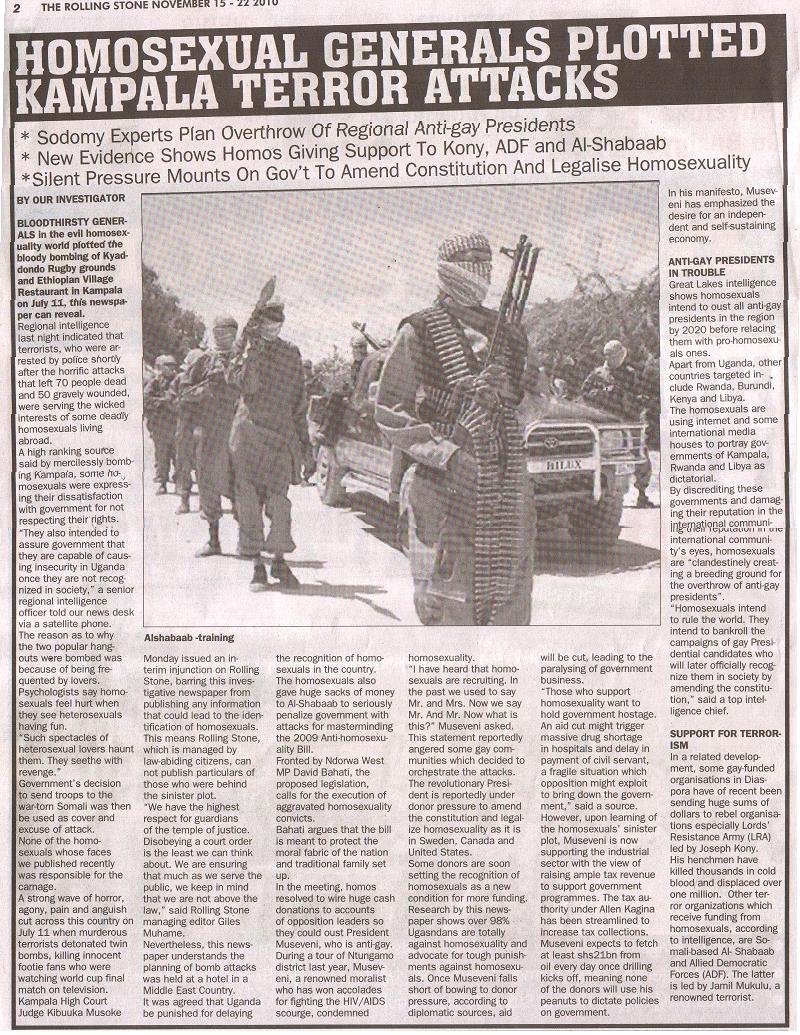
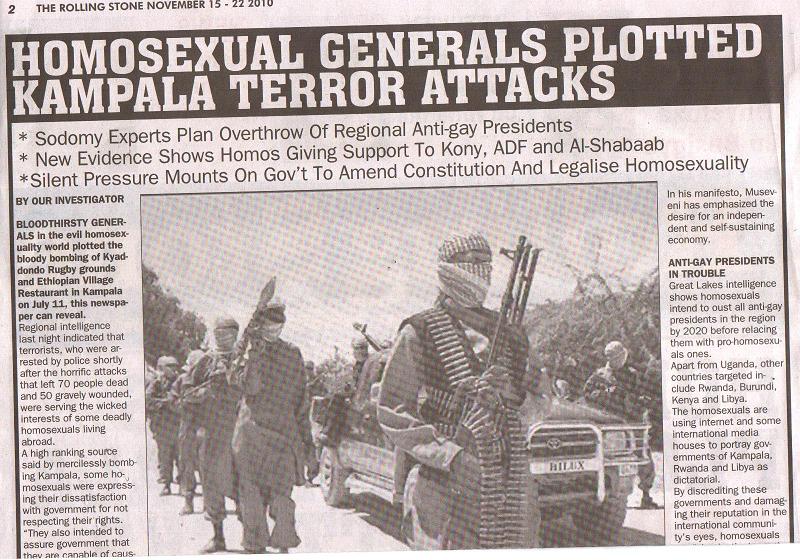
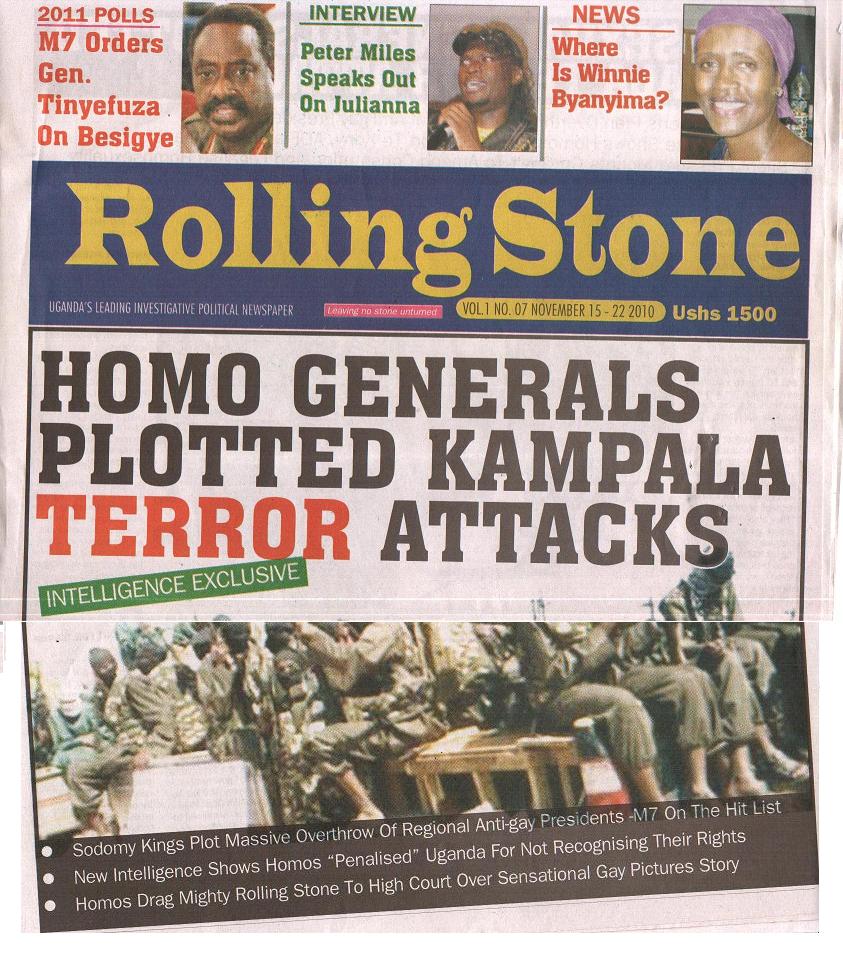
Escalating their war on homosexuality, Uganda’s Rolling Stone is blaming the Kampala bombings on gays, as well as making up links to terrorist Joseph Kony in the North. The following images are from the November 15-22 issue out now.

Click on the image on the right to read the Rolling Stone’s claims. As you will see, no sources are offered, no proof is provided. Perhaps in a nod to the recent court ruling in Uganda, the editors said that none of the bombings were carried out by people named in previous issues. That might be the only accruate statement in the entire article. However, a variety of terroristic activities are blamed on gays without any evidence whatsoever.

The article has no author and cites unnamed sources, but claims that the July attacks in Kampala during the World Cup were plotted by “deadly homosexuals living abroad.” The article claims homosexuals are angry that the government won’t respect their rights. The article claims without awareness of the contradiction that the government sent troops to Somali to cover the real story. The tale gets taller when the paper claims that homosexuals from the Middle East paid Somali terror group Al-Shabaab to bomb Kampala due to outrage over the Anti-Homosexuality Bill. Finally, gays are blamed for funding the Lord’s Resistance Army who have committed atrocities in the North.

This is another disturbing development in a series of such happenings. I will have more to say about this Monday, but I spoke yesterday with the mover of the Anti-Homosexuality Bill, Hon. David Bahati, and he confirmed to me that he expects the bill to be considered during the lifetime of this parliamentary session. It seems likely that the Rolling Stone’s campaign is designed to increase pressure on the Museveni government, facing a surprisingly strong opposition heading into upcoming elections, to move the Anti-Homosexuality Bill toward passage (e.g., read the Rolling Stone’s editorial).

UPDATE: Boxturtlebulletin also has these images as well as images of one of the other tabloid focused on gays, The Onion. BTB provides one article acknowing that Martin Ssempa has lost support over his support of the AHB.

Girls and boys are protected by law in Uganda

Some defenders of the Anti-Homosexuality Bill in Uganda say that the bill is needed to cover instances of same-sex defilement. However, as this news report demonstrates, police are able to arrest those who commit crimes against boys or girls.

Kampala

A primary school teacher in Luweero District has been arrested over allegations of sodomy.

The teacher, names withheld for legal reasons, is accused of having sexual relations with three male pupils from one school. According to a Police report, three sodomy cases implicating the teacher were reported in February.

The suspect recorded a statement and got released on Police bond. He later jumped bond and hid at Buvuma Islands, Lake Victoria until Wednesday when Police got hold of him again.

Central Region Police spokesman, Lameck Kigozi, said the suspect was arrested at Katosi Landing Site in Buikwe District. He had just alighted from a ferry. “He is detained at Luweero Police Station and we have preferred charges of unnatural offences. His file has been taken to the Director of Public Prosecutions for advice,” Mr Kigozi said on Thursday.

Recently police arrested another teacher for sodomising two girls. The latest police crime statistics show that over 120 people are sodomised annually. This means in every three days a person is sodomised in the country.

Tragic as they are, both men and women commit the crimes and the law is sufficient to address the perpetrators.

What kind of dialogue will we have?

Focus on the Family’s revised Day of Dialogue seems to be a kinder, gentler version of the former Day of Truth. On the new website, the group comes out strongly against bullying:

Any form of bullying and harassment of others is always wrong, including making fun of others, speaking down to them and saying things that hurt people. Christian students in particular should be bold in speaking up to oppose that kind of behavior because it goes completely against the model Christ gave us and that is reflected in Bible verses like these: “For God so loved the world, that He gave His one and only Son, that whoever believes in Him shall not perish, but have eternal life. For God did not send His Son into the world to condemn the world, but to save the world through Him.” John 3:16-17.

They also emphasize that any objections to homosexuality must be expressed in a respectful manner.

Any verbal and written expressions used by students participating in this event should be loving and compassionate—and never be expressed in a condemning or antagonistic way to others. Even when we disagree with others, we should always demonstrate the utmost compassion and respect for them.

While I appreciate this tone, I wonder what kind of dialogue the sponsors hope to create. Let’s set the stage for the proposed dialogue. The DoD is set to take place on Monday, April 18, 2010, the Monday after the Friday the Day of Silence is observed. On the Day of Silence, some students are silent during non-instructional time to dramatize the silence surrounding the harassment and bullying of students who identify as GLBT or those who are perceived to be a sexual minority. The sponsors suggest providing cards to pass out which “speak” for them. Here is what they say:

Please understand my reasons for not speaking today. I am participating in the Day of Silence (DOS), a national youth movement bringing attention to the silence faced by lesbian, gay, bisexual and transgender people and their allies. My deliberate silence echoes that silence, which is caused by anti-LGBT bullying, name-calling and harassment. I believe that ending the silence is the first step toward building awareness and making a commitment to address these injustices. Think about the voices you are not hearing today.

DAY of SILENCE – What are you going to do to end the Silence?

This would be one side of a dialogue. What is the other side? Is there another side? The DoS invites a dialogue about ending bullying relating to perceptions of sexual orientation. What kind of dialogue is envisioned by the DoD? From the website:

As a high school or college student, do you sometimes feel discouraged when controversial subjects like homosexuality are brought up in your school—and the conversation seems stifled, one-sided and doesn’t allow free room for discussion? Do you feel like your beliefs—the deepest truths of Christianity—are being mischaracterized?

Wish your classmates could hear more of the story—like the truth about God’s deep love for us and what the Bible really says about His redemptive design for marriage and sexuality? Wouldn’t it be nice if a deeper and freer conversation could happen?

As it stands, on Friday, the DoS students will ask for a conversation about anti-gay name-calling and bullying and then on Monday, the DoD students will answer with a defense of evangelical beliefs about sexuality. To me, that seems like two groups talking about two different things.

And so, I will continue to promote the Golden Rule Pledge during the days surrounding the “Days.” GRPledgers will join with those calling for an end to anti-gay bullying and offer that response to the question: “What are you going to do to end the Silence?” In addition, I encourage students to be keep the dialogue about ending bullying on the DoD.