Alan Colmes Radio Show: Wayne Besen vs. Richard Cohen

I listened to the Alan Colmes Radio Show tonight with a debate of sorts between Richard Cohen and Wayne Besen. During the call-in segment, Chad Thompson called in and said a cheery hello. Chad, you were the most reasonable voice on the show.

I think Richard mostly got the best of Wayne. Wayne needs to learn to let people talk. He sounds like he had way too much caffiene.

Wayne’s criticisms of Richard’s marriage were in very poor taste.

Richard made a point to emphasize that homosexuals are emotionally wounded and can change if they heal their wounds.

Wayne attacked Richard on several grounds. Of course, Richard is vulnerable here due to his expulsion from the ACA. Here is the expulsion letter and below are the sections of the code violated.
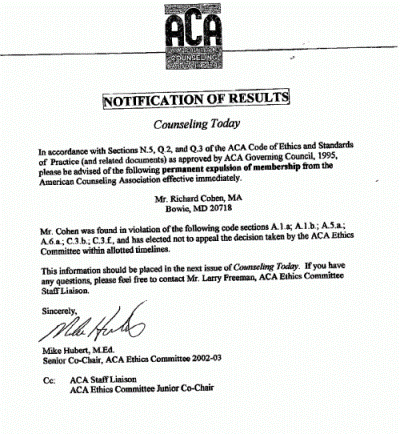
A.1.a: Primary Responsibility. The primary responsibility of counselors is to respect the dignity and to promote the welfare of clients.

A.1.b: Positive Growth and Development. Counselors encourage client growth and development in ways that foster the clients’ interest and welfare; counselors avoid fostering dependent counseling relationships.

A.5.a: Personal Needs. In the counseling relationship, counselors are aware of the intimacy and responsibilities inherent in the counseling relationship, maintain respect for clients, and avoid actions that seek to meet their personal needs at the expense of clients.

A.6.a: Avoid When Possible. Counselors are aware of their influential positions with respect to clients, and they avoid exploiting the trust and dependency of clients. Counselors make every effort to avoid dual relationships with clients that could impair professional judgment or increase the risk of harm to clients. (Examples of such relationships include, but are not limited to, familial, social, financial, business, or close personal relationships with clients.) When a dual relationship cannot be avoided, counselors take appropriate professional precautions such as informed consent, consultation, supervision, and documentation to ensure that judgment is not impaired and no exploitation occurs.

C.3.b: Testimonials. Counselors who use testimonials do not solicit them from clients or other persons who, because of their particular circumstances, may be vulnerable to undue influence.

C.3.f: Products and Training Advertisements. Counselors who develop products related to their profession or conduct workshops or training events ensure that the advertisements concerning these products or events are accurate and disclose adequate information for consumers to make informed choices.

Additional note: My friend David Blakeslee got on the show and reinforced the concept of people living in alignment with their beliefs and values. Chad and David were the highlights as far as I’m concerned.

www.truthwinsout.shh – TWO

Strange thing about Wayne Besen’s Truth Wins Out website; you can’t get to it without a password. I’ll bet he just forgot to send me mine.

ADDITIONAL NOTE: The website is active now and Wayne’s favorite therapist is on the front page. I suspect many thoughtful gay folk will be uncomfortable with TWO (the loneliest number since the number ONE). I think the most offensive aspect of it is this point from his 10 point program for ridding the world of ex-gay ministries: “TWO will verify credible information and potentially create devastating consequences for the future of the ex-gay ministries. Indeed, a limited ad campaign inquiring about such leads coupled with a hotline would likely yield results. We have uncovered major scandals with no formal mechanism for doing so. Imagine the potential for success if we address this issue with a laser-like focus.”

An ex-gay hotline? I-800-Gotcha!

Therapy vs. therapeutic

Relevant to recent discussions of touch in therapy:

Boundaries in psychotherapy are crucial for it to be psychotherapy. Otherwise, it becomes one of number of other wish-fulfilling relationships we could have (friend, physical therapist, hair stylist, parent, bartender, etc.). Just because therapeutic (read: helpful) things happen in a relationship doesn’t make the relationship therapy. For therapy to have impact beyond what these other relationships can have, it needs to be something different from what these other relationships can be.

I have had a few clients who have requested touch or some kind of physical contact. They explain that they see me as a parent figure and that it would be healing to experience non-sexual touch. I gently explain that we need to talk about feelings rather than act on them. Expressing feelings is not an end in itself as catharsis but it is a means of bringing about awareness and self-control. Gaining control over urges and feelings is the reason that they are seeking my help so it would not help for me to move in an opposite direction. Acting on feelings runs counter to the objective of understanding them and finding strategies to contain them. This has been effective with more rapid results than in experiential therapy (e.g., the client on the CNN segment – 3 years and running.)

Bioenergetics and other explanations

I have been meaning to blog a bit more about bioenergetics. I wanted to comment about my belief that clients who engage in this techniques do feel better and may even stay better. I was going to talk about how different theoretical perspectives all have success stories and many have limited data showing successful outcomes. Then I came across Judd Marmor’s response to Alexander Lowen’s speech at the Evolution of Psychotherapy convention in 1997 (published by Brunner/Mazel). In his speech, Lowen described his three years of character analysis with Wilhelm Reich and subsequent study with him. Reich was in Freud’s inner circle for awhile. Lowen broke with Reich when Reich began exploring orgone energy (a kind of life energy that is in everything and emanates from living cells. Adherents claim to be able to see a blue aura around people and analyse it). Point for Lowen.

Lowen ended his speech with this summary:

My evolution has brought me to where I understand that the body will heal itself if one surrenders to it. The surrender to the body means feeling it fully from head to feet. It means sensing all the chronic muscular tensions in the body, understanding their history, and their function in the present. It means feeling one’s pain and sorrow and crying. It means being able to protest the loss of one’s innocence and one’s joy…It means to have faith in the body, for it is the abode of God, and to trust its feelings because they express your truth. I had to learn this before I could teach it to my patients. And I have to learn it again and again, because my narcissistic ego still thinks that it knows best (p. 144-145).

Following Dr. Lowen’s speech, psychiatrist Judd Marmor gave the reaction. The whole thing is worth reading (145-148). This quote is about how I feel about bioenergetics:

I have no doubt that Dr. Lowen is an excellent psychotherapist. I see him…as a warm, caring, passionate man with powerful convictions who unquestionably inspires strong feelings of positive transference in most of his patients. However, I do question his explanation of why his patients respond positively to his therapeutic method.

Dr. Marmor goes on to describe how relaxing and directly working on the body may bring some relief but does very little to address specific problems in the absence of other more accepted methods (talking, interpreting, etc.)

Marmor summarized: “…it is not what he does to or with his patients but what takes place between them in their relationship that helps them to make progress.”

This summarizes my thoughts about Richard Cohen and bioenergetics. Several of his supporters have contacted me to let me know that Richard is a caring person. In my dealings with him, I have found this to be true as well. However, liking someone on a personal level does not preclude vigorous disagreement about other matters. Being of the same faith does not preclude such disagreement either.

I think the fact that a therapist is caring and charismatic can attract clients who seek personal dynamism. Motivational speakers are called this because they use the strength of their personality and communication skills to motivate. I believe many “therapies” rely on the relationship the therapist can create to motivate change a person was already capable of making.

On point, here is a segment from an interview with Lowen:

GG: How do you respond to the critics of bioenergetics who say that touching a client’s body is unethical?

AL: A therapist is in some ways a substitute parent. He is not simply a guide. One doesn’t get into transference relationships with a guide. Can one be a good parent if one is afraid to touch his children? But one can be a very bad parent (destructive) if touching a child is sexual. That is sexual abuse. The therapist who cannot control the way he touches a patient should never touch one.

I do not think that you can convince critics because they are projecting their anxiety about touching into the situation. Bioenergetics is a very powerful technique, and it involves doing a lot of things that other people would not do. Not all therapists are really fully qualified to be body therapists. It is unfortunate. One of the reasons is that it takes half a lifetime to be a good therapist. There are a lot of life experiences that are needed: working on yourself, working on your problems, and learning how to do bioenergetics.

If patients can trust you, then touch is not a breach of trust. If you are not trustworthy, then don’t touch them! I don’t always have perfect results with my patients, but they know I am sincere, straight, and doing the best that I can.

Much the same could be said for coaches. Therapists that create paternalistic transference reactions can expect strong positive and sometime negative reactions. The strong reactions may lead to transference cures or actual breakthroughs as a client begins to make the learning his own. However, the risk for negative reactions seems greater than those therapy styles that are more collaborative and egalitarian. If you can get the therapeutic benefit generated by a warm, trusting, and yes, emotive, therapy relationship without the baggage of the parental role and invasive touch, then why not do it? I believe Marmor is correct. If research on this point is accurate, most change in therapy occurs due to the therapeutic relationship and the application of common factors (learning, change, emotion) that most therapies share. Figure out how to apply them properly and you’ve got something.

LA Times article about ex-gays and schools

LA Times article regarding ex-gays and schools.

Comments anyone?

In this section of the LA Times article, the “ex-gay pamplet” refers to my brochure Respect and the Facts:

In Boulder, Colo., educators are considering including an ex-gay pamphlet in a resource guide to help teachers handle questions about sexuality. The pamphlet states that sexual identity is fluid and that conversion therapy can help some gays and lesbians overcome depression. The district — in one of the most liberal cities in the country — does not endorse that philosophy, but “we’re a big believer in providing all viewpoints,” spokeswoman Maela Moore said. “It would be negligent to omit.”