In her interview with Katie Couric, Sarah Palin comments on abortion, homosexuality and origins.
I suppose the media now will attempt to track down Palin’s dear gay friend.
Stay tuned.
Author: Warren Throckmorton
Alternatives to a bailout
CNN Money has an article on alternatives to a bailout if no deal is done.
Among the steps that the government could undertake are:
-Suspend so-called mark-to-market accounting rules, which during the past year have required financial firms to write down more than $500 billion in losses.
-Change federal requirements that force banks to keep a certain level of cash on hand for every dollar they lend out.
-Give banks the chance to exchange loan notes for notes from the Federal Deposit Insurance Corp. As a government agency, the FDIC’s notes would be more valuable than the banks’ notes, allowing the banks more flexibility to make loans.
-Purchase on a massive scale mortgage-backed securities issued by finance giants Fannie Mae and Freddie Mac. The Bush plan calls for the Treasury to buy a broader range of mortgage-backed securities.
-Extend limits on short sales of financial sector stocks.
-Cut the fed funds rate – the Federal Reserve’s target for short-term lending – perhaps all the way to zero, or in coordination with rate cuts by other central banks around the globe.
Feel free to post links in your comments to other alternatives…
What did Francis Collins really say about homosexuality?
In his book, The Language of God: A scientist presents evidence for belief, Francis Collins has this to say about homosexuality on page 260:
An area of particularly strong public interest is the genetic basis of homosexuality. Evidence from twin studies does in fact support the conclusion that heritable factors play a role in male homosexuality. However, the likelihood that the identical twin of a homosexual male will also be gay is about 20% (compared with 2-4 percent of males in the general population), indicating that sexual orientation is genetically influenced but not hardwired by DNA, and that whatever genes are involved represent predispositions, not predeterminations.
On the web, there are a number of sources who have quoted the OneNewsNow report that Francis Collins said the following:
‘Homosexuality is not hardwired. There is no gay gene. We mapped the human genome. We now know there is no genetic cause for homosexuality.’”
The problem is – Dr. Collins did not say this. As I noted here, Dr. Collins confirmed to me that he did not make this statement. He did say this:
It troubles me greatly to learn that anything I have written would cause anguish for you or others who are seeking answers to the basis of homosexuality. The words quoted by NARTH all come from the Appendix to my book “The Language of God” (pp. 260-263), but have been juxtaposed in a way that suggests a somewhat different conclusion that I intended. I would urge anyone who is concerned about the meaning to refer back to the original text.
The evidence we have at present strongly supports the proposition that there are hereditary factors in male homosexuality — the observation that an identical twin of a male homosexual has approximately a 20% likelihood of also being gay points to this conclusion, since that is 10 times the population incidence. But the fact that the answer is not 100% also suggests that other factors besides DNA must be involved. That certainly doesn’t imply, however, that those other undefined factors are inherently alterable.
Your note indicated that your real interest is in the truth. And this is about all that we really know. No one has yet identified an actual gene that contributes to the hereditary component (the reports about a gene on the X chromosome from the 1990s have not held up), but it is likely that such genes will be found in the next few years.
Note this part of the quote: “That certainly doesn’t imply, however, that those other undefined factors are inherently alterable.” Sexual attractions may come from the operation of several factors, in different ways for different people. The nature of the cause however, does not directly lead to understanding of how alterable the attractions might be. Perhaps attractions develop with some mix of environment and pre-natal factors. However, once set, attractions for most people seem to be pretty durable.
Go here for the entire post describing the confusion over what Collins said.
Palin did not cut Special Olympics budget: National Review Online
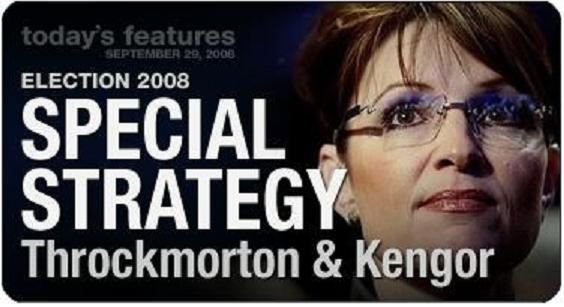
Paul Kengor and I have an article in today’s National Review Online which addresses the claims that Sarah Palin cut the budget of the Special Olympics.
Rep Phil English (R-PA) explains his vote to oppose financial bailout
My Representative, Phil English, (R-PA) voted against the financial bailout package today. Here is his statement in support of his stance.
Contact: Julia Wanzco (202) 225-5406
News for immediate release
September 29, 2008
English Responds to House Vote on Financial Rescue Package
Washington, D.C. – Today, the U.S. House of Representatives voted on the Economic Stabilization Act of 2008, legislation aimed to restore confidence in the American financial markets. U.S. Rep. Phil English (R-Pa.) a member of the Joint Economic Committee, voted against the legislation and released the following statement:
“From the outset, it has been my strong belief that any rescue proposal necessarily include real consequences for bad actors, strong taxpayer protections and accountability and transparency of any tax dollars used. I believe that the bill considered today failed to meet these minimum thresholds. Despite my belief that the right action by Congress could have a positive effect, this bill’s flaws and unchecked risk to the taxpayer, in my view, outweighed any potential benefits.
“This legislation fails to encompass critical financial safeguards for taxpayers, savers and the economy as a whole and lacks clear parameters and shifts the power to unelected bureaucrats in the Treasury. The bill creates a program where the same people whose mistakes have hurt the financial system will be able to game the auctions and leaves open the door for golden parachutes for top executives. And, while included on a limited basis, the insurance program is not the centerpiece of the initiative.
“There are weak guarantees of oversight as well as weak taxpayer protections. This legislation allows the program to be used for non-mortgage debt like credit card debt, forces taxpayers to bailout foreign banks, and turns over more than five percent of the Gross Domestic Product to Treasury with only very broadly defined terms.
“Further, the bill fails to get at the core problem which created this mess. Finally this measure overlooks opportunities to attract new, private capital into the market to help stabilize the marketplace.
“While I support the need for congressional action to stabilize the credit markets, the legislation negotiated by the Bush Administration and congressional leaders created a Rube Goldberg device that was ineffective in bolstering the economy, protecting the taxpayer or restraining the authority of the central government.”
The Economic Stabilization Act of 2008 failed to pass the House floor today by a vote of 205 to 228.
-###-