Canyon Ridge Christian Church in conversation with Martin Ssempa

In response to the Current TV documentary, Missionaries of Hate, Canyon Ridge Christian Church (Las Vegas, NV) today issued this statement to me regarding their mission partner, Martin Ssempa.

The mission partners of Canyon Ridge Christian Church are more than just names on a bulletin board or a web site, they are our dearly loved friends and family. Because of this, we take seriously our commitment to them.   When accusations or ill reports come to us about one of our partners and their ministry activities, we’re committed to do what the Bible instructs us to do; we go to our partners (when possible, going to see them face to face) and work through the issues with them personally. We don’t make public statements about our partners until we have worked through issues with them personally and brought those issues to resolution. We have been and are currently in conversation with Martin Ssempa and others regarding the controversy in Uganda and his activities in addressing it.

Martin Ssempa was featured prominently in Missionaries of Hate showing deviant porn to a stunned audience. He is shown praying with Islamic clerics for David Bahati, the author of the Anti-Homosexuality Bill. This statement seems to move slightly away from their earlier position which was:

Canyon Ridge Christian Church partners with missionaries and ministry leaders around the world, including Martin Ssempa, for the purpose of reaching people with the gospel of Jesus Christ and providing humanitarian aid where possible.


With the oversight of our elders and missions team, we constantly evaluate our ministry partners and their activities. We will only support those who engage in and promote activities consistent with the redemptive and grace-filled purposes of Jesus Christ in the world.


Canyon Ridge Christian Church does not wish to enter into the debate over the legislation in Uganda. We do encourage those involved to seek God’s leadership in humility and grace and to follow Jesus command to love one another as they wrestle with this difficult issue. Our prayers are for the good of the people Uganda.

It seems to me that Canyon Ridge has entered the debate through their mission partner. He has become one of the public faces of the bill around the world and has recently partnered with Islamic clerics on a renewed effort to promote the bill.

More on Bryan Fischer’s theories about homosexuality and the Nazis

In various ways, over the last two weeks, Bryan Fischer of the American Family Association has advanced three theories about Hitler, the Nazi Party and homosexuals. They are:

1. Hitler was an active homosexual.

2. Hitler could not find straight soldiers who were savage enough to carry out his evil plans, so he recruited homosexuals to do it.

3. Homosexuals in the Nazi military led to the Holocaust.

Fischer produces several quotes from historians and students of the Nazi movement to support him. It seems to me that he pulls these quotes right out of their context and uses them to paint an incomplete picture of history.

Hitler’s sexuality has been examined from several different angles. He is an enigma for sure, but you wouldn’t know it by listening to Fischer who called Hitler “an active homosexual.” In the historical record it is clear that Hitler displayed some interest in certain women but this was glossed over by Fischer. Even if Hitler did have a homosexual period –this is by no means proven — there was a clear shift in attitude toward homosexuals after the murder of Ernst Rohm. It is accurate to say that Rohm and several of the SA Brownshirts were homosexual. Hitler tolerated them until they were no longer useful and had them executed in 1934 during the Night of the Long Knive purge. The man who led the execution of Rohm and who later had responsibility for instilling the uncompromising cruelty of the concentration camps at Dachau and later as general inspector of all camps was Theodore Eicke. Eicke, not mentioned in Scott Lively’s book, was married with two children; very straight and very savage.

What follows are just a sampling of quotes which are relevant to Fischer’s theories.

Hitler avoided contact with women, meeting with cold indifference during visits to the opera alleged attempts by young women, probably seeing him as something of an oddity, to flirt or tease him. He was repelled by homosexuality. He refrained from masturbation. Prostitution horrified but fascinated him. He associated it with venereal disease, which petrified him. (p. 23)

–Ian Kershaw in Hitler: A Biography (2008). WW Norton & Co. 

“Diels says of Hitler, “He [Hitler] lectured me on the role of homosexuality in history and politics. It had destroyed ancient Greece he said. Once rife, it extended its contagious effects like an ineluctable law of nature to the best and most manly of characters, elimination from the reproductive process those very men on whose offspring a nation depended. The immediate result of the vice, however, was that unnatural passion swiftly became dominant in public affairs if it were allowed to spread unchecked”. (p.118) (Rudolf Diels was the first chief of the Gestapo)

–Frank Rector. (1981). The Nazi Extermination of Homosexuals.  Stein & Day Publishing. 

Hitler was prudish in his abhorrence of the “sins” of the modern big city like prostitution, homosexuality, and even immodest dress. He wrote of these matters as the “political, ethical and moral contamination of the people” and the “poisoning of the health of the body politic.” (p. 336)

–Robert Gellately (2007). Lenin, Stalin and Hitler: The Age of Social Catastrophe. Random House.  

In November, 1941 Hitler even signed a decree making homosexual offenses among SS members and policemen a capital offense. Two months earlier, Hitler had explained to Goebbels the Darwinian underpinnings of his opposition to homosexuality. After remarking that homosexuality should not be tolerated, especially in the Nazi party and the Army, Hitler continued:

The homosexual is always disposed to drive the selection of men toward the criminal or at least the sickly than the useful in the selection of men. If one would give him free rein, the state would eventually be an organization of homosexuality, but not an organization of manly selection. A real man would defend himself against this endeavor, because he sees it as an assassination of his own evolutionary possibilities. (p. 131)

Hitler’s Ethic: The Nazi Pursuit of Evolutionary Progress  (2009). Richard Weikart. Palgrave MacMillan.

There are many more such quotes and accounts which demonstrate the clear distain for homosexuality from Hitler and the Nazis. Last week, I noted that Lothar Machtan, who Bryan Fischer quotes at length, discounted points 2 and 3 above. For more on homosexuality and the Nazis, consult this link and this one.

Policy statement: Exodus International opposes criminalization of homosexuality

Today, Exodus International issued a policy statement regarding the criminalization of homosexuality.

Criminalization of Homosexuality

Exodus International opposes the criminalization of homosexual behavior as conducted by consensual adults in private. We strongly oppose the imprisonment, mistreatment, or death of homosexual men and women on the basis of their perceived or known sexual orientation. These actions breed cultural violence and institutionalized shame, neither of which reflect God’s redemptive heart.

In the blog post, Alan Chambers also expressed regret for the delayed response to information he received about the Ugandan ex-gay conference as well as the potential fall out.

That said, and without a wordy explanation or excuse, this public post is way overdue and I sincerely hope it clears up any speculation about how I really feel about gay and lesbian people, Ugandan or otherwise, the criminalization of homosexuality, Exodus’s connection to the now infamous Ugandan conference where Exodus board member, Don Schmierer spoke, and most importantly the grace of God.

First things first, I was personally lax in investigating thoroughly the pre-conference intelligence that was coming in from Timothy Kincaid, David Roberts and Warren Throckmorton, to name a few.  My initial belief was that their major concern was over Caleb Lee Brundidge’s association with Richard Cohen.  Again, no excuses, I was negligent in digging deeper and heeding their warnings.  While I did share my concerns with Don Schmierer prior to the event, he was on the ground in Uganda and I saw this as an issue that didn’t warrant him canceling his appearance there—after all, in my mind, Don was simply sharing his normal talk on parenting.  I do realize that his mere presence there, even as a private citizen, did give the appearance that Exodus was endorsing the conference and eventually the horrific political position that was fueled by that event.

I appreciate this acknowledgement. Alan is correct that some of the initial concern related to the involvement of Brundidge but as he says here, it was much deeper. The events in Uganda, played out over the last 16 months, have required U.S. Christians to rethink their stance toward homosexuals. As Alan’s remarks indicate, it is now necessary to articulate one’s position on criminalization. The Uganda situation unearthed a division among social conservatives about the law and homosexuality. Just yesterday, one of the voices of the American Family Association, Bryan Fischer, again said that he favors a return to laws penalizing homosexual conduct.  The Ugandan initiative has touched many American evangelicals in a way that few issues have, forcing many ministries and leaders to choose sides. While I personally had little doubt that the policy of Exodus was to oppose criminalization, today’s announcement makes that clear. I applaud them.

McCollum contradicted Rekers in gay adoption case appeal

I posted last week that Florida Attorney General and Republican candidate for Governor, Bill McCollum hired George Rekers as an expert in a gay adoption case over the advice of his staff. The state lost the case and the ban on gay adoption was set aside by Judge Cindy Lederman. Lederman took strong exception to Rekers’ work, saying that Rekers’ testimony “was far from a neutral and unbiased recitation of the relevant scientific evidence.” Despite the apparent harm the testimony did to the case, AG McCollum defended Rekers in a brief filed August 6, 2009 before a Florida state court of appeals seeking to overturn the lower court ruling. More specifically, McCollum defended Rekers’ religious writings and the evidence Rekers presented in defense of the ban on gays adopting children.

However, on one point McCollum contradicts his expert without acknowledging the contradiction. Rekers testified that one might exclude Native Americans from adopting if it could be shown that, as a group, they had higher rates of many distressing conditions. Here is Rekers’testimony:

Q. Well, Dr. Rekers, earlier you testified that Native-Americans have a higher rate of alcohol abuse than the general population does, right?

A. Yes.

Q. It’s a very significantly elevated rate of alcohol abuse, I mean compared to the general population?

A. Yes.

Q. So if Native-Americans have significantly higher rates of alcohol abuse, and if they also have significantly higher rates of psychiatric disorders, and if they also have higher rates of relationship instability, is that enough for you to say that all of a sudden they should be categorically excluded?

The Court: I think you can add violence to that, as well.

The Witness: Yeah, violence, yeah.

Q. And violence, as well.

A. Yeah, if it turned out that a majority of the individuals in the Native-American population, that a majority of them were high risk for one of these things happening, as a lifetime prevalence, there could be a parallel rationale for excluding them, as adoptive parents, because it would be not only them, they would tend to hang around each other. So the children would be around a lot of other Native-Americans, who are doing the same sorts of things, you know. So it would be a high risk, and, in fact, since you can’t perfectly predict human behavior, the best you can do and the best the State can do is to look at risk levels, and if a particular kind of household poses multiple high risks for condition that would be detrimental for children, then that would be a rationale for excluding that group.

Perhaps, with hindsight, Dr. Rekers would reconsider his testimony. However, there is no indication that it was ever amended or directly addressed by the state of Florida. However, here Rekers provides a rationale for excluding Native Americans along with homosexuals.  The line of questioning seems as though it was designed to get Rekers to make some sort of distinction between sexual orientation and race.  However, at least in this instance, he did not.  

As I have looked into this, I have been puzzled about why Mr. McCollum would not dismiss his witness at that point or seek to distance himself from the testimony. I have also been puzzled about why Native American groups did not speak out when this was first repored in May. One representative of a Native American advocacy group, speaking on condition of anonymity said that such criticisms of Native Americans are made frequently and they do not take them seriously.

Perhaps one reason they do not take such arguments seriously is because such arguments would likely be dismissed in a real public debate or in a court proceeding. When arguing racial issues, courts take a more strict review of any governmental action to discriminate on the basis of race. Generally, on matters of race, if a government policy burdens an individual due to racial category, the government policy will not survive. AG McCollum argues in the 2009 appeal that the adoption case should be decided on a rational basis test. In this test, the government is generally given the benefit of the doubt in crafting laws when no fundamental rights or suspect classes are involved. McCollum argues and all agree that adoption is not a fundamental right and he also argues — and this is where the disagreement comes — that homosexuals are not a class worthy of the strict scrutiny test.

On page 8 of the appeal, McCollum discusses the matter of Native Americans and adoption.
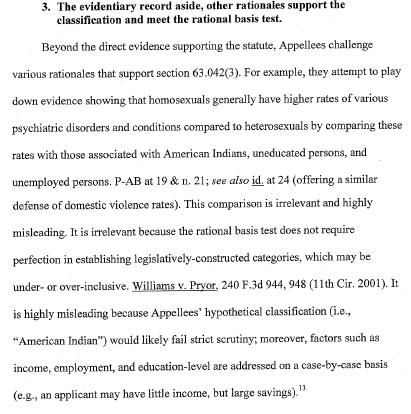
McCollum here contradicts Rekers by saying that the category of Native American “would likely fail strict scrutiny.” This means the Florida legislature would have to have a much higher burden of proof as to why violation of the equal protection clause — e.g., excluding Native Americans — would serve a compelling state interest. What surprised me here, and perhaps it is because I am not a lawyer, is that the appeal narrative does not mention the testimony of Rekers in this section, even as Rekers is defended in the other sections of the appeal. Rekers clearly testified that the basis for exclusion in his opinion was the higher rates of distressing conditions. In the appeal, McCollum addresses the theory but does not address the fact that his own expert failed to make categorical distinctions.

The ways that some conservatives think about gays confuse me. On one hand, gays are considered a cohesive enough group with characteristics so common that they can be lumped together. When viewed this way, Rekers-style testimony is offered about the high rates of distressing problems and thus, how the entire group of people should be viewed negatively. However, on the other hand, some social conservatives do not consider homosexuals  to be related enough to be a suspect class. Some go so far as to say there is no such thing as a homosexual, rather heterosexuals with homosexual behavior or problems.

McCollum then continues his argument that sexual orientation does not warrant a strict scrutiny standard.
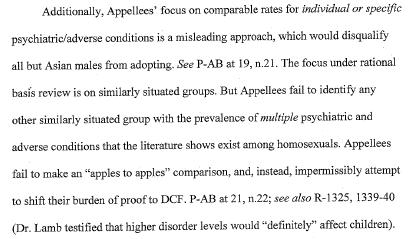
McCollum here continues to argue that one distressing condition is not sufficient, or else only Asian males could adopt. However, McCollum wants the appeal court to know that the lower court did not demonstrate any other group like homosexuals, who have as many problems. Without acknowledging it, McCollum disagrees with his expert to further serve his case.

In this situation, I don’t think there is a fundamental right to adopt or be adopted so I am not sure how this case will turn out.  However, a troubling thing here is the reasoning which invalidates individual rights due to membership in a particular group. It should make everyone a little nervous when individual gays are judged due to rates of distressing problems among larger groups of gays. Even on a practical level, such stereotyping can become the basis for predjudice and discrimination. Christians complain about this and we have freely chosen our beliefs. We don’t like it when such logic is used against us, and we should be very careful about where such thinking can lead.

McCollum overruled assistant to hire Rekers as expert

Documents have been released demonstrating the process behind hiring George Rekers as an expert in the FL gay adoption case. His staff opposed hiring Rekers due to bias Rekers had demonstrated in prior cases and in his writings.

McCollum’s office was brought in by the Department of Children and Families to defend the state’s three-decade old ban on gay adoption after it was challenged by Martin Gill. Gill is a North Miami man who wanted to adopt two foster children that are living with him and his partner.

Records show that DCF did not want to hire Rekers as an expert witness in the lawsuit because he wanted to charge $300 an hour. DCF only agreed to his hiring after McCollum strongly recommended it.

The state considered over 30 other people who declined.

The e-mails released Thursday show that an attorney in McCollum’s own office warned against hiring Rekers, whose testimony had been deemed suspect in an earlier Arkansas lawsuit that challenged a ban on placing foster children in homes with gay parents.

Assistant Attorney General Valerie Martin wrote in a July 2007 e-mail that after talking to Arkansas officials and reviewing the background of the former University of South Carolina professor that she would “recommend NOT using him.”

E-mails also show that during a conference call Martin — who said the state considered more than 30 possible expert witnesses — was ordered to hire Rekers “against my strong cautions.”

This is an interesting revelation. I was one of those 30 people contacted by the FL AG’s office. I declined the request because I did not think the law was defensible or appropriate. 

There are other aspects of this situation that are disturbing. For instance, Rekers testified that Native Americans could be excluded from adopting because of high rates of substance abuse, domestic violence, and suicide as compared to other groups. Subsequently, McCollum’s office defended Rekers’ status as an expert. Rekers offered a legal basis for discrimination and he was defended in a later appeal. In the appeal of the lower court’s findings (allowing the children to stay with their gay parent), McCollum says gays and lesbians have higher rates of problems on a variety of distressing conditions and this is one reason they should be excluded. He erroneously said no one from his side argued that distressing conditions alone would be a valid reason to exclude an entire class. However, Rekers did say Native Americans could be excluded on the same basis as McCollum argues that gays can be.

I hope to lay this out with references next week.