Counseling Today article about sexual identity and religion. One side fits all?

The official newsletter of the American Counseling Association is called Counseling Today. Unfortunately, only members can get it online so I cannot provide links to the article I want to discuss. In the April, 2007 issue, a pastoral psychotherapist from DC, Stacy Notaras Murphy published an article titled “Strange Bedfellows: Religion and sexual identity in the counseling office.” I have asked Counseling Today for permission to reprint and will link to a copy of it if I hear a positive response. For now, I will have to include excerpts.

The article purports to be an examination of how people deal with religious identity and sexual identity. From early in the piece:

Most counselors agree that sexual identity is a major aspect of personality development. While more in the field are recognizing that spiritual identity informs personality development as well, the intersection of the two hasn’t received much attention. But the connections may seem more natural when both are considered under the umbrella of multicultural competency.

I certainly agree that training programs outside of religious institutions are rarely helping counselors understand the role of religious identity in integrating a sexual identity. In fact, one of the counselors quoted, Michael Kocet, agreed when he said:

“I would like to see AGLBIC [Association for Gay, Lesbian, Bisexual Issues in Counseling] and ASERVIC [Association for Spritual, Ethical, Religious and Value Issues in Counseling] partnering more on how to integrate their two competency models into effective practice with GLBT clients,” he says. “Right now, I think they’re very much treated separately, most likely unintentionally. I think more research should be done on that; it’s an untapped area within the GLBT community.”

I don’t think it is untapped, but I do think counselors are often confused about how to work ethically and helpfully with clients for whom sexuality and religious faith are important and/or in conflict. The AGLBIC competencies do not mention religion. There is no guidance from that group on how to handle religious conflicts. The ASERVIC competencies on the other hand do provide relevant guidance, especially the following ones:

Competency 5 – The professional counselor can demonstrate sensitivity and acceptance of a variety of religious and/or spiritual expressions in client communication.

Competency 6 – The professional counselor can identify limits of her/his understanding of a client’s religious or spiritual expression, and demonstrate appropriate referral skills and generate possible referral sources.

Competency 7 – The professional counselor can assess the relevance of the religious and/or spiritual domains in the client’s therapeutic issues.

Competency 8 – The professional counselor is sensitive to and receptive of religious and/or spiritual themes in the counseling process as befits the expressed preference of each client.

Competency 9 – The professional counselor uses a clients’ religious and/or spiritual beliefs in the pursuit of the clients’ therapeutic goals as befits the clients’ expressed preference.

Note especially competencies 7-9. Religious beliefs are relevant to clients’ therapeutic goals and should reflect clients’ expressed preference.

Now back to the article and I will cut to the chase. The article conspicuously avoided any mention of religious beliefs that view homosexual behavior in a negative manner. The only alternative presented was to adopt a religious identity that is gay affirming. Note the organization presented to counselors as “Sprituality-based Resources” to such clients:
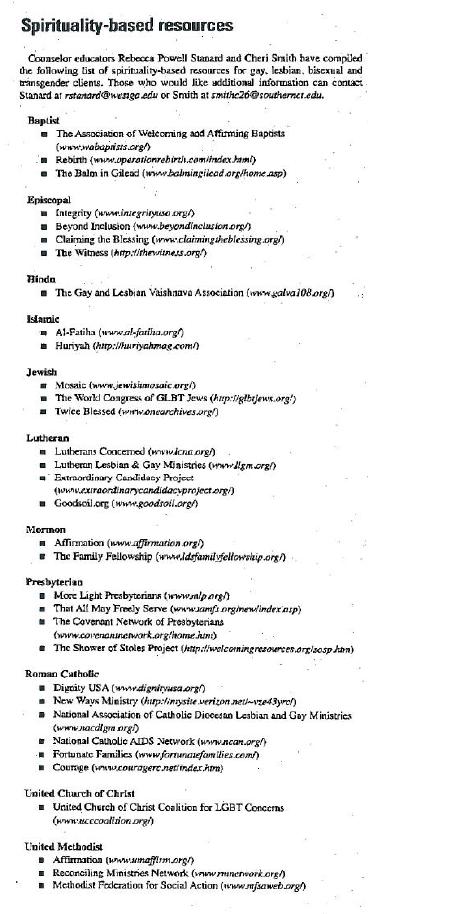
Counseling Today, April, 2007

Courage is the only group listed that promotes a traditional sexual ethic. The ASERVIC competency does not call on counselors to endorse or impose a brand of religiousity on clients, rather to use “a clients’ religious and/or spiritual beliefs in the pursuit of the clients’ therapeutic goals as befits the clients’ expressed preference.” What if a client’s expressed preference is for a religious view that is not represented by any group on that list? Then what?

Long time readers will know that the sexual identity therapy framework works within the values and beliefs of the client so I am not advocating for one side here. In fact, what I am saying is that one side will not fit all, even if the exclusion is prefaced by claims of multicultural competence.

UPDATE: I now have permission to post the article. The staff at Counseling Today provided a legible version of the article — thanks to them for that.

Only the gay die young? Part 8 – Loose ends

I have read the Camerons replies to me in this ongoing discussion and have only a few more things to say.

Regarding Paul Cameron’s letter, I have very little to say. It does not appear to me that he really addressed any of my critiques. Instead, he convinced me that he has his mind made up about those who lead as he put it “parasitic lives.” He had a lot to say about his two quests in life, one being the public health consequences of second hand smoke and the other being the menace of what you could call second-hand-gay (we are all doomed because a small percentage of people are attracted to the same sex). If that doesn’t make sense, you’ll have to read his letter to me – but then again, that might not help either.

Kirk Cameron’s note was more substantial but I still need to see their data before I will comment more on the Denmark component of their study. Kirk Cameron says the paper is in peer review and so he cannot make the data available. When (if) the study is published, then I will review it further. He had various replies to Dr. Frisch’s critiques as well, none of which were especially convincing to me. As I read through the letter, it seemed like some fast dancing was going on. Here are examples:

As I will explain, you have apparently misread or misunderstood aspects of our methodology. Further, the ‘whole story’ about our research is not fully contained in the EPA paper, but rather in a series of separate, but related articles, each addressing a slightly different topic. Be that as it may, I do find it a bit of a double standard that you would implicitly criticize our use of the media and internet as a forum for dissemination of new information, when your blogsite is not, as far as I can tell, subject to any scholarly oversight (beside your own).

Ok, so I am supposed to read your mind? You have bits and pieces of justifications in other papers but since I don’t have them I can’t know what you intend. And Kirk compares a blog to a news release?

Yes, our estimates of homosexual longevity are preliminary and may change with additional data. But are they necessarily false or unreliable? No.

So when the news releases say dogmatically straights outlive gays by 20 years, this is “dissemination of new information?” So which is it? New information or preliminary data?

Kirk C. spends much time attempting to make an analogy (benchmark) between estimates of longevity for the general population and estimates for gays. However, one can take a representative sample of a known population, but using the same methods with an unknown population may not lead to the same results. I am not convinced that he has properly sampled homosexuals (or their deaths) in order to satisfy the assumptions needed to make the analogy reasonable.

And then there is this deflection:

Plus, there is the issue of nonrespondents. For the Canadian study this was relatively low — around 20% — but clearly still large enough to dramatically change the prevalence estimates were non-response correlated with a concealed homosexual orientation. This did not prevent Statistics Canada from asserting publicly that only 1.7% of the Canadian population was bisexual or homosexual. Were they professionally negligent in doing so? And what about the research teams from Great Britain, France, and the U.S. that have also reported low estimates of homosexual prevalence despite even larger refusal rates? Are you also criticizing them in the same vein, or is it only us in whom you have no confidence?

Statistics Canada nor have other researchers made something out of their numbers beyond the estimates of prevalence. The Camerons have read into what is essentially a black box and promoted their guesses in the press as facts. I personally don’t care what the facts turn out to be. However, I get the feeling that the Camerons do.

Unless something else comes up, this is probably part last.

APA appoints task force on abortion and mental health

First mentioned in passing in a January 21 New York Times article, the APA has appointed a task force to conduct an updated review of research on abortion and mental health outcomes. In contrast to the more public process used by the APA to appoint the task force on sexual orientation responses, the APA did not consult the membership for nominations. The APA reached back to partially reconfigure the 1989 task force that found minimal mental health risk in abortion. The members of the Task Force are:

Mark Appelbaum, PhD, University of California, San Diego

Linda Beckman, PhD, California School of Professional Psychology

Mary Ann Dutton, PhD, Georgetown University School of Medicine

Brenda Major, PhD, University of California-Santa Barbara

Nancy Felipe Russo, PhD, Arizona State University

Carolyn West, PhD, University of Washington, Tacoma

According to Rhea Farberman, PR Officer at APA,

A slate of potential members for this task force was determined based on a database search of research on abortion and related issues. That initial list was reviewed by the APA Committee on Women in Psychology which sent recommendations to the APA Board for the Advancement of Psychology in the Public Interest which in turn sent recommendations to the APA Board of Directors. The Board of Directors made the final appointments to the task force.

The task force was constituted with the following goals:

Include leading researchers who were members of the group that did the review 15 years ago, while not completely reconstituting the original group;

Include research and practice expertise in the following areas: social attitudes, sexual behaviors, violence/trauma/sexual assault, women’s mental health, and minority populations; and,

Include a methodologist, because so many of the most visible/critical questions are methodological in nature.

Concerning the final composition of the task force, three of the task force members have prior expertise directly related to issue of abortion and mental health; the other three have expertise in the related issues noted above.

Rhea added that any information germane to the charge of the Task Force is welcome – it doesn’t necessarily have to be from members — and can be sent to: Women’s Program Office, American Psychological Association, 750 First Street, NE, Washington, DC 20002.

The manner and members of the task force have raised some questions. One psychologist I interviewed, Dr. Rachel MacNair, wonders about the objectivity of this committee. Dr. MacNair is the author of Perpetration-Induced Traumatic Stress: The psychological consequences of killing. Dr. MacNair says she is a “pro-life feminist” who “sees all violence as connected and wrong, with abortion being one kind of violence.” She observed that half of the task force have been openly critical of pro-life views and have public positions negating any relationship between abortion and negative mental health consequences. Dr. MacNair also believes qualified people were overlooked by the APA’s selection process.

Would the committee’s credibility have been strengthened by including members with opposing perspectives? Dr. MacNair thinks so and told me, “Only if the report comes out with conclusions opposite to what one would expect with the ideological commitment of half of its members will it have credibility. If it comes out as predicted, the absence of balance on the task force will be a problem for its scientific credibility.”

You can read more of Dr. MacNair’s thoughts in a column I just posted on my website call Abortion and American Psychology.

UPDATE: 5/18/07 – The Washington Times carried the Abortion and American Psychology column today.

Ex-wife of ex-ex-gay speaks about reorientation therapy experiences

Pam Ferguson, also known to many as Willful Grace, describes her experiences with her ex-husband’s reparative therapy in a post at ExGayWatch.

Her descriptions of some of the things done in the name of sexual reorientation make me cringe. I continue to believe those who support a patient’s right to pursue sexual reorientation should be more zealous to root out such practices. I appreciate Pam’s decision to share and encourage others to do so here in response.

I think the entire post is worth reading but here is one excerpt:

The therapist, who was always in stocking feet, would often rub his foot on Tdub’s [her nickname for her ex-husband] leg (This occurred in couples session; I witnessed this.) I found this a bit awkward and, assuming it went on in his individual sessions, I asked Tdub about it. He admitted that it made him feel awkward at first but that he’d gotten used to it and it was just a part of the therapist’s “way”. He later went on to mention that the therapist sort of played the role of a father figure and was teaching them lessons about safe and affirming male touch.

Note to the movement: The whole therapist-as-a-father-figure thing has got to go, and the sooner the better.