What do Dan Savage and AFTAH’s Mike Heath have in common?

They both support Ron Paul.

In a Slate article out yesterday, gay activist Dan Savage (the inspiration behind the It Gets Better campaign), defended Ron Paul in comparison with social conservatives like Rick Santorum, saying:

“…Ron [Paul] may not like gay people, and may not want to hang out with us or use our toilets, but he’s content to leave us the fuck alone and recognizes that gay citizens are entitled to the same rights as all other citizens. Santorum, on the other hand, believes that his bigotry must be given the force of law. That’s an important difference.”

And then there is the chair of the board of the Americans for Truth About Homosexuality, Mike Heath. He is currently the Iowa State Director for Ron Paul’s campaign. Obviously, he too is a Ron Paul supporter but in his former positions, he has a record more in alignment with Rick Santorum than Ron Paul. Heath was lauded in an AFTAH article as being the only person in history to successfully turn back two state gay rights laws (in Maine in 1998 and 2001).

Maybe Heath has changed his views. Heath has not yet replied to my email asking what he thought of Savage’s characterization of Ron Paul’s views.

Having examined a sampling of Paul’s writings and looking at who is endorsing him in Iowa, I think Savage is only partly correct about Paul. I agree that Paul wants the federal government to leave gays alone. State government, however, is another matter. Paul criticized the Lawrence v. Texas Supreme Court decision because he believes the state has the right to make laws concerning sexuality.

In Ron Paul’s version of the world, gays would be free from interference from Washington, DC, but if Iowa, or Texas, or South Carolina wanted to recriminalize homosexual behavior, then Paul would support their right to do so.

As it turns out, the strange bedfellows are not limited to those on the opposite ends of the culture war. If there is a candidate favored by Christian reconstructionists in the GOP field, it would have to be Ron Paul. Recently, Paul was endorsed by a prominent Christian Reconstructionist pastor in Iowa, an endorsement touted by Paul on his website.

More on why Paul is attractive to Christian reconstructionists will come in a post later today.

Related:

What Does Ron Paul Really Believe About Gays?

What does Ron Paul really believe about gays?

Currently, with one week remaining until Iowa’s Presidential Caucus, Ron Paul is in the hot seat. The Texas GOP hopeful denies writing racist columns for a newsletter bearing his name during the 1990s. Examining Paul’s denials, the Washington Post’s Josh Hicks gave Paul three Pinocchios which according to the Post means that Paul’s statements are misleading and use “legalistic language that means little to ordinary people.”

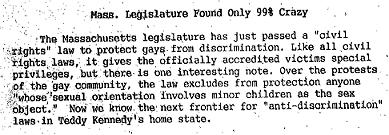
Paul’s views on gays are also open to question. One newsletter citation, frequently noted in the press, relates to his views on gays and HIV. Reportedly Paul said that gays “enjoy the attention” of that illness. In another 1989 newsletter, he criticizes the Massachusetts legislature for passing a gay rights laws, and implies that gays wanted to promote pedophilia:

Given the fact that Paul recently reversed himself and voted to repeal Don’t Ask, Don’t Tell, one might wonder if his views on gays have changed. However, the Paul campaign’s current State Director is Mike Heath. Heath is also the chairman of the board of the Americans for Truth About Homosexuality and once worked to oppose state initiatives such as the one condemned by Paul in the 1989 newsletter. A 2010 article on the AFTAH website describes Heath as

…the former executive director of the Christian Civic League of Maine and the new executive director of American Family Association of New England. (Heath will also retain the title of AFA of Maine.) He is also the only pro-family leader in American history to direct (as part of a pro-family coalition in Maine) the defeat of two statewide homosexual “special rights” laws, 1998 and 2001. In this interview, Heath, the Board Chairman of AFTAH, touches on the new evangelical politics surrounding anti-”gay marriage” initiatives — in which principled advocates against homosexuality like Heath are ostracized in the name of building coalitions more palatable to “moderate” voters.

AFTAH describes itself as “a group dedicated to exposing the homosexual activist agenda.” Last year, the organization was listed as a “hate group” by the Southern Poverty Law Center due to frequent misrepresentations and vilification of gays in public statements and literature. Just recently, AFTAH used the Penn State child abuse scandal as a platform to link sex crimes of pedophiles with homosexuality.

Apparently, Heath’s work is having some effect in Iowa with at least one endorsement touted on Paul’s website. According to the news release announcing the endorsement, Heath has been to “295 houses of worship” in Iowa. On the matter of gays and gay rights, I wonder what position is being articulated in those houses of worship.

Given his prior newsletters and his current staff, it is fair to ask what Ron Paul really believes. Despite Paul’s denials, his views in 2012 may be about what they were in 1989.

UPDATE: Here is more on Ron Paul’s views from a former staffer. According to Eric Dondero, Paul is uncomfortable around gays but believes they should be free to do whatever they please in their private lives. The Paul campaign is taking this seriously, responding to CBS News over the matter.

If Paul had any chances to catch on with the mainstream, they are pretty much gone now. He claims he didn’t write the racist and bigoted newsletters but he has yet to name who did. He says he does not know but he has not, as far as I can read, given even a theory about who did or how he could recommend the newsletter without knowing what was in it.


David Barton adds to history and the Bible at the same time

Today Right Wing Watch has a clip of David Barton claiming that the Founders based our republican form of government on Exodus 18:21. He added that some Founders actually referred to the Exodus passage as the basis for electing people to various office at the local, state and federal levels. Here is the clip:

Barton claims that “God set out elections at the very beginning.” He added that Israel was a monarchy later but before that “God established elections.”

However, that is not what happened according to Exodus 18. To get the context, I cite here Exodus 18:13-26. In this passage, Moses is lamenting to his father-in-law, Jethro, that he has to judge disputes of the people all day long. His father-in-law responded to Moses’ complaint with some good advice.

 13 The next day Moses took his seat to serve as judge for the people, and they stood around him from morning till evening.14 When his father-in-law saw all that Moses was doing for the people, he said, “What is this you are doing for the people? Why do you alone sit as judge, while all these people stand around you from morning till evening?”

15 Moses answered him, “Because the people come to me to seek God’s will. 16 Whenever they have a dispute, it is brought to me, and I decide between the parties and inform them of God’s decrees and instructions.”

17 Moses’ father-in-law replied, “What you are doing is not good. 18 You and these people who come to you will only wear yourselves out. The work is too heavy for you; you cannot handle it alone. 19 Listen now to me and I will give you some advice, and may God be with you. You must be the people’s representative before God and bring their disputes to him. 20Teach them his decrees and instructions, and show them the way they are to live and how they are to behave. 21 But select capable men from all the people—men who fear God, trustworthy men who hate dishonest gain—and appoint them as officials over thousands, hundreds, fifties and tens. 22 Have them serve as judges for the people at all times, but have them bring every difficult case to you; the simple cases they can decide themselves. That will make your load lighter, because they will share it with you. 23 If you do this and God so commands, you will be able to stand the strain, and all these people will go home satisfied.”

24 Moses listened to his father-in-law and did everything he said. 25 He chose capable men from all Israel and made them leaders of the people, officials over thousands, hundreds, fifties and tens. 26 They served as judges for the people at all times. The difficult cases they brought to Moses, but the simple ones they decided themselves.

Moses did not put the matter to the people in an election. He simply chose able people who could serve as judges over the people. It is remarkable to me that Barton would claim that this passage is the basis for popular elections when the Bible is clear that Moses did the choosing and appointing.

Barton then insists that the Founders referred to Exodus 18:21 as the basis for Article IV, Section 4 of the Constitution. That section states:

The United States shall guarantee to every State in this Union a Republican Form of Government, and shall protect each of them against Invasion; and on Application of the Legislature, or of the Executive (when the Legislature cannot be convened) against domestic Violence.

In the short clip, Barton does not give any names; he just says “the Founding Fathers who wrote that cited Exodus 18:31 as the basis.” I will have to study this a bit more but an initial search for confirmation of this has come up empty.

On Barton’s Wallbuilder’s website, Barton links the verse to early writers but he actually adds the reference to their writing. For instance, consider this reference to Noah Webster. Barton quotes Noah Webster and adds the reference to Exodus 18:21.

Founding Father Noah Webster delivered a similar admonition:

Let it be impressed on your mind that God commands you to choose for rulers just men who will rule in the fear of God [Exodus 18:21]. . . . [I]f the citizens neglect their duty and place unprincipled men in office, the government will soon be corrupted . . . If [our] government fails to secure public prosperity and happiness, it must be because the citizens neglect the Divine commands, and elect bad men to make and administer the laws.

However, in Webster’s book, the reference is not there:

Webster did not cite Exodus 18:21 as a basis for favoring elections as Barton implies on his website. Barton leaves a false impression that James Otis referred to the Exodus passage when, in fact, he did not. Elsewhere on the Wallbuilder’s site, he claims that Exo. 18:21 supports the Republican form of government but does not cite anyone who wrote the Constitution.

Even if a Framer did refer to the Exodus passage, that would not mean that Framer was correct in asserting that God established elections via the advice from Jethro. Many Framers believed that leaders should fear God and be honest. However, this does not mean they took the concept of representative government from Exodus.

Clearly Jethro’s advice was enlightened. Moses needed help and delegating authority was a wise approach. However, Jethro did not advise Moses to nominate some good people and then let the people vote.

Top Ten Posts – 2011

To reflect on 2011, I have listed here the ten most popular posts in terms of visits this year. Two of the posts were written in prior years but were visited frequently this year. In addition to being popular, I think they are representative of the stories and issues which I wrote about this year.

1. The Trail of Tears remembered

2. Uganda update: Anti-Homosexuality Bill on tomorrow’s agenda

3. Committee chair says Uganda’s Anti-Homosexuality Bill may not be considered

4. What would dominionists do with gays?

5. A major study of child abuse and homosexuality revisited (2009)

6. NARTH is not primarily composed of mental health professionals

7. Only the gay die young: Examining the claims of shorter life expectancy for homosexuals (2007)

8. The evangelical blackout of research on sexual orientation

9. William Penn founded the Quakers and other tall tales from David Barton

10. Was the Jefferson Bible an evangelism tool?

Finding the Seven Mountain Teaching in Unexpected Places

Since publication in 2007, I have referred many people to the book, unChristian by David Kinnaman and Gabe Lyons.  In their book, Kinnaman and Lyons report that the church is known more for what it is against than what it is for. They also document the extreme anti-gay sentiment which dominates evangelicalism. Among young people outside the church, nine out of ten viewed Christians as anti-gay.

Part of my retreat from the culture war relates to the realization that evangelicals have earned this perception. Evangelicals have not stopped with disagreement, but actively opposed equal treatment of gays. And they have not stopped with political opposition. Evangelical thought leaders blame gays for every societal evil and do so with a venom that is often shocking. When I read unChristian, it seemed that the research reported there validated my worries that Christians were largely on the wrong track.

Until recently, I had referred people to the book without knowing much about the organization which produced it. UnChristian author Gabe Lyons runs a group called Q. On the Qideas website, Lyons describes Q as:

Q Ideas

Q was birthed out of Gabe Lyons’ vision to see Christians, especially leaders, recover a vision for their historic responsibility to renew and restore cultures. Inspired by Chuck Colson’s statement, “Christians are called to redeem entire cultures, not just individuals,” Gabe set out to reintroduce Christians to what had seemed missing in recent decades from an American expression of Christian faithfulness; valuing both personal and cultural renewal, not one over the other. Re-educating Christians to this orthodox and unifying concept has become central to the vision of Q.

I was surprised by two items in this description. One, Chuck Colson, a respected evangelical figure, has done a lot to earn Christians the anti-gay reputation that Lyons seems to lament in their book. For instance, today’s column from Colson complains about the President’s recent push to promote decriminalization (more about that in a coming post).

The second element which surprised me was the embrace of the cultural mandate – the belief that Christians are called to create a Christian society. A modern version of this view is that Christians are called to dominate the seven areas of culture and thereby create a Christian society. In an article, titled Influencing Culture, Lyons lays out the program:

HOW NOW SHALL WE INFLUENCE?

The idea of culture shaping is widely debated. Most people, and until recently myself included, implicitly believe that cultures are changed from the bottom-up and that to “change our culture, we need more and more individuals possessing the right values and therefore making better choices.” The problem is that it is only part of the solution. In a widely distributed briefing that was presented to The Trinity Forum called To Change the World, James Davison Hunter asserts, “It is this view of culture that also leads some faith communities to evangelism as their primary means of changing the world. If people’s hearts and minds are converted, they will have the right values, they will make the right choices, and the culture will change in turn.” 

Hunter goes on to say, “…the renewal of our hearts and minds is not only important, it is essential, indeed a precondition for a truly just and humane society. But by itself, it will not accomplish the objectives and ideals we hope for.” This could explain why Christianity as it is practiced by many well meaning, admirable Christians in the past decades has failed to have significant traction.

Cultures are shaped when networks of leaders, representing the different social institutions of a culture, work together towards a common goal: “Again and again we see that the impetus, energy and direction for changing the world were found where cultural, economic and often political resources overlapped; where networks of elites, who generated these various resources, come together in common purpose.”

Saving souls is not enough. “Networks of elites” must come together with the “common purpose” of creating a Christian culture. Then he describes the seven mountains teaching with the slightly different phrase “seven channels of cultural influence.”

The Seven Channels of Cultural Influence

What are the different social institutions of our culture that Hunter is referring to? They are the social institutions that govern any society, including business, government, media, church, arts & entertainment, education and the social sector. Their combined output of ideas, films, books, theology, websites, restaurants, investments, social work, laws, medical breakthroughs and technology drive an entire nation.

The ideas and values they perpetuate sustain the moral fiber and social conscience of the culture. The people who lead these influential institutions have the opportunity to shape the ideas, thoughts and preferences of millions of others. If Hunter is right, it doesn’t take all that many people or time to witness dramatic shifts in the convictions and aspirations of a culture.

And one of the most unique channels of cultural influence is the church. Few other institutions convene participants from so many areas of society. When Christians embrace the common goals of both redeeming cultures and individual souls, the possibilities for positive cultural influence dramatically increase.

Lyons then uses what he calls “the homosexual movement” as an example of how one may use the seven mountains teaching to change the culture. He points to an article in the Regent University Law School Journal by Paul Rondeau (a past president of the board of the Parents and Friends of Ex-gays) which claims the current acceptance of gays as people stem from a small group of gays gathered in 1988 in Warrenton, VA. According to this narrative, the ability of that small group to steer the seven channels of influence is what has triggered the social change.

Lyons wants to do the same thing via the Church.

THE CHURCH’S OPPORTUNITY TO INFLUENCE CULTURE

I believe that the church is the hope of the world and is positioned like no other channel of influence to shape culture. Its people are called to be in the world. As John Stott puts it, “we find ourselves citizens of two kingdoms, the one earthly and the one heavenly. And each citizenship lays upon us duties which we are not at liberty to evade.” Although the work of culture creation may take place outside the physical walls of a church building, the local church creates a natural space where social networks of leaders, within all seven channels of culture, can work together towards a common goal. Nowhere else does this potential for synergy exist. Unlike other channels, the church is a living organism where God’s spirit constantly moves and seeks to express Himself through a willing Body.

Sadly, by focusing on just the “spiritual” and the afterlife, the Christian church has strayed away from its potential influence in the here and now, positioning itself instead as just another subculture. Many Christians currently hold unique and influential positions throughout the seven channels of culture, but have never been supported by fellow believers.

There is nothing particularly new in this. This is an expression of a familiar controversy about the role of the church in society. Lyons says it is sad that the church has focused on the spiritual. I think the church does not focus enough on it. Especially as the 2012 election looms, it is clear to me that many in the religious right want to use the church a a tool of political organizing for the GOP.

Lyons and Kinnaman rightly complain that the church today is known more for being anti-gay than for anything else. However, in my view, the approach suggested by Lyons is part of the problem. If the church is seeking to express Christian views of spiritual life to individuals then the personal characteristics of that individual don’t matter much. However, when cultural change is your aim, then those who would be hurt by your vision of culture become your enemies.

For instance, Chuck Colson inspires Lyons to redeem cultures. Colson’s vision of a redeemed culture does not include defense of people oppressed because of their sexual orientation.  Colson is using his position as a cultural leader to oppose the decriminalization of homosexuality around the world. If Colson is doing it well, as Lyons implies, then the anti-gay attitudes Lyons documents are inevitable.

I think the Founders got it right. Religion in general can be beneficial when it supports the rights of all and freedom of conscience. However, when one religion seeks to dominate, then others who believe differently will rise up to seek protection for their beliefs.