Nazi movement rallies against gays in Springfield, MO

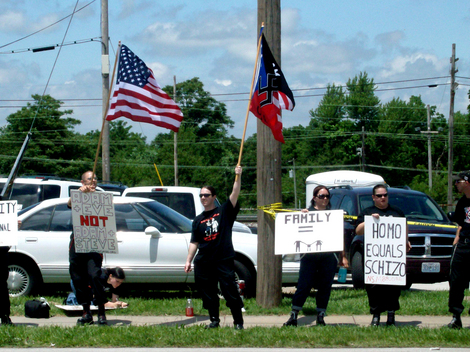
Yesterday, as planned, the National Socialist Movement (American Nazis) conducted a protest of gay pride in Springfield, MO.

springfieldnsm

According to video of the event, the National Socialist shouted “death to gays” at their rally.

A festival meant to celebrate the gay and lesbian communities in the Ozarks was met with mixed opinions Sunday afternoon.

The local chapter of the National Socialist Movement made their opnions (sic) heard at Pridefest.

Leaders with the Socialist movement say gays and lesbians are not welcome in Springfield.

The Minutemen United stood just to the side of the celebration.

They say they were praying for God to lift up the homosexual community.

The Minutemen United appear to be a Christian group who were there rallying against gay pride. It is not clear, but it does not appear that the MU were there to protest against the NSM.

The behavior of the NSM raises a significant challenge to the thesis of Kevin Abrams and Scott Lively about National Socialism and homosexuality. Abrams and Lively are founding members of the International Committee for Holocaust Truth. The first report from that small group proposed this thesis:

Hitler’s plans for a “1000 Year Reich,” is a “Homofascist” Conspiracy which still thrives today disguised as “gay” rights.

There is a problem with this thinking. The neo-Nazis in America yesterday shouted hatred at the same gay rights movement that Lively and Abrams consider the “homofascist conspiracy.” The NSM would like to implement “Hitler’s plans,” but this would mean “gays and lesbians are not welcome.” How can gays extend “Hitler’s plans” when they are not allowed in the Nazi movement? I really doubt the NSM would agree that the gay rights movement is true extention of “Hitler’s plans.”

(Here is a slideshow of the Pridefest and protests)

Update: The Minutemen United is a loosely organized bunch of men who are affiliated with Dave Daubenmire’s Pass the Salt ministry. On the front page of that organization’s website, there is a link to a podcast from Springfield, MO. There intent there was to do street preaching and evangelism at a gay bar and the Pridefest. According to this Springfield News-Leader report, some of the Christian groups, perhaps the MU included, also preached to the Nazis.

Prior posts in this series:

May 28 – Scott Lively wants off SPLC hate group list

May 31 – Eliminating homosexuality: Modern Uganda and Nazi Germany

June 3 – Before The Pink Swastika

June 4 – Kevin Abrams: The side of The Pink Swastika

June 8 – A historian’s analysis of The Pink Swastika, part 1

June 9 – A historian’s analysis of The Pink Swastika, part 2

June 11 – American Nazi movement and homosexuality: How pink is their swastika?

June 15 – Nazi movement rallies against gays in Springfield, MO

June 17 – Does homosexuality lead to fascism?

June 23 – The Pink Swastika and Friedrich Nietzsche

List of posts on Uganda and The Pink Swastika

Researchers question use of sexual abuse data

Today, researchers Ron Stall and Ron Valdiserri released a statement regarding use of their book, Unequal Opportunities: Health Disparities Affecting Gay and Bisexual Men in the United States by Focus on the Family writer Jeff Johnston.

The report they question was released recently by Focus and is titled: “Childhood Sexual Abuse and Male Homosexuality: Is there a link?” In that report, Johnston cites statistics from the book, along with quotes from other studies and an interview with Narth past-president Dean Byrd. Here are the relevant portions of the book edited by Stall, Valdiserri and colleague Richard Wolitski (all footnotes in this section are to the Unequal Opportunities book).

Many pro-gay researchers, activists and theorists deny that there could be a connection between child sexual abuse and adult homosexuality. Some possible reasons for denying this link are the stigma that surrounds sexual abuse; the fear of associating homosexuality with “recruitment” or pedophilia; and because so many gays continue to believe that homosexuality is inborn and immutable. In 2008, however, a group of researchers from the U.S. Centers for Disease Control and Prevention (CDC) published a book that documented the high rates of sexual abuse among “men who have sex with men (MSM).”[6]

In a chapter titled, “Childhood Sexual Abuse Experienced by Gay and Bisexual Men: Understanding the Disparities and Interventions to Help Eliminate Them,” from the book Unequal Opportunity, researchers analyze and report on data from 17 different studies from the past 15 years.[7] They find the rates of childhood sexual abuse (which they abbreviate as CSA) for men who have sex with men range from 11.8% to 37.0%, and note that “the best-designed studies tend to converge on CSA prevalence of 15% to 25%.”[8]

While most of those who perpetrate sexual abuse are men, abusers are not necessarily homosexual or gay-identified,[9] and the authors note that “in studies focusing on MSM, the perpetrators are always at least 90% male.”[10] The range of abuse varies in the different studies depending on the definition of abuse and the sample method.[11]

The researchers report that the rates of child sexual abuse for gay- or bisexual-identified men are significantly higher than those found among heterosexually-identified men. They write that the rates for heterosexual men are usually “less than 10%,” and state that in five studies that compared the two groups, the men who have sex with men are “at least three times more likely to report CSA, however defined, than heterosexual men.”[12] This finding is reiterated in their conclusion: “Rates for MSM are 15% to 25% in the best designed studies, which is at least triple the rates reported among heterosexual men.”[13]

Consequences of Sexual abuse

Children are not equipped emotionally, physically, spiritually or psychologically to handle adult sexuality. Individual boys will handle sexual abuse in different ways: what leads to shame and guilt in one child might lead to self-questioning and gender confusion in another or to anger and acting out in a third. Each child is unique, grows up in a unique environment and will respond in an individual way to sexual abuse or early sexual encounters with the same sex.

There are, however, common themes and outcomes that consistently emerge in studies of men who were sexually abused as children. Two common outcomes of sexual abuse – out of the many possible – are that boys may question their identity and be confused about their sexuality.

The followin quotes may have generated the most concern by Stall and Valdiserri:

The authors in Unequal Opportunity are reluctant to say that childhood sexual abuse is one of the factors that leads to or contributes to the development of homosexuality, but they do speculate,

The fact that most childhood abusers of MSM were males suggests either an etiological link between CSA and adult sexual orientation, or the existence of childhood characteristics that are related to adult sexual orientation in men that increase vulnerability, or both.”[23]

And later, they say that these early sexual experiences “can be considered a form of sexual learning, even if that learning is involuntary and the results dysfunctional.”[24] They continue, “Sexual orientation and gender identity can be particularly confusing for men who experienced arousal during the abuse, and MSM who experienced abuse may continue to be aroused by circumstances that mirror the abusive situation.[25]

Drs. Stall and Valdeserri’s statement is as follows:

We want to respond to a recent Focus on the Family characterization of scientific findings reported in our book, Unequal Opportunities: Health Disparities Affecting Gay and Bisexual Men in the United States (Oxford University Press) that misrepresented findings in the book to suggest that childhood sexual abuse causes male homosexuality. The Focus on the Family description of the findings reported in Unequal Opportunities is inaccurate and, in our opinion, a distortion of the scientific literature.

Most basically, the Focus on the Family characterization of the literature on childhood sexual abuse among gay men represents a misunderstanding of scientific approaches to distinguishing between correlation and causation. The book chapter in question reports that gay men are more likely to report childhood sexual abuse by men than are heterosexual men. This correlation does not mean that the reported abuse caused the adult sexual orientation. If that were the case, then the fact that some heterosexual men report sexual abuse by women means that sexual abuse by women “causes” heterosexuality in men. It is also worth noting that the argument that childhood sexual abuse causes homosexuality in gay men is undermined by the fact that the vast majority of gay men are not sexually abused as children.

One potential partial explanation for this correlation, and one that makes the most sense when you consider people of all orientations, is that some youth, particularly post-pubertal youth (who still cannot legally consent to sexual activity) have sexual experiences with males or females, depending on their pre-existing orientation. Let’s be very clear that this does not mean that these experiences are appropriate or healthy. However, it also does not mean that these experiences

caused the sexual orientation of the youth. The development of a person’s sexual orientation is a complex and multifaceted process. The research into these processes has barely begun, and the development of sexuality is very difficult to study. Mischaracterizations of the scientific literature on the development of sexual orientation is not helpful to science.

Rather than mischaracterize these findings, we would like to point out the harm to health that can be caused by childhood sexual abuse among boys and girls of all sexual orientations. Childhood sexual abuse occurs to far too many young Americans and a large and growing literature supports that this abuse can cause lifelong damage to the physical and mental health and wellbeing of men and women of all sexual orientations. We suggest that Focus on the Family and

other concerned organizations focus on how to work to ensure that all of our children remain safe from unwanted sexual experiences– whether heterosexual or homosexual.

That said, we want to state clearly that the published research does not support the claim that the development of a homosexual orientation is caused by childhood sexual abuse. Furthermore, adult homosexual orientation is no longer considered a pathology or a maladjustment. We urge those who are interested in trying to better understand some of these complex issues from a scientific perspective to read the discussions in our book, as well as the scientific literature on childhood sexual abuse, and not rely on second-hand interpretations.

Ron Stall

Ron Valdiserri

Related post:

A major study of child abuse and homosexuality revisited

American Nazi movement and homosexuality: How pink is their swastika?

Scott Lively’s book The Pink Swastika purports to demonstrate a link between Nazi aggression and homosexuality. He also discusses other atrocities which he blames on homosexuality in that book as well as another titled, The Poisoned Stream. In that book, he says in the introduction that he has found gay fingerprints on

the Spanish Inquisition, the French “Reign of Terror,” the era of South African apartheid, and the two centuries of American slavery. My thoughts have increasingly turned toward writing a larger, more comprehensive analysis of homosexuality in history. I have come to believe, with Samuel Igra, that homosexuality has truly been a “poisoned stream” in human history.

He does not elaborate but says another book is coming where he reveals his evidence. Just one more: Recently, in a speech before the Temecula Republican Party, he linked the Columbine school massacre to imagined homosexuality of the shooters. I examined that proposed link here.

If homosexuality was so associated with National Socialist ideals and aims, then shouldn’t the current Nazis be dominated by homosexuals? Lively believes that the German Nazis were animated by homosexuality while publicly opposing it. So if the American Nazis are anti-gay that perhaps means that they really are gay rights activists after all. So expressing the opposite of what you really believe is what they do with gay stuff but not other things. Like really, they love the Jewish people…

Anyway, for the record, here is what the American Nazi movement (NSM = National Socialist Movement) says about homosexuality:

What is the NSM’s view on homosexuality and child pornography?

Homosexuality is not a genetic defect. It is a chosen lifestyle and a mental sickness. Homosexuality is a social degeneracy that must be expunged from our society.

We as a civilized people cannot fall trap to the political correctness and turn a blind eye to this perverted lifestyle. It is not normal nor is it acceptable, and it goes against the laws of nature.

Homosexuals serve no greater purpose other than that of their own selfish greed. They contribute nothing to the further survival of our race. Our children are being inundated with the false ideas that homosexuality is normal and acceptable. They see it out in the public, in their schools, and on the TV programs they watch.

With homosexuality comes the threat of our children being at increased risk of sexual pedophiles, kidnappings, rapes, and murders. Most crimes involving the kidnapping, violation, and/or murder of children, were acts committed by homosexual prone monsters.

We can see the evil effects of social liberal acceptance of homosexuality by the increased number of pedophiles, child pornography cases, and kidnapping of children (in which most cases once this perverted animal has had its way with these poor innocent and helpless children, the child is murdered).

In a National Socialist Society, these individuals would receive an instant death penalty.

Now if you are viewing Nazi beliefs and homosexuality as related in some vital way, this might be a bit hard to explain. Maybe, in a Spongebob Squarepants opposite day kind of way, it could make sense, but otherwise, I am not getting it.

On the front of the website, readers are invited to sign up, but not all are welcome.

The NSM, America’s National Socialist Party, is the largest and most active National Socialist political party in America.

The NSM’s core beliefs include: defending the rights of white people everywhere, preservation of our European culture and heritage, strengthening family values, economic self-sufficiency, and reform of illegal immigration policies, immediate withdrawal of our national military from an illegal Middle Eastern occupation and promotion of white separation.

Party Membership is open to non-Semitic heterosexuals’ of European Descent. If you really care for your heritage and for the future of your family, race and nation, fill out a Membership Application today.

If you are under the age of 18 please have your parents read about the Party Viking Youth Movement.

Gays need not apply. So disappointing. And then there is this article on the website of the California branch:

Better fascist than gay – Mussolini’s granddaughter

Thu Mar 9, 2006 8:05 PM GMT

ROME (Reuters) – The granddaughter of Italy’s wartime dictator Benito Mussolini has defended being a fascist by saying it was better than being a “faggot”.

Alessandra Mussolini’s televised derogatory remarks came less than a month after Prime Minister Silvio Berlusconi welcomed her far-right political party into his coalition before a general election in April.

Mussolini, proud of her ancestral ties to “Il Duce”, had been criticised by a drag queen-turned-politician about being a fascist on Italian TV talk show Porta a Porta.

“I’m proud of it,” she snapped in comments due to be aired later on Thursday.

Vladimir Luxuria, who hopes to be Europe’s first “transgender” MP and is running with the Communist Refoundation party, then asked if Mussolini wanted to lock up homosexuals.

“Better to be a fascist than a faggot,” Mussolini said, using the highly offensive Italian word “frocio”, according to Porta a Porta’s press office.

It was not the first time one of Berlusconi’s allies publicly insulted homosexuals. Mirko Tremaglia, an outspoken right-wing minister for Italians living abroad, said in 2004 that Europe was ruled by “culattoni”.

The word derives from the Italian colloquial for bottom (culo) and refers to sodomists.

And then finally, there is this lovefest

planned for Springfield, MO on June 14.

NSM Springfield will hold a Protest Against Homosexuals

– ANNOUNCEMENT –

On June 14, 2009 Springfield, MO Unit will hold a Protest Against Homosexuals . This event is held every year on Commercial Street in downtown Springfield. The Glo Center sponsors this event and calls it family friendly, this means that there will be children attending. The Springfield Unit will be there along with other white nationalist and members of the community to let the homosexuals know that they are not welcome in our town and that we will not tolerate their “celebration”.

If you are interested in attending please contact [email protected] for more information.

No pink swastikas here.

Prior posts in this series:

May 28 – Scott Lively wants off SPLC hate group list

May 31 – Eliminating homosexuality: Modern Uganda and Nazi Germany

June 3 – Before The Pink Swastika

June 4 – Kevin Abrams: The side of The Pink Swastika

June 8 – A historian’s analysis of The Pink Swastika, part 1

June 9 – A historian’s analysis of The Pink Swastika, part 2

June 11 – American Nazi movement and homosexuality: How pink is their swastika?

June 15 – Nazi movement rallies against gays in Springfield, MO

June 17 – Does homosexuality lead to fascism?

June 23 – The Pink Swastika and Friedrich Nietzsche

List of posts on Uganda and the Pink Swastika

A major study of child abuse and homosexuality revisited

The role of child sexual abuse in sexual orientation has received some attention lately. In January of this year, a prospective study demonstrated that child sexual abuse was associated with ever engaging in adult homosexual behavior for males but not for females. The study by Widom and Wilson demonstrated that physical abuse or neglect did not associate with homosexuality, nor did sexual abuse predict same-sex cohabitation or current sexual partner. In other words, measures of behavior (living with a same-sex partner ever, or living with one in the last year) that would be more reflective of orientation were not associated with histories of child sexual abuse. For males, ever engaging in homosexual behavior, however, was associated with sexual abuse. Many observers are not surprised by this finding which indicates that sexual behavior is associated with past abuse but enduring orientation may not be.

Prospective studies are quite valuable since they help control for loss of memory, reconstructed memories, self-report issues relating to abuse and other sources of bias. This study used court records and followed up the abused persons 30 years after the fact.

In evangelical circles, sexual abuse is frequently offered as a major cause of homosexuality, if not the major cause. NARTH often points to the traumatic experience as an important factor. Recently, Focus on the Family promoted a paper by Jeff Johnston on the topic. Cited by Dean Byrd in that paper and often cited in this context is a study based on a 2000 doctoral dissertation by Marie Tomeo, titled “Sexual Orientation Development” and conducted at the California School of Professional Psychology. The journal article based on the dissertation was published by the Archives of Sexual Behavior in 2001 with the following reference:

Tomeo, M. E., Templer, D. L., Anderson, S., & Kotler, D. (2001). Comparative data of childhood adolescence molestation in heterosexual and homosexual persons. Archives of Sexual Behavior, 30, 535–541.

The study compared people at a gay pride parade with a straight sample drawn primarily from a university. The abstract reports the highlights:

In research with 942 nonclinical adult participants, gay men and lesbian women reported a significantly higher rate of childhood molestation than did heterosexual men and women. Forty-six percent of the homosexual men in contrast to 7% of the heterosexual men reported homosexual molestation. Twenty-two percent of lesbian women in contrast to 1% of heterosexual women reported homosexual molestation. This research is apparently the first survey that has reported substantial homosexual molestation of girls. Suggestions for future research were offered.

Demonstrating a difference between gay and straight groups on sexual abuse is not novel. Numerous studies have reported at least some difference with only a few reporting no difference in abuse frequency between groups. However, Tomeo did something that was relevant to her overall dissertation topic. She was interested in exploring sexual abuse as a potential causal factor. Tomeo’s prime research hypothesis was that homosexuals would report more sexual abuse than heterosexuals. She also wanted to know when a person identified as gay and when the abuse occurred. This is an important question for studies which seek to attribute cause to abuse. With some people being aware of same-sex attraction at very early ages, one cannot say any subsequent abuse caused their SSA. Simply finding a significant difference between gay and straight groups cannot tell you anything definitive about cause. Here are the first nine questions Tomeo asked her participants:

1. Do you regard yourself as predominantly a heterosexual person or predominantly a gay/lesbian person?

2. If predominantly of heterosexual orientation, at what age did you begin to regard yourself as heterosexual?

3. If predominantly of homosexual orientation, at what age did you begin to regard yourself as homosexual?

4. Before you were 16 years old, did you ever have sexual contact with a woman or girl 5 or more years older than yourself and at least 16 years of age? (YES NO)

5. IF YES, at what age did this first occur?

6. What was your relationship to the person with whom this sexual contact occurred?

7. Before you were 16 years old, did you ever have sexual contact with a man or boy 5 or more years older than yourself and at least 16 years of age? (YES NO)

8. IF YES, at what age did this first occur?

9. What was your relationship to the person with whom this sexual contact occurred?

For a study of causation, these questions clearly have their limitations. For one thing, when one regards oneself as homosexual probably occurs later (sometimes much later) than awareness of same-sex attraction. Perhaps one could offer a theory of identity formation which includes sexual abuse but such a theory would not of necessity be a theory of how one’s attractions take the direction they do.

In Tomeo’s reporting of her study in both the dissertation and the journal article, however, there is a much larger concern. There are contradictions in the paper and the dissertation between the results sections and the discussion sections. A crucial problem is the inability to be certain about when the abuse occurred – before or after awareness of same-sex attraction. In the Archives of Sexual Behavior article, the following statement is made on pages 540-541 (this same statement is identical to her closing discussion in the dissertation):

Sixty-eight percent of the present homosexual male participants and 38% of the present homosexual female participants (68 and 36%, respectively, if including just the homosexual fair participants) did not identify as homosexual until after the molestation. This suggests that if molestation resulted in homosexuality, this phenomenon occurs in a greater proportion of male homosexuals. It may not, however, be a casual factor in either gender. Perhaps children or adolescents with a higher potential for homosexual behavior are more likely to enter a situation that leads to same-sex molestation. It must also be borne in mind that the present homosexual participants may not be representative of homosexual persons. The overwhelming preponderance of homosexual participants was in the gay pride group. There were only three homosexual men and seven homosexual women in the college group.

The clear implication in this discussion section is that the frequency of homosexual identification was a consequence of the abuse. However, in the table which reported the data regarding timing of identification, the authors report the same percentage of males who reported identification as gay before the abuse. Table II on page 538 reports (click the link for a clearer view):
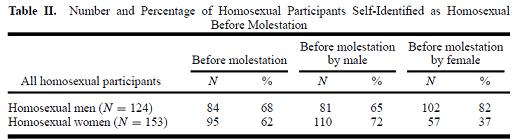
Tomeo et al 2001

Something is not right here.  If the table is correct, then the case for causation from this study is somewhat compromised. The table indicates that 68% of men identified as homosexual before their molestation experience.

My colleague Gary Welton and I first discovered this discrepancy nearly three years ago while preparing a scholarly article on the effects sizes of various suggested correlates of homosexuality (one which will be published later this year or early next year). At that time, I contacted Donald Templer, one of the co-authors and advisor to first author Marie Tomeo. I then contacted him again recently in preparation for this post. He has been unable to locate Dr. Tomeo to get clarification. I hope Dr. Tomeo can at some point clarify these matters.

Recently, I ordered the dissertation to check the original study. However, there are discrepancies in this document as well. First, here are the relevant research questions with results.

From page 36 of Marie Tomeo’s dissertation:

The 10th research question addressed, of homosexual women who were molested, what percentage were molested before self-identification as a homosexual woman and what percentage were molested after self-identification as a homosexual woman? Of homosexual women who were molested, 62% were molested before self-identification as a homosexual woman, and 38% were molested after self-identification as a homosexual woman.

On page 37, the other relevant result relates to men.

The 13th research question addressed, of homosexual men who have been molested, what percentage were molested before self-identification as homosexual men, and what percentage were molested after self-identification as homosexual? Of homosexual men who were molested, 68% were molested before self-identification as homosexual, and 32% were molested after self-identification as homosexual.

These results are at odds with the discussion sections of the dissertation and the journal. They are also at odds with the Table from the journal article. For what its worth, Dr. Templer thinks the correct data are in the Table from the journal article.

The bottom line is that the study should not be cited until a follow up correction can be made. The main results — gays report more abuse than straights — may indeed be correct, given the similarity to past studies. However, I do not believe any inferences about causation should be made. Without the actual surveys, there is no way a reader can figure out the results from the journal article and/or the dissertation.

One final thought, the research on sexual abuse among GLBT populations is often misused to make inferences about causation. There are many reasons why this line of research is important but causation is not at the top. Sexual abuse is a profoundly disruptive experience for many people and may contribute to a variety of negative outcomes in adulthood. Finding appropriate clinical and ministry responses may be clouded by focusing on the trauma as a cause of same-sex attraction.