WORLD investigates the Trinity Broadcasting Network

This story should cause a little concern among Christians who believe in the Seven Mountains teaching (the view that Christians must fill top spots in education, media, politics, entertainment, etc. in order to accomplish cultural renewal). Trinity Broadcasting Network is the largest Christian network and it has been plagued with scandal for years. WORLD’s Warren Cole Smith opens the door on another scandal at TBN working its way through the courts. Christians are not immune to the temptations which comes from wealth and power. Whatever the truth turns out to be, the inner workings of TBN, revealed in articles like this one, provide evidence that the fulfillment of the 7M teaching wouldn’t change much.

With this story, the articles on David Barton and past reporting (e.g., the Fellowship), WORLD fills an important niche among Christian media for investigative reporting.

Christian Reconstructionist Takes David Barton to Task for Faulty History in The Jefferson Lies

I don’t know how large American Vision’s audience is but I suspect there is at least some overlap between David Barton’s Christian nation audience and American Vision’s Christian reconstruction constituency.

If so, this article today by Joel McDurmon could cause Mr. Barton some heartburn. Mr. McDurmon offers a devastating analysis of Barton’s chapter on Jefferson’s faith. He begins his critique by grounding it in his worldview:

In short, when we create a false reality of what a Christian and biblical society is or may be, we blind ourselves to the real changes and sacrifices we need to make. And in stretching the facts to create that false reality, we discredit ourselves and hand power and opportunity over to liberals to have free reign. But in the end, we have no one to blame but ourselves, because we have deceived ourselves, lied, and become complacent in the first place.

This is why I wish to offer an overview and partial critique of the important factual errors in Barton’s book. It is important that Christians see and understand the depth of these so they can have a true foundation from which to plan and to move forward.

While I have strong differences with Christian reconstructionism, I understand this starting point. We started in a similar place in our book. We did not write it to attack Christianity (as if fact checking Barton is an attack on Christianity), we wrote the book to uphold our faith. A little later in the article, McDurmon calls me a liberal (compared to McDurmon, most people are liberals). It is all the more striking that McDurmon and I come to similar conclusions about the factual problems with The Jefferson Lies. As with other evangelical figures and groups (Chuck Dunn, Colson’s Breakpoint, World magazine), no one can accuse McDurmon and American Vision of being liberal.

I encourage readers to review the entire article, but here is a taste of McDurmon’s analysis of the claim that Thomas Jefferson was theologically orthodox throughout most of his adult years:

Yet Barton selectively quotes [Benjamin] Rush to give just the opposite appearance of Jefferson’s views. Indeed, he uses this sole piece of butchered evidence to prove his claim that “for nearly every Christian doctrine that Jefferson called into question in his last fifteen years, there were times in his earlier sixty-eight years when he had embraced that very same doctrine as orthodox.”[10] As we have seen, this is utter nonsense, and is unsupported by anything Barton has presented. It is not clear by any means that Jefferson at any time in his life held orthodox Christian views. That anyone would claim otherwise, especially upon such terrible evidence, is a disservice to both historical scholarship and the Christian faith.

With all of these exaggerated and outright dishonest claims about Jefferson, there is indeed one thing about Barton’s book that is apt: its title, The Jefferson Lies. They abound not only from the “academic collectivists” and “deconstructionists,” but in this book as well.

As such, it is no surprise that when alerted, Thomas Nelson reacted as quickly as it did.

Bam! By which I mean, he nailed it.

McDurmon closes by telling his readers that he cannot recommend the book because they would need to fact check everything.

While a book like this needs to be written vindicating Jefferson from much liberal nonsense, the reader nonetheless will need to fact-check nearly every claim Barton makes for accuracy. And this is way too much to ask of the average reader. If that is to be the task, it would be better to skip Barton’s book altogether and go read all of Jefferson’s papers directly, because that what the reader will have to do eventually anyway.

Or you can get Getting Jefferson Right where we do the heavy lifting and point you in the right way.

This article is a significant shift for American Vision. Currently, they are hosting, with Kirk Cameron, a cruise featuring the movie Monumental which prominently features David Barton’s stories. If McDurmon submits Barton’s work in Monumental to the same scrutiny as he did to The Jefferson Lies in this article, then there will be a need for a disclaimer at the beginning and end of that movie.


Did Thomas Jefferson Fund the Thompson Hot-Pressed Bible or Simply Buy One?

This post is an additional note to our earlier post on Jefferson and the 1798 Thompson Bible. To briefly recap, David Barton says his description of the situation is accurate; we say it is not. Here is what Barton said in The Jefferson Lies about the Bible, followed by what he told Kirk Cameron in the movie, Monumental. First in his book:

Furthermore, in 1798 Jefferson personally helped finance the printing of one of America’s groundbreaking editions of the Bible. That Bible was a massive, two-volume folio set that was not only the largest Bible ever published in America to that time, but it was also America’s first hot-pressed Bible. President John Adams, several signers of the Constitution and Declaration, and other major Founders joined with Jefferson to help fund that Bible.

Then, in Monumental, Barton said:

This Bible was funded by about a dozen signers of the Constitution and signers of the Declaration as well as by President John Adams and Vice President Thomas Jefferson. They’re the guys that put up the financial backing to do this Bible.

When you see this stuff, you go wait a minute. These guys…why would any atheist, agnostic, or deist promote the Word of God, fund it and want it distributed to every family and everyone in America?

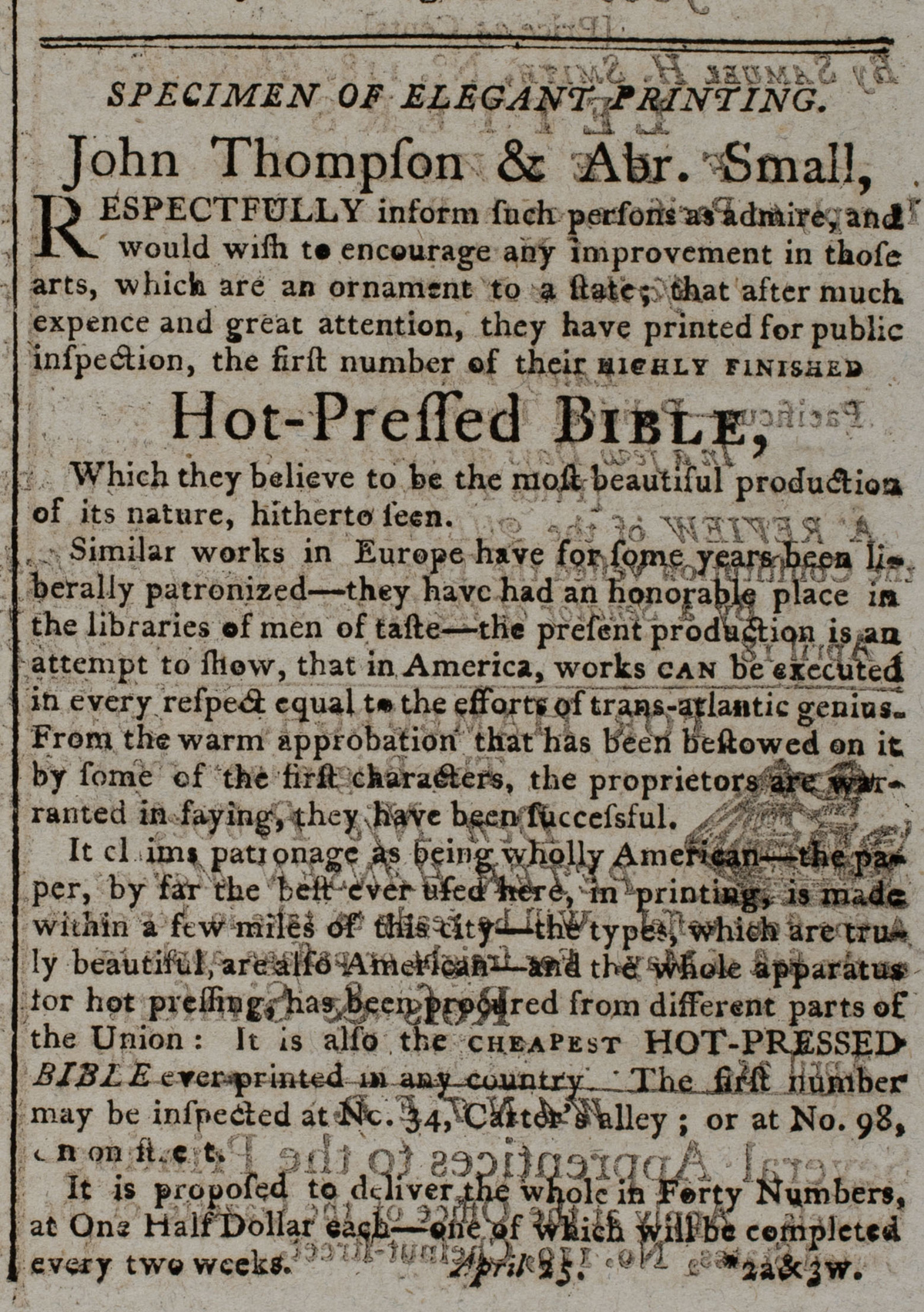
In our previous post, we noted that Jefferson did not finish paying for his copy of the Bible until January, 1799. In that post, we did not list all three payments. However, after getting some additional documentation, we can put together a little better picture of what probably took place. First, note this broadside dated January, 1798 advertising the Thompson Bible.
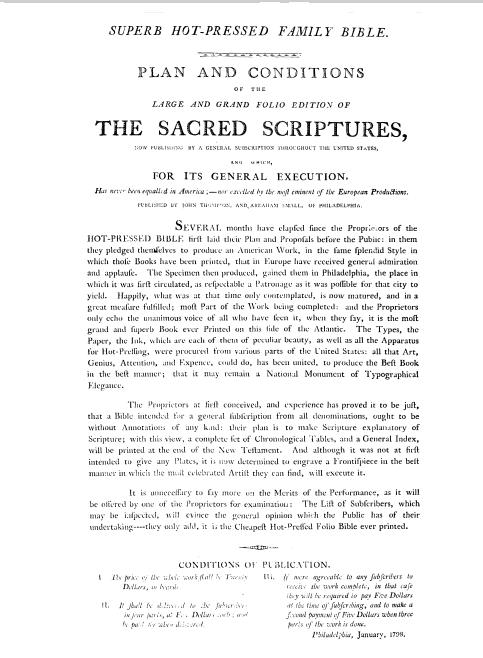
Figure 1

Because figure 1 is probably a little hard to see, you can click this link to see the PDF, generously provided by the American Antiquarian Society. We thank them for permission to use this image.

Remember that the first ad for this Bible was placed in the Gazette of the United States in April, 1796, also provided by the American Antiquarian Society. See figure 2 below:
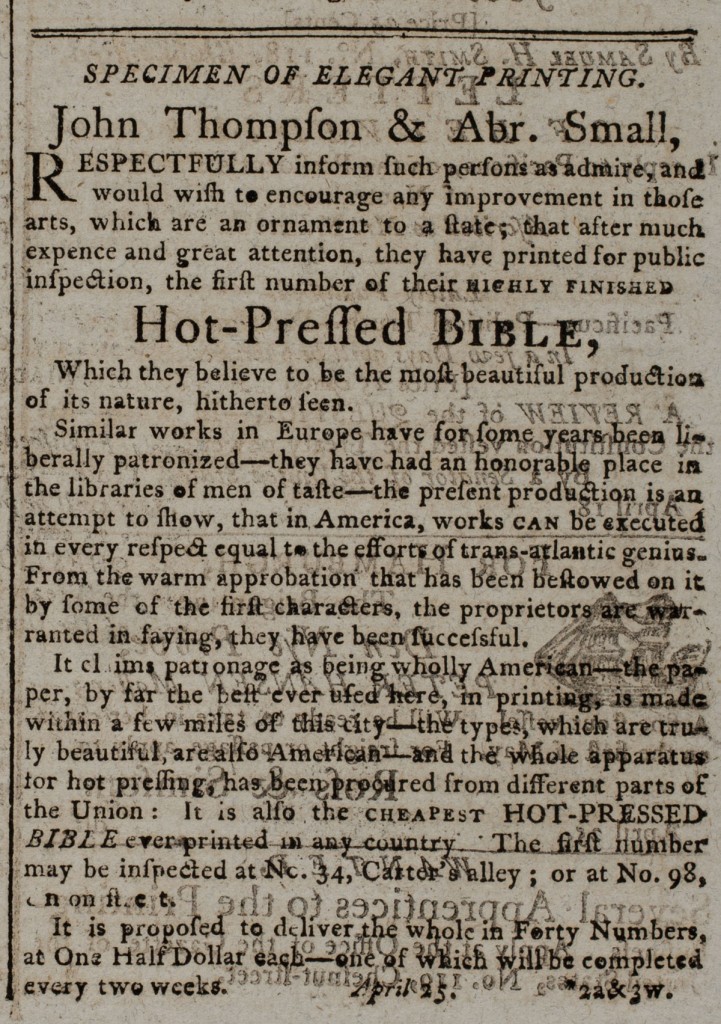
 Figure 2

Given the dates of Jefferson’s payments, he either didn’t see this ad or he saw it and did not decide to do anything about it until about two years later.

The date on figure 1 above titled, “Superb Hot-Pressed Family Bible” is January, 1798. Jefferson’s first payment of $5.00 was made the following month on February 26, 1798. He must have seen the ad and it either jogged his memory that he wanted a copy of this Bible or he decided at that point that he would buy one. By that time, the Bible was mostly completed. Consider the text of the ad:
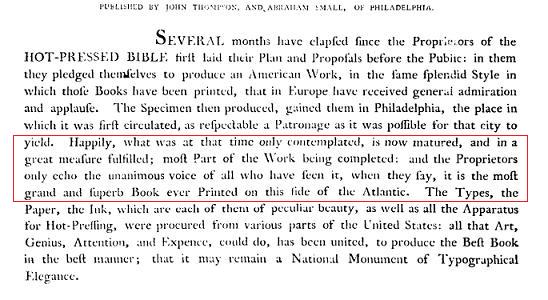
Figure 3

The section in red in figure 3 is especially important: “Happily, what was at that time only contemplated, is now matured, and in a great measure fulfilled; most part of the Work being completed: and the Proprietors only echo the unanimous voice of all who have seen it, when they say, it is the most grand and superb Book ever Printed on this side of the Atlantic.” The Bible was almost complete for the first wave of buyers.

To Jefferson who once said, “I cannot live without books,” this ad must have been irresistible. The Bible was almost complete and the proprietors, rightfully proud of their accomplishment, wanted to offer their “grand and superb book” to a wider audience. Those who had not subscribed at the beginning could still get in on the action. The terms of the purchase were spelled out by Thompson and Small at the end of the broadside (click the image to enlarge it).
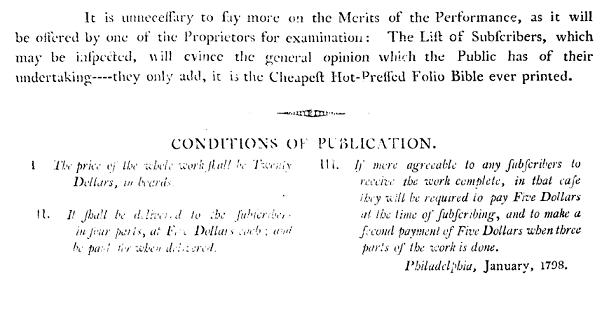
Figure 4

Note that a list of subscribers (hundreds by this time – see the full lists in Getting Jefferson Right) was already available for a potential buyer to examine. Then also see the “conditions of publication” in figure 4. Jefferson apparently agreed to the third approach because his first payment of $5 was recorded on February 26, 1798 (“Pd. 5.D. in part of 20.D. subscription for a hot press bible“*) with his second payment of $5 was made on May 26, 1798 (“Gave order on do. in favr. Thompson & Small in part subscription for bible 5.D.“), presumably when “three parts” of the work was done. His final payment of $10 was made on January 5, 1799 (“Gave Thompson & Small ord. on J. Barnes for 10.D. the balance due for a hot press bible.“).

It should be now abundantly clear that Thomas Jefferson did not specially finance or go together with other founders/signers to “put up the financial backing” for this Bible in the manner implied by David Barton in his book and in the movie, Monumental. He purchased one Thompson Bible using a payment plan.

*Citations from Jefferson’s Memorandum Books: Accounts, with Legal Records and Miscellany, 1767-1826, Vol. II, Eds. J.A. Bear & L.C. Stanton, (Princeton: Princeton University Press. 1997), pp. 979, 984, 996.

Earlier posts in this series:

Jefferson and Slavery: A Response to David Barton on the Glenn Beck Show, Part One

Jefferson and Slavery: A Response to David Barton on the Glenn Beck Show, Part Two

Jefferson and Slavery: A Response to David Barton on the Glenn Beck Show, Part Three

Jefferson and the Bible: A Response to David Barton on the Glenn Beck Show, Part Four (This post also discusses the Thompson Hot-Pressed Bible)

Jefferson and the Bible: A Response to David Barton on the Glenn Beck Show, Part Five
Jefferson and the Bible: A Response to David Barton on the Glenn Beck Show, Part Five

When David Barton was clearing the air on the Glenn Beck Show (8/16/12), he muddied the water regarding Jefferson and the so-called Jefferson Bible.  Here is the segment:

Barton begins by saying

He [Jefferson] cut out the passages and put them all together and he told his friends this is what we can use with the Indians, cause you can read the life of Christ here.

Glenn Beck lets this claim go without challenge. However, this is an astonishing claim. We have not been able to find any primary source evidence for it, and Barton doesn’t offer any. Jefferson’s only reference to Indians in relationship to the 1804 version is the title page:

The Philosophy of Jesus of Nazareth, extracted from the account of his life and doctrines, as given by Matthew, Mark, Luke, and John; being an abridgment of the New Testament for the use of the Indians, unembarrassed with matters of fact or faith beyond the level of their comprehension.

While this sounds like Jefferson may have had some interest in getting his book to the Indians, there are no primary source documents that support this conclusion. The only references to the story told by Barton we can find is in Henry Stephens Randall’s 1858 biography of Jefferson and in the introduction to the 1820 version by Cyrus Adler. First, Randall cites a reference to Indians in an undated letter from Jefferson’s grandson, Thomas Jefferson Randolph:

His moral character was of the highest order founded upon the purest and sternest models of antiquity, softened chastened and developed by the influences of the all pervading benevolence of the doctrines of Christ which he had intensely and admiringly studied. As a proof of this, he left two codifications of the morals of Jesus — one for himself, and another for the Indians; the first of which I now possess, viz., a blank volume red morocco gilt lettered on the back “The Morals of Jesus” — into which he pasted extracts in Greek, Latin, French, and English taken textually from the four Gospels and so arranged that he could run his eye over the readings of the same verse in four languages. (p. 671)

In a footnote on page 452, Randall wrote:

This is sometimes mentioned as Mr Jefferson’s “Collection for the Indians,” it being understood that he conferred with friends on the expediency of having it published in the different Indian dialects as the most appropriate book for the Indians to be instructed to read in.

In The Jefferson Lies, Barton does not cite any source for his contention that Jefferson gave his 1804 version to missionaries, or to anyone to use with the Indians.

In any case, Randolph’s knowledge of the “codifications” was second hand. A little later in his letter to Randall, Randolph said, “His codification of the Morals of Jesus was not known to his family before his death and they learnt from a letter addressed to a friend that he was in the habit of reading nightly from it before going to bed.” It appears that his family did not know he cut up the Gospels. Randolph’s knowledge of the 1804 version did not come from Jefferson directly. The most likely scenario is that Randolph took the title page at face value without knowing what Jefferson had told his friends: the 1804 effort was done for his own use. There is another report from Cyrus Adler by a great granddaughter of Jefferson that the extraction was for the use of the Indians but there is no indication that Jefferson said this to anyone beyond the title page of the 1804 version.

Thus, the Randall and family reports are not based in any direct knowledge of Jefferson’s intent. Barton presents no primary source verification which is consistent with our findings as well. As we noted in Getting Jefferson Right, we searched for evidence regarding this claim, and we asked the same of the Monticello  Library research staff as well. Nothing turned up. If Mr. Barton has correspondence or some primary source evidence that Jefferson gave the 1804 to anyone, he should produce it. As it stands the report of the Randolph family members and the footnote in Randall’s biography cannot be verified. The story of Jefferson giving his edited Gospels to missionaries for use with Indians appears to be similar to the story of George Washington and the cherry tree.