The President is releasing his long form birth certificate today.
Trump and Franklin Graham may have pushed the right/wrong buttons.
So will this calm the storm? Open forum – what will the new objections be? What will birthers say about this development? And what new and startling findings will we see?
Been pretty serious around here for a spell, let’s have some fun with this.
And here it is…
I wonder if this thread will finally die? (2800 comments and counting)
Year: 2011
AP report: Bahati says death penalty to be dropped from antigay bill – UPDATED
He told me this months ago, but Bahati seems to be wanting to get some attention back on Uganda’s Anti-Homosexuality Bill.
at 11:25 on April 26, 2011, EDT.
AP Interview: Death penalty provision in Uganda’s anti-homosexual bill likely to be dropped
The Associated Press
KAMPALA, Uganda – The Ugandan parliamentarian behind an anti-homosexual bill that attracted worldwide condemnation says the most controversial part of the proposed legislation — the death penalty provision — is likely to be dropped.
David Bahati says if the committee the bill currently sits before recommends that the provision be removed, that he would concede the issue.
Stephen Tashobya, the chairman of the parliament’s Legal and Parliamentary Affairs Committee, said Tuesday that he would try to bring the bill up for a vote before parliament’s current session ends May 12.
After Bahati’s bill was proposed in 2009, it attracted international condemnation, including from President Barack Obama. The bill has since languished in committee.
UPDATE: The full AP article is much longer than this short version.
Read it here.
It does sound like Stephen Tashobya intends to get the bill a vote. Given the information, I have been getting from close to the Cabinet, this will not be viewed favorably by the ruling party. An alternative view is that a focus on homosexuality might take the minds of the people off of the recent riots and arrests of opposition party leaders.
David Barton on Thomas Jefferson – Gnadenhutten and the Christian Indians
Last Thursday, I wrote about my appearance on the Paul Edwards radio show, just after David Barton was on to respond to my series on Thomas Jefferson. During his time, Barton claimed that Thomas Jefferson signed an act three times “to propagate the gospel among the heathen.” Here are Barton’s exact words:
The actual quote out of all three acts was “to propagate the gospel among the heathen.” Now, when you take the context of those three federal acts, and you know, you can check the acts, March 3rd, 1803, March 19, 1805, I can give you the dates, you can look them all up and read it. It says, ‘for propagating the gospel among the heathen.’ Now this is not a territory exchange, by the way, and even if it were, let’s say the United States today makes some kind of territory exchange with the Cherokee tribe in North Carolina, or Oklahoma, what do you think happens if the federal government puts in money to pay a Catholic priest, or to build a Catholic church, even if that’s what the Cherokees want?
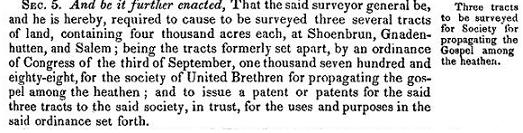
I demonstrated on Thursday that Congress, on June 1, 1796, provided land to Christian converts from among the Delaware tribe via a trust to a group called “The Society of United Brethren for Propagating the Gospel Among the Heathen.” Just to be clear, here is an image of the title of the bill:
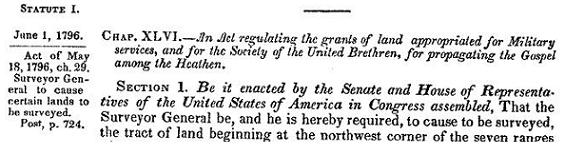
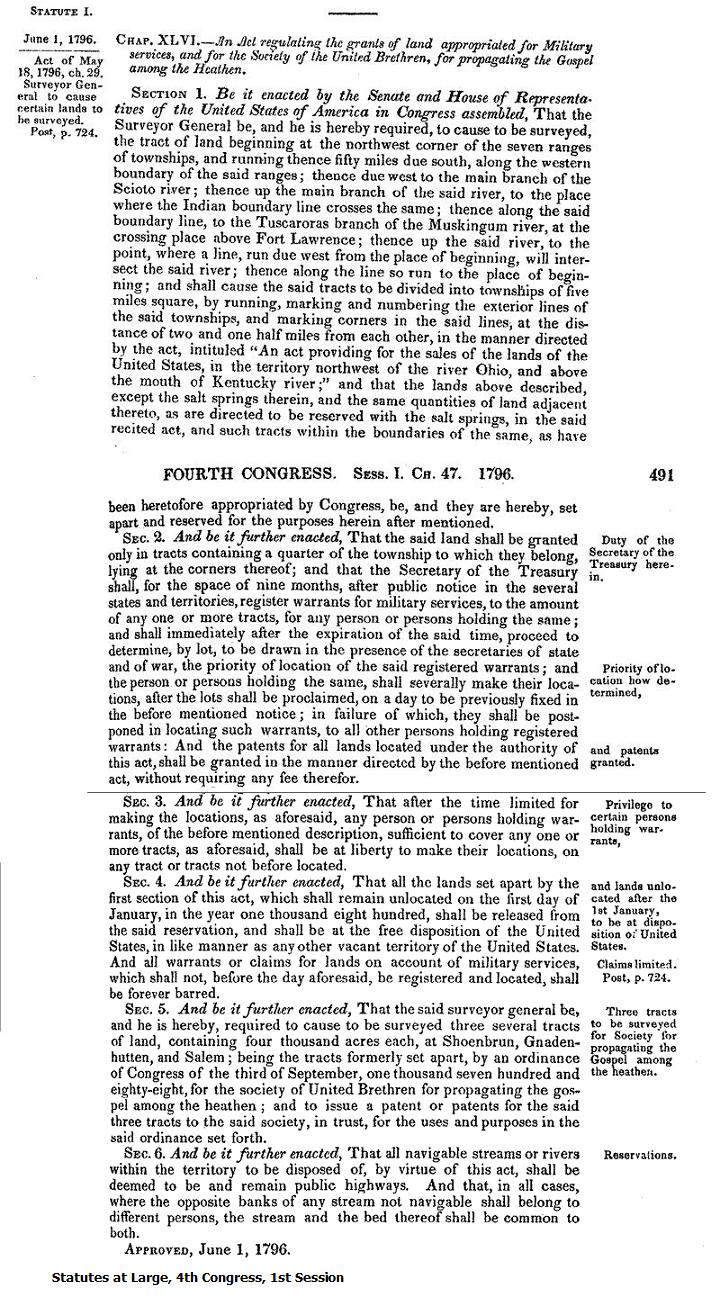
Note the the 1796 bill, enacted when George Washington was President, was titled, “An Act regulating the grants of land appropriated for Military services, and for the Society of the United Brethren, for propagating the Gospel among the Heathen.” (Click the link to see the entire Act). Over a decade after the Delaware converts and the Brethren missionaries had been displaced to Northern Ohio, the Congress made arrangements for the Society of Brethren to take trust of the land on behalf of the Christian Indians. As the language of the Act makes clear the phrase “propagating the gospel among the heathen” was a part of the legal name of the responsible organization.
As I noted last Thursday, Jefferson later renewed the act for the purposes of providing new law relating to military lands, with nothing new regarding the Brethren or the Christian Indians. The Society’s name remained in the title of the Act, which is apparently where David Barton comes up with his claims about Jefferson. Once the original act was signed by Washington, the Brethren went to work trying to rebuild the mission in Eastern Ohio. Eventually, the Society ceded the land back to the federal government because the converts did not return in sufficient numbers to make the mission viable.
The narrative developed by Barton is misleading and obscures the situation. All Jefferson did was approve bills that had a religious society’s name attached to the title.
I am reviewing this again because I continue to be bothered by Barton’s appropriation of this story as evidence for his view of Christian America. This bothers me for at least two reasons. First, he does an injustice to the historical record which includes the initial Northern relocation of peaceful elements of the Delaware tribe, and the massacre at Gnadenhutten. The Christian converts were marched to Northern Ohio and left there without provisions. Then when a group returned to Gnadenhutten to find food, they were brutally killed by the Pennsylvania Militia. The Society of the Brethren had to constantly bring the horrible treatment suffered by the native people to the attention of the “Christian nation” in order for even the most basic of response, years later. Barton’s narrative misrepresents the role of federal government and minimizes the Gnadenhutten atrocity.
Second, Barton complained on the Paul Edwards program that liberals would protest if the federal government today used funds for religious purposes with Native Americans, apparently oblivious to the fact that the federal government pushed Christianity on Native American tribes until early in the 20th century. Native children were removed from their families in elementary school and sent away to boarding schools, sometimes run by church groups. They were forbidden to speak their language or follow native customs. Some recall harsh punishments if the rules were violated. Even Christian Native Americans say that the treatment was demeaning. By using the treatment of Native Americans as evidence for his vision of Christian America, Barton inadvertently demonstrates at least one peril of his construction.
Next: Did Jefferson authorize the Capitol for church services and/or order the Marine Band to act as a worship band?
Previously:
David Barton on Thomas Jefferson – United Brethren and the Christian Indians
David Barton on Thomas Jefferson – In the Year of Our Lord Christ
David Barton on Thomas Jefferson: The Kaskaskia Indians
Was the Jefferson Bible an evangelism tool?
More on Thomas Jefferson and Christianity
David Barton: Pluralism not the goal of the First Amendment
Related:
Did the First Amendment Create a Christian Nation?
Switchfoot – Dare You to Move
It is a good Friday indeed.
David Barton on Thomas Jefferson – United Brethren and the Christian Indians
Yesterday, David Barton and I were on the Paul Edwards radio program, although at different times. Mr. Barton did not want to be on the show at the same time, so he went first and responded to my series on Jefferson and then I followed.
The podcast is here (April 20 show) which contains the entire program (start at about 1:23:23 for both segments).
During the program, Barton said that the difference in our views on the Kaskaskia tribe treaty was related to semantics. He believed that federal funds being used for the subsidy of a priest was significant even though the funds were given to a sovereign nation. However, I maintain that it is simply misleading to say that Jefferson approved funds to evangelize the tribe when the tribe was already predominantly Catholic.
Then Barton said that I might be unaware that Jefferson also approved assistance to the Moravians “to propagate the Gospel among the Heathen.” I was aware of this situation and want to report some of what I found.
The story of the Christian Indians in Ohio is a long one and quite involved. I am going to describe the situation as briefly as possible. Let me start at the end. In 1823, Indian converts to Christianity affiliated with the United Brethren church ceded three tracts of land to the government. You can see a copy of the Schedule of Indian Land Cessions here. Note the information regarding the “Moravian or Christian Indians.” The information is also archived on the Library of Congress website.
Date: March 3, 1823
Where or how concluded: Act of Congress.
Reference: Statutes at Large, Volume III, page 749.
Tribe: Moravian or Christian Indians.
Description of cession or reservation: Congress, by the provisions of this act, appropriated $1,000 with which to purchase and extinguish the Indian title to three tracts of land, containing 4,000 acres each, lying on Muskingum river, in Tuscarawas county, Ohio. These tracts were as follows:
1. One tract of 4,000 acres at Shoenbrun
2. One tract of 4,000 acres at Gnadenhutten
3. One tract of 4,000 acres at Salem
Historical data and remarks: An ordinance of Congress of Sept. 3, 1788, set apart three tracts of 4,000 acres each at Shoenbrun, Gnadenhutten, and Salem, on Muskingum river, for the Society of United Brethren, to be used in propagating the gospel among the heathen. By act of Congress approved June 1, 1796, provision was made for surveying and patenting these tracts to the society in question, in trust for the benefit of the Christian Indians. Under the provisions of the act of Mar. 3, 1823, Lewis Cass was appointed to negotiate for the relinquishment of the title to the U. S. This he secured and transmitted the relinquishment of both the society and the Indians to the War Department, under date of Nov. 19, 1823, and by act of May 26, 1824, Congress made provision for the disposition of the lands.
At first glance, it does appear that the government in 1788 set apart land in Ohio “to be used in propagating the gospel among the heathen” by the Society of United Brethren. Indeed, the government did authorize land to Indian converts of missionaries from the United Brethren church. However, this initially was done for the purpose of returning them to land which rightfully belonged to them.
One can read the full history of the Delaware tribe converts here. Essentially, the United Brethren church had a long history of mission work among various tribes in Pennsylvania, much of it conducted by David Zeisberger. Facing a need to move his work westward, Zeisberger and some of his converts traveled to what is now eastern Ohio, near New Philadelphia in 1772. The Brethren mission was successful in that other settlements of native converts were established. However, they soon became embroiled in conflicts with the Americans and the British during the Revolutionary War. While the mission communities wanted to remain neutral, both sides along with other Indian tribes distrusted the “Christian Indians” as they came to be called. The situation was so bad that by 1781, the settlers were relocated near Sandusky.
In 1782, some of the Indians returned to Gnadenhutten, Then, in March, a group of Pennsylvania militiamen attacked the mission at Gnadenhutton, killing all men, women and children. The residents of the mission were unarmed and taken captive by stealth, in a particularly gruesome atrocity.
United Brethren John Ettwein wrote Congress in 1783, just after the Revolutionary War ended asking for an investigation into the massacre and for assistance in securing the Indian survivors rights to their land near Gnadenhutten. There were several letters between Ettwein and Secretary of the Congress, Charles Thomson. Here is a 1784 letter from Thomson to Ettwein:
Letters of Delegates to Congress: Volume 21 October 1, 1783 – October 31, 1784
Charles Thomson to John EttweinSir, Annapolis 7 April 1784
I received by last post your letter of the 4 of March, and have to inform you that agreeably to my promise I laid your Memorial before Congress on the first of November last. It was then read and referred to a Committee, who reported thereon the 31 of March.(1) I presume the unsettled state of Congress and the want of a full representation rendered it in their opinion unnecessary to report sooner. The report is favourable. It has been read and now lies before Congress for their determination but at what time they will take it up I cannot say. It might not be amiss to write to some of the delegates of Pensylvania or of any other state you may be acquainted with and engage them to bring it forward.(2) You may rest assured I shall as far as in my power favour the cause of those unhappy people and most heartily wish your laudable endeavours to promote their spiritual and temporal Welfare may be crowned with success. I am, Sir, Your obedt humble Servt.
Cha Thomson
RC (PBMCA: Ettwein Papers).
1 For the committee report on Ettwein’s October 31, 1783, memorial to Congress on the plight of the Moravian Indians in the aftermath of the Gnadenhutten massacre of March 1782, see Committee of Congress Draft Resolve, March 31, 1784. Ettwein’s.
It is clear that the United Brethren petitioned Congress to repair the situation and provide relief to the Christian converts of these settlements. Eventually, that is exactly what Congress did. On July 27 1787, Congress resolved to set aside 10,000 acres along the Muskingum River for them and named the Brethren as those who would hold the trust (Congress finally made the trust law in 1796). In July of 1787, the Brethren had not organized in such a way that they could manage the trust, so the document referred to a society which had already been engaged in promoting Christianity among the natives. The document stated
Whereas the United States in Congress Assembled have by their ordinance passed the 20th May 1785 among other things Ordained “that the Towns Gnadenhutten, Schoenbrun and Salem on the Muskingum and so much of the lands adjoining to the said Towns with the buildings and improvements thereon shall be reserved for the sole use of the Christian Indians who were formerly settled there, or the remains of that society, as may in the judgement of the Geographer be sufficient for them to cultivate”.
Resolved That the board of treasury except and reserve out of any Contract they may make for the tract described in the report of the Committee which on the 23d instant was referred to the said board to take order, a quantity of land around and adjoining each of the before mentioned Towns amounting in the whole to ten thousand acres, and that the property of the said reserved land be vested in the Moravian Brethern at Bethlehem in Pennsylvania, or a society of the said Brethern for civilizing the Indians and promoting Christianity, in trust, and for the uses expressed as above in the said Ordinance, including Killbuck and his descendants, and the Nephew and descendants of the late Captain white Eyes, Delaware Chiefs who have distinguished themselves as friends to the cause of America.
Later that same year, in September, The Society of the United Brethren for propagating the Gospel among the Heathen was organized in order to further their mission and to act as the holder of the trust. From a history of the society:
In the year 1787 an event took place, which seems to promise much for the future service of the mission among the Indians. A society called The Society of the United Brethren for propagating the Gospel among the Heathen, in imitation of the Society for the furtherance of the Gospel established by the Brethren in England forty-six years ago. This society consists of all the elders and ministers of the congregations of the United Brethren ia North America and many other members chosen at their request and with the consent of the Society. They held their first meeting on the 21st of September 1787 at Bethlehem inPennsylvania, and February 27,1788, this society was declared and constituted a body politic and corporate by the state of Pennsylvania.
What about Jefferson?
The Society was referred to in future legislation which makes it seem as though the federal government continued to support evangelization of the Delaware. As I demonstrated, however, the actual purpose of the government intervention was to protect the property rights of the Bethren converts, a group which had been brutalized by the Pennsylvania militia. The Gnadenhutten massacre required a just and reparative response.
Eventually, Thomas Jefferson signed reauthorizations of this act (which also included regulations for military land) which is source of the claims that Jefferson authorized Christian evangelization of the Indians. For instance, he signed this bill which contained the Society’s name and for all the world makes it seem as though Jefferson was supporting the Brethren’s evangelism. However, if you review the bill, there is nothing in it about Indians or religion, beyond the title of the bill. The first bill accomplished two purposes, one relating to military land, the other relating to the Delaware tribe. Once the reparations were accomplished, the bill retained the same name but the content was about the military land tracts. Read it and see. The title of the bill retained the reference to the Society but no additional funds were authorized for religious purposes.
So when Barton says that Jefferson signed bills authorizing the “propagation of the gospel to the heathen,” he is not telling the whole story. Some might think this is a minor point. However, I am really troubled that Barton did not tell the whole story of the Gnadenhutten massacre and the real purpose of the involvement of the federal government with the United Brethren and the Christian Indians. By making these bills about Jefferson and his alleged support for religion, Barton minimizes an atrocity committed against native people. When one examines this episode in context, it is clear that the federal government did not simply decide to give money to the United Brethren in order for them to “propagate the gospel among the heathen.” The federal government gave a trust to a group of people who organized as “The Society of the United Brethren for propagating the Gospel among the Heathen” for the purpose of helping the brutalized Indians return and keep rights to their lands. If there had not been a displacement, or an atrocity, there would have been no need for federal involvement in this case.
For an even more detailed account of the story see Chris Rodda’s book, Liars for Jesus. Since I started this series, several readers have referred me to her book. I resisted reviewing it until today because I wanted to do my own research. I did however, consult her chapter on the Brethren and found it corresponds to what I found but reports much more detail and background.
You can also catch the audio in a blog post at Right Wing Watch which reported on the Paul Edwards program as well.
Next (probably next week), what was Jefferson’s role in church services at the US Capitol?
Previously:
David Barton on Thomas Jefferson – In the Year of Our Lord Christ
David Barton on Thomas Jefferson: The Kaskaskia Indians
Was the Jefferson Bible an evangelism tool?
More on Thomas Jefferson and Christianity
David Barton: Pluralism not the goal of the First Amendment
Related:
Did the First Amendment Create a Christian Nation?