The Trail of Tears was a low point in American history when the United States government brutally carried out a systematic removal of Native Americans from locations throughout the South to the Indian Territory (now eastern Oklahoma). Broadly the forced removal began in 1830 with the signing of the Indian Removal Act and culminated in the forced death march of the Cherokee in 1838 and 1839 where 4,000 of an estimated 17,000 travelers died. The last Cherokees arrived in present day Oklahoma in March, 1839.
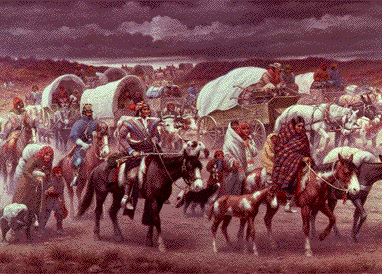
The Trail of Tears has been obscured in the retelling of American history. It seems obvious that the American Family Association does not grasp the significance of the event and has spread misinformation to their millions of listeners and readers about the relationship of the United States and native peoples.
This is not a partisan issue. In 2004, conservative Senator Sam Brownback authored a resolution apologizing to the Cherokee and other native people for the Trail of Tears. It was not passed until 2009 and signed by President Obama on December 19, 2009. According to the American Family Association and Bryan Fischer, the US had nothing to apologize for.
In a small way, I want to remember this sad and regrettable time in our history. We must never forget the consequences of supremacist thinking and pledge, never again.
The first print is called the Shadow of the Owl.
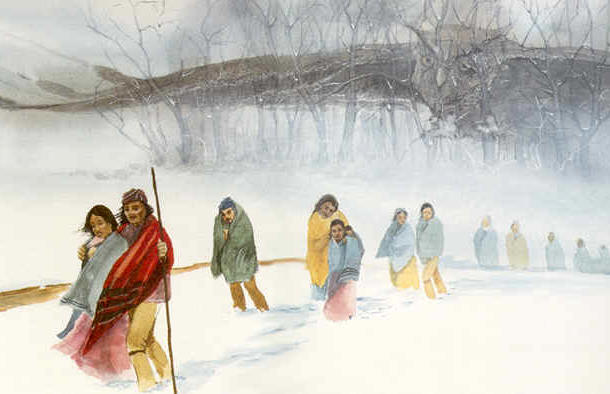
The one below is titled “Trail of Tears” Robert Lindneux, 1942. Granger Collection New York, NY.
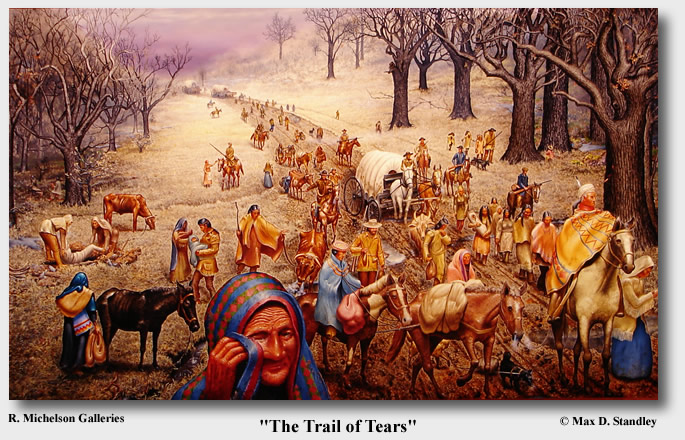
This one is attributed to Max Standley.
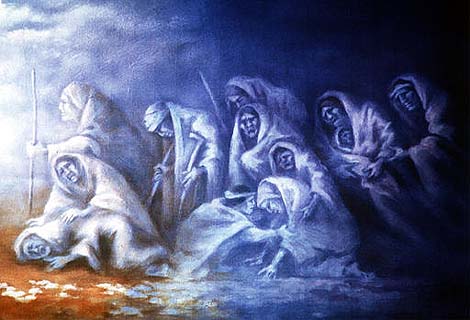
I am unable to find the creator of the following stunning portrait.
This article on the CNN website from November, 2010, provides a narrative of the US treatment of Native Americans.
In 1838, Gen. Winfield Scott arrived in Georgia and began rounding up those Cherokees who would not leave willingly. Some 16,000 members of the tribe were herded into makeshift prisons. Scott’s men seized women and children first to guarantee that the men would come out of hiding to protect them.
The Cherokees were then forced into wagons, often at bayonet point. As they left their ancestral land, some saw Georgians digging up family graves, looking for silver jewelry. For five months, they were jolted along the route from Georgia to Oklahoma that became known as the Trail of Tears.
Northern missionaries who shared the ordeal testified to families wrested from their homes so suddenly that they had nothing to protect them against the freezing winter rains. Pneumonia and exhaustion carried off the old and the very young. Although estimates vary about how many did not survive, wagon trains stopped every day for rough burials along the roadside.
As the US apologized to ancestors of indigenous people, I believe the AFA owes them an apology for these recent articles from Bryan Fischer. If Sam Brownback can see the need for reflection and remorse, then surely the AFA can see the need to publicly recant and apologize for this Fischer authored statement:
Had the other indigenous people followed her [Pocahontas] example, their assimilation into what became America could have been seamless and bloodless. Sadly, it was not to be.
What is also sad is the effort to shift the responsibility for the atrocities to those who suffered them.
Other posts on this topic:
Does the AFA agree with Bryan Fischer about Native Americans? – 2/28/11
Native American columnist blasts Bryan Fischer’s “ugly article” – 2/24/11
Bryan Fischer speaks with forked tongue – 2/22/11
AFA divided over Bryan Fischer’s views on Native Americans – 2/14/11
Bryan Fischer explains why the AFA pulled his column on Native Americans – 2/11/11
Native American group: Bryan Fischer’s article “not worth dignifying” – 2/10/11
Bryan Fischer prefers European depravity to the native kind – 2/8/11
I have a couple of Jonny Hawk paintings that deal with the Trail of Tears. His work in that are is somewhat ethereal; and that last painting reminds me of his work. One of mine has a male leading a horse carrying his wife and a child through a snow storm. Another shows a group of people walking away from the viewer and then they are in a tear-drop lifted a bit off the ground and further away and then again the same but higher and further way, and again the same until they disappear in the sky. His work is rather evocative. I also have one of his signature red-tail hawk feathers. But Jonny wasn’t a Cherokee, he was from the Creek and Seminole tribes.
I think the following quote from Archbishop Desmond Tutu is quite apt to what happened to the Cherokee, and actually, quite a number of Native Americans.
A Native American professor told my adult daughter in a multi-cultural class: “We all have our Trail of Tears.”
It was a gracious and collaborative comment, grounding her in all the world’s suffering and the need for forgiveness.
We all have our Trail of Tears…so Love your neighbor as yourself.
“According to the American Family Association and Bryan Fischer, the US had nothing to apologize for.”
And I bet these hypocrites would be 1st in line to demand an apology for the Bataan Death march.
The US (and british colonists) have had a long sad history regarding the Native Americans. Sadly, people like Fischer only make it worse.
As published in “The Story of the Cherokee People” by Tom B. Underwood, Cherokee Publications, 1961.
“Birthday Story of Private John G. Burnett, Captain Abraham McClellan’s Company, 2nd Regiment, 2nd Brigade, Mounted Infantry, Cherokee Indian Removal 1838-39.
“This is my birthday December the 11th 1890, I am 80 years old today…I grew into manhood fishing in Beaver Creek and roaming through the forest hunting the Deer, the wild Boar and the timber Wolf… On these long trips I met and became acquainted with many of the Cherokee Indians, hunting with them by day and sleeping around ther camp fires by night… The removal of the Cherokee Indoans from their life long homes in the year of 1838 found me a young man in the prime of life and a Private soldier in the American Army. Being acquainted with many of the Indians and able to fluently speak their language, I was sent as interpreter into the Smokey Mountains, and witnessed the execution of the most brutal order in the history of American warfare…One can never forget the sadness and solemnity of that morning. Chief John Ross led in prayer and when the bugle sounded and the wagons started rolling many of the children rose to their feet and waved their little hands good-bye to their mountain homes, knowing they were leaving them forever. Many of these helpless people did not have blankets and many of them had been driven from home barefooted…On the morning of November 17th we encountered a terrific sleet and snow storm with ffreezing temperatures and from that day until we reached the end of the fateful journey on March the 26th 1839, the sufferings of the Cherokee were awful…The only trouble that I had with anybody on the entire journey to the west was with a brutal teamster by the name of Ben McDonal, who was using his whip on an old feeble Cherokee to hasten him into the wagon. The sight of that old and nearly blind creature quivering under the lashes of a bull whip was too much for me. I attempted to stop McDonal and it ended in a personal encounter…In the year of 1828, a little Indian boy…had sold a gold nugget to a white trader, and that nugget sealed the doom of the Cherokees… Chief John Ross sent…an envoy to plead with President Jackson for protection for his people, but [Jackson] curtly said, “Sir, your audience is ended, there is nothing I can do for you.” The doom of the Cherokee was sealed, Washington DC had decreed that they must be driven west… In one home death had come during the night, a little sad faced child had died…and some women were preparing the little body for burial. Al were arrested and driven out leaving the child in the cabin. In another cabin was a frail Mother, apparently a widow with three small children, one just a baby. When told that she must go the Mother gathered the children at her feet, prayed an humble prayer in her native tongue, patted the old family dog on the head, told the faithful creature good-by, with a baby strapped on her back and leading a child with each hand started on her exile. But the task was too great for that frail Mother. A stroke of heart failure relieved her sufferings. She sunk and died with her baby on her back, and her other two children clinging to her hands. Chief Junaluska who had saved President Jackson’s life at the battle of Horse Shoe witnessed this scene, the tears gushing down his cheeks and lifting his cap he turned face toward the Heavens and said, “Oh my God if I had known at the battle of the Horse Shoe what I know now American History would have been differently written.” …Let the historian of a future day tell the sad story with its sighs, its tears and dying groans. Let the great Judge of all the earth weigh our actions and reward us according to our work. Children–thus ends my promised birthday story. This December the 11th 1890.” [This story is greatly abbreviated here.]
As published in “The Story of the Cherokee People” by Tom B. Underwood, Cherokee Publications, 1961.
“Birthday Story of Private John G. Burnett, Captain Abraham McClellan’s Company, 2nd Regiment, 2nd Brigade, Mounted Infantry, Cherokee Indian Removal 1838-39.
“This is my birthday December the 11th 1890, I am 80 years old today…I grew into manhood fishing in Beaver Creek and roaming through the forest hunting the Deer, the wild Boar and the timber Wolf… On these long trips I met and became acquainted with many of the Cherokee Indians, hunting with them by day and sleeping around ther camp fires by night… The removal of the Cherokee Indoans from their life long homes in the year of 1838 found me a young man in the prime of life and a Private soldier in the American Army. Being acquainted with many of the Indians and able to fluently speak their language, I was sent as interpreter into the Smokey Mountains, and witnessed the execution of the most brutal order in the history of American warfare…One can never forget the sadness and solemnity of that morning. Chief John Ross led in prayer and when the bugle sounded and the wagons started rolling many of the children rose to their feet and waved their little hands good-bye to their mountain homes, knowing they were leaving them forever. Many of these helpless people did not have blankets and many of them had been driven from home barefooted…On the morning of November 17th we encountered a terrific sleet and snow storm with ffreezing temperatures and from that day until we reached the end of the fateful journey on March the 26th 1839, the sufferings of the Cherokee were awful…The only trouble that I had with anybody on the entire journey to the west was with a brutal teamster by the name of Ben McDonal, who was using his whip on an old feeble Cherokee to hasten him into the wagon. The sight of that old and nearly blind creature quivering under the lashes of a bull whip was too much for me. I attempted to stop McDonal and it ended in a personal encounter…In the year of 1828, a little Indian boy…had sold a gold nugget to a white trader, and that nugget sealed the doom of the Cherokees… Chief John Ross sent…an envoy to plead with President Jackson for protection for his people, but [Jackson] curtly said, “Sir, your audience is ended, there is nothing I can do for you.” The doom of the Cherokee was sealed, Washington DC had decreed that they must be driven west… In one home death had come during the night, a little sad faced child had died…and some women were preparing the little body for burial. Al were arrested and driven out leaving the child in the cabin. In another cabin was a frail Mother, apparently a widow with three small children, one just a baby. When told that she must go the Mother gathered the children at her feet, prayed an humble prayer in her native tongue, patted the old family dog on the head, told the faithful creature good-by, with a baby strapped on her back and leading a child with each hand started on her exile. But the task was too great for that frail Mother. A stroke of heart failure relieved her sufferings. She sunk and died with her baby on her back, and her other two children clinging to her hands. Chief Junaluska who had saved President Jackson’s life at the battle of Horse Shoe witnessed this scene, the tears gushing down his cheeks and lifting his cap he turned face toward the Heavens and said, “Oh my God if I had known at the battle of the Horse Shoe what I know now American History would have been differently written.” …Let the historian of a future day tell the sad story with its sighs, its tears and dying groans. Let the great Judge of all the earth weigh our actions and reward us according to our work. Children–thus ends my promised birthday story. This December the 11th 1890.” [This story is greatly abbreviated here.]
I think the following quote from Archbishop Desmond Tutu is quite apt to what happened to the Cherokee, and actually, quite a number of Native Americans.
I have a couple of Jonny Hawk paintings that deal with the Trail of Tears. His work in that are is somewhat ethereal; and that last painting reminds me of his work. One of mine has a male leading a horse carrying his wife and a child through a snow storm. Another shows a group of people walking away from the viewer and then they are in a tear-drop lifted a bit off the ground and further away and then again the same but higher and further way, and again the same until they disappear in the sky. His work is rather evocative. I also have one of his signature red-tail hawk feathers. But Jonny wasn’t a Cherokee, he was from the Creek and Seminole tribes.
“According to the American Family Association and Bryan Fischer, the US had nothing to apologize for.”
And I bet these hypocrites would be 1st in line to demand an apology for the Bataan Death march.
The US (and british colonists) have had a long sad history regarding the Native Americans. Sadly, people like Fischer only make it worse.
A Native American professor told my adult daughter in a multi-cultural class: “We all have our Trail of Tears.”
It was a gracious and collaborative comment, grounding her in all the world’s suffering and the need for forgiveness.
We all have our Trail of Tears…so Love your neighbor as yourself.