The role of child sexual abuse in sexual orientation has received some attention lately. In January of this year, a prospective study demonstrated that child sexual abuse was associated with ever engaging in adult homosexual behavior for males but not for females. The study by Widom and Wilson demonstrated that physical abuse or neglect did not associate with homosexuality, nor did sexual abuse predict same-sex cohabitation or current sexual partner. In other words, measures of behavior (living with a same-sex partner ever, or living with one in the last year) that would be more reflective of orientation were not associated with histories of child sexual abuse. For males, ever engaging in homosexual behavior, however, was associated with sexual abuse. Many observers are not surprised by this finding which indicates that sexual behavior is associated with past abuse but enduring orientation may not be.
Prospective studies are quite valuable since they help control for loss of memory, reconstructed memories, self-report issues relating to abuse and other sources of bias. This study used court records and followed up the abused persons 30 years after the fact.
In evangelical circles, sexual abuse is frequently offered as a major cause of homosexuality, if not the major cause. NARTH often points to the traumatic experience as an important factor. Recently, Focus on the Family promoted a paper by Jeff Johnston on the topic. Cited by Dean Byrd in that paper and often cited in this context is a study based on a 2000 doctoral dissertation by Marie Tomeo, titled “Sexual Orientation Development” and conducted at the California School of Professional Psychology. The journal article based on the dissertation was published by the Archives of Sexual Behavior in 2001 with the following reference:
Tomeo, M. E., Templer, D. L., Anderson, S., & Kotler, D. (2001). Comparative data of childhood adolescence molestation in heterosexual and homosexual persons. Archives of Sexual Behavior, 30, 535–541.
The study compared people at a gay pride parade with a straight sample drawn primarily from a university. The abstract reports the highlights:
In research with 942 nonclinical adult participants, gay men and lesbian women reported a significantly higher rate of childhood molestation than did heterosexual men and women. Forty-six percent of the homosexual men in contrast to 7% of the heterosexual men reported homosexual molestation. Twenty-two percent of lesbian women in contrast to 1% of heterosexual women reported homosexual molestation. This research is apparently the first survey that has reported substantial homosexual molestation of girls. Suggestions for future research were offered.
Demonstrating a difference between gay and straight groups on sexual abuse is not novel. Numerous studies have reported at least some difference with only a few reporting no difference in abuse frequency between groups. However, Tomeo did something that was relevant to her overall dissertation topic. She was interested in exploring sexual abuse as a potential causal factor. Tomeo’s prime research hypothesis was that homosexuals would report more sexual abuse than heterosexuals. She also wanted to know when a person identified as gay and when the abuse occurred. This is an important question for studies which seek to attribute cause to abuse. With some people being aware of same-sex attraction at very early ages, one cannot say any subsequent abuse caused their SSA. Simply finding a significant difference between gay and straight groups cannot tell you anything definitive about cause. Here are the first nine questions Tomeo asked her participants:
1. Do you regard yourself as predominantly a heterosexual person or predominantly a gay/lesbian person?
2. If predominantly of heterosexual orientation, at what age did you begin to regard yourself as heterosexual?
3. If predominantly of homosexual orientation, at what age did you begin to regard yourself as homosexual?
4. Before you were 16 years old, did you ever have sexual contact with a woman or girl 5 or more years older than yourself and at least 16 years of age? (YES NO)
5. IF YES, at what age did this first occur?
6. What was your relationship to the person with whom this sexual contact occurred?
7. Before you were 16 years old, did you ever have sexual contact with a man or boy 5 or more years older than yourself and at least 16 years of age? (YES NO)
8. IF YES, at what age did this first occur?
9. What was your relationship to the person with whom this sexual contact occurred?
For a study of causation, these questions clearly have their limitations. For one thing, when one regards oneself as homosexual probably occurs later (sometimes much later) than awareness of same-sex attraction. Perhaps one could offer a theory of identity formation which includes sexual abuse but such a theory would not of necessity be a theory of how one’s attractions take the direction they do.
In Tomeo’s reporting of her study in both the dissertation and the journal article, however, there is a much larger concern. There are contradictions in the paper and the dissertation between the results sections and the discussion sections. A crucial problem is the inability to be certain about when the abuse occurred – before or after awareness of same-sex attraction. In the Archives of Sexual Behavior article, the following statement is made on pages 540-541 (this same statement is identical to her closing discussion in the dissertation):
Sixty-eight percent of the present homosexual male participants and 38% of the present homosexual female participants (68 and 36%, respectively, if including just the homosexual fair participants) did not identify as homosexual until after the molestation. This suggests that if molestation resulted in homosexuality, this phenomenon occurs in a greater proportion of male homosexuals. It may not, however, be a casual factor in either gender. Perhaps children or adolescents with a higher potential for homosexual behavior are more likely to enter a situation that leads to same-sex molestation. It must also be borne in mind that the present homosexual participants may not be representative of homosexual persons. The overwhelming preponderance of homosexual participants was in the gay pride group. There were only three homosexual men and seven homosexual women in the college group.
The clear implication in this discussion section is that the frequency of homosexual identification was a consequence of the abuse. However, in the table which reported the data regarding timing of identification, the authors report the same percentage of males who reported identification as gay before the abuse. Table II on page 538 reports (click the link for a clearer view):
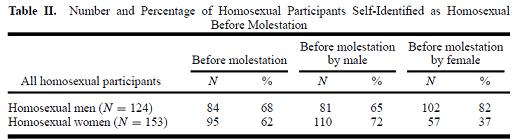
Something is not right here. If the table is correct, then the case for causation from this study is somewhat compromised. The table indicates that 68% of men identified as homosexual before their molestation experience.
My colleague Gary Welton and I first discovered this discrepancy nearly three years ago while preparing a scholarly article on the effects sizes of various suggested correlates of homosexuality (one which will be published later this year or early next year). At that time, I contacted Donald Templer, one of the co-authors and advisor to first author Marie Tomeo. I then contacted him again recently in preparation for this post. He has been unable to locate Dr. Tomeo to get clarification. I hope Dr. Tomeo can at some point clarify these matters.
Recently, I ordered the dissertation to check the original study. However, there are discrepancies in this document as well. First, here are the relevant research questions with results.
From page 36 of Marie Tomeo’s dissertation:
The 10th research question addressed, of homosexual women who were molested, what percentage were molested before self-identification as a homosexual woman and what percentage were molested after self-identification as a homosexual woman? Of homosexual women who were molested, 62% were molested before self-identification as a homosexual woman, and 38% were molested after self-identification as a homosexual woman.
On page 37, the other relevant result relates to men.
The 13th research question addressed, of homosexual men who have been molested, what percentage were molested before self-identification as homosexual men, and what percentage were molested after self-identification as homosexual? Of homosexual men who were molested, 68% were molested before self-identification as homosexual, and 32% were molested after self-identification as homosexual.
These results are at odds with the discussion sections of the dissertation and the journal. They are also at odds with the Table from the journal article. For what its worth, Dr. Templer thinks the correct data are in the Table from the journal article.
The bottom line is that the study should not be cited until a follow up correction can be made. The main results — gays report more abuse than straights — may indeed be correct, given the similarity to past studies. However, I do not believe any inferences about causation should be made. Without the actual surveys, there is no way a reader can figure out the results from the journal article and/or the dissertation.
One final thought, the research on sexual abuse among GLBT populations is often misused to make inferences about causation. There are many reasons why this line of research is important but causation is not at the top. Sexual abuse is a profoundly disruptive experience for many people and may contribute to a variety of negative outcomes in adulthood. Finding appropriate clinical and ministry responses may be clouded by focusing on the trauma as a cause of same-sex attraction.
Some right wing site had the gall to say this:
“So much for homosexuality being an immutable characteristic, like race or sex. No Gay Gene has ever been found, and more to the point, homosexuals fear one being found, lest couples in the GATTACA future screen for and eliminate potentially-gay babies. Instead, homosexuals are often products of molestation themselves or other forms of aggressive childhood recruiting.”
https://politicalvelcraft.org/2010/11/05/reparative-therapy-for-those-addicted-and-suffering-with-homosexualisms-pepsi-is-giving-a-million-dollars-to-pimp-homosexualism-agenda/
Yeah let’s look at these anti-gay failures:
https://www.lehmiller.com/blog/2014/3/31/are-religiously-motivated-people-able-to-change-their-sexual-orientation
And off course they then link to failed studies: http://www.religioustolerance.org/hom_exst.htm
http://www.starnewsonline.com/article/NC/20100612/News/605064114/WM/
http://www.boxturtlebulletin.com/Articles/000,003.htm
Unfortunately the Tomeo (2001) study is commonly still cited on anti-gay sites. There is an article shared tens of thousands of times titled “The entire LGBT narrative just crumbled“, which uses Tomeo to claim half of gay people were abused, and calls it a “fact”.
One of the main authors of Tomeo (2001) was Donald I. Templer, a white supremacist who pushed pseudoscientific race and IQ theories. He said black people naturally had poor impulse control and should voluntarily opt for sterilization in return for cash payments.
it really makes you question the intentions of Templer, who appears to be the main author of the study. When you discount the boys who were already homosexual, just 15% of the total homosexual group reported a ‘molestation’ prior to knowledge of their sexuality.
What this study really shows is that inappropriate age gap sexual activity can occur in young homosexual teenagers, since they cannot risk exposing their sexuality to people in their own age group. Thus they are much more likely to go to the internet/venues where the men will be older, and because a small minority of men will always be willing to pursue a youthful person (male or female) the ability for them to do so is increased with the gay teenager who has no other options.
Figures.
Sadly, most Americans are incapable of critical thinking and do not even realize they are being brainwashed on numerous levels.
Tim,
I agree with the above statement except I would substitute the word “most” with “some”.
I am very interested in the myriad of orientations you referred to. I have always thought orientation had varying degrees and dimensions, however, I didn’t know there were so many. Do you have any link or information that I can refer to for this?
Interesting topics of discussion. The answer why female homosexuals have less STDs than male homosexuals is because biologically the p-nis was designed to impregnate the female and not the male rectum (resulting in numerous hygenic problems). And despite claims to the contrary by activists, rectal sex is widely practiced and has led to over 300,000 dead male homosexuals from lethal STDs in America at a rate 100 times the normal population and creating the worst health epidemic in the nations history.
FYI, the human genome project confirmed that there is no such thing remotely close to a “gay gene” and it was all fabricated by delusional activist researchers and promoted in the press and academia to fraud the public and further the gay revolution/fraud. Not to mention there was a book published by gay activists (called After the Ball) that blantantly said to lie about the causes of sexual orientations and to make in seem inborn in order to advance the gay revolution.
By the way, there are over 500 different types of sexual orientations, and according to the gay activist argument, if a person does not pursue their orientation or act on impulse they will get depressed, suicidal, etc. Where-as, the rest of society must control their impulses, yet, somehow manage to not get depressed., etc., etc. But of course sexual repression is bad, where as repressing gluttony, greed, and violent orienations is good., etc., etc.
In summary, every single argument made by a homosexual can be deconstructed and rendered illogical by applying basic reasoning. Sadly, most Americans are incapable of critical thinking and do not even realize they are being brainwashed on numerous levels.
The entire gay revolution is a fraud based on Kinsey’s well proven fabricated research, and supplanted by delusional activist researchers and sex industry that just generate studies to feed their delusions and make billions of dollars on exploiting impulses and delusions.
NO CIVILIZATION, GENERATION, OR RELIGION EVER IN THE HISTORY OF THE HUMAN RACE (in over 8,000 years of written history) EVER HAD ANYTHING REMOTELY CLOSE TO HOMOSEXUAL MARRIAGES. Its a complete fraud.
I think people here are confusing orientation with philias. Sexual orientation is like a compass, it points to a direction. Philias – or what you’re specifically attracted to (ethnicity, height, age, body type) – is like the weather.
SO, if you’re steering a ship on the ocean, the compass will tell you which way is north or south – but it will NOT tell you what the weather will be like in those directions. And obviously if you seek clear skies and not thunderstorm clouds, you’ll have to use some other method to obtain that information – and it has nothing to do with the direction you’re traveling, but rather, what happens to exist in that direction.
Teresa, the main reason why lesbian STD rates are so “low” is because there is a large blackout in study of WSW epidemiology. Again, WSW are seen as “not having real sex” so it’s not worth any scientist’s time to study.
The truth is we DO have our own health issues to worry about.
As for men having hire STD rates, this is not because they are “freakier.” It’s because certain sexual practices of gay men involve more bodily fluids and higher risk of exposure to these fluids. The same is true for WSM. Women in heterosexual acts are more likely to contract a disease because of the nature of the act and the design of our bodies. In fact heterosexual acts are “more diseased” than female homosexual acts.
Does this make them morally worse? No. They are just as “moral” as any other sexual act involving consenting adults.
I think if you looked back 50-60 years ago, you would have heard some saying that.
Ken,
I think you are probably right, however, I don’t think the attractions, in and of themselves, precluded the possibility of choice. In other words, the attractions were a preference, not an orientation.
Ann says:
April 13, 2013 at 10:45 pm
“I don’t think I have ever heard anyone say they wish they wouldn’t have an attraction to a certain ethnicity”
I think if you looked back 50-60 years ago, you would have heard some saying that.
I am intimately involved with a very dysfunctional family that consists of 10 siblings (7 boys and 3 girls). They are all adults now. They were all horrifically abused by their mother. The three girls all suffer from PTSD, eating disorders and relationship disorders. The boys suffer from drug abuse, alcohol and relationship disorders 3 of the boys are misogynists while the remaining 4 are admitted homosexuals. Way outside the acceptable percentage of naturally occurring normal characteristics.
What is your point, David H.? One family does not a representative sample make.
In my opinion, women with same sex attractions are a much smaller subset of an already small subset of all persons with same sex attraction. The numbers don’t justify much work in this area. Although we all know Lisa Diamond and her study with women.
Secondarily, women with same sex attraction have the least STD’s of any sexually active group. It’s a known fact that gay men engage in risky sex and ‘can be’ very promiscuous (need I point to studies). We need only look at the current virulent bacterial meningitis that’s hit New York City, and has its first known death in a WeHo (West Hollywood) man. Homosexual women, until now, don’t have that problem. Attention goes, where attention is warranted.
“At present, the Center for Gender Wholeness does not have expertise in working with female homosexuality.”
This is largely because female homosexuals have been swept aside as though we don’t exist. This is part of a larger trend of misogyny. Women aren’t seen as having strong sexual desire, and even if we do, it can only be justified when a man takes us to bed. However I’ve seen that women can have sexual desires that are just as strong as men’s – maybe they’re expressed in different manners, but it’s just as strong. But the greater problem is that since women are in general are thought only to matter sexually if a man is involved, then sex between women doesn’t matter. And, since a man who exhibits “womanly” characteristics (such as wanting to be with a man sexually) is absolutely horrid in the minds of most cultures – especially patriarchal cultures like Mormonism, and Christianity in general – obviously this “abomination” must be “cured” at all costs.
However, for a goodly number, that is probably not going to happen, and trying to make it so leads to a lot of wasted time, or worse.
Teresa,
Again, I agree and also think it is “the trying to make it so” that is the genesis of failure for any potential relationship. Dr. Throckmorton said something many years ago about all this and it has stuck with me – he said “you have to start with what is true”. To me, this does not mean a collective truth, rather what is true for the individual. I think realizing and understanding this is life giving as we realize this truth does not have to define us, rather we can define it based on how we want to live.
I absolutely believe that female same sex attraction is not at all like male same sex attraction … except for our labeling of it.
Teresa,
As do I. Also, labeling seems to always give temporary satisfaction when facts are unknown.
Why is it more important to understand attractions based on gender rather than race or ethnicity?
Ken,
I don’t think I have ever heard anyone say they wish they wouldn’t have an attraction to a certain ethnicity – I believe they consider it a preference rather than something they cannot control or do not want. Individuals who have same gender attractions, at the exclusion of opposite gender attractions, usually connect this with an identity that, given a preference, they would not choose for themselves. I think, for them, understanding why they are not attracted to the opposite sex would be very important for a myriad of reasons.
Tom Van Dyke said:
I absolutely believe that female same sex attraction is not at all like male same sex attraction … except for our labeling of it. So, I’m in agreement with you Tom on this. As men are different from women, so is same sex attraction different in men than in women.
I note that the newest Mormon website on therapy for homosexuals specifically states the following:
The website is: Gender Wholeness
Ann says:
April 13, 2013 at 9:19 am
“For orientation purposes (only – not ethnicity) , I kind of think this is an important issue to understand.”
Why is it more important to understand attractions based on gender rather than race or ethnicity?
What if it were true about men but not for women? How inconvenient if if one size doesn’t fit all.
That would be the ultimate test of all those theories about inborn homosexuality. And why isn’t it done?
Patrocles,
That would be interesting. I think there is a credible test being done now regarding the possibility of epigenetics.
I don’t think there is a “main component” for why someone might be attracted to a specific ethnicity. As I said, there are many factors that determine attraction
Ken,
Yes, I agree – finding attraction in someone or something is, in itself, not a problem for most individuals as long as discernment is used. I guess what I am trying to understand is what holds the attraction at the exclusion of other reasonable possibilities. For instance, a woman is attracted to a woman or only women at the exclusion of men or a white man that has always only been attracted to black women at the exclusion of any other ethnicity, including his own. For orientation purposes (only – not ethnicity) , I kind of think this is an important issue to understand.
Ann says:
April 12, 2013 at 9:48 pm
“What do you think is the main component associated with, and responsible for, enduring attractions to a specific ethnicity, excluding all others?”
I don’t think there is a “main component” for why someone might be attracted to a specific ethnicity. As I said, there are many factors that determine attraction,
As far as how attractions (sexual and otherwise) develop there are a host of factors (biological, environmental, sociological) that effect who you are attracted to (and more than just gender also body type, hair color, skin tone, wealth, personality type, etc).
Ken,
What do you think is the main component associated with, and responsible for, enduring attractions to a specific ethnicity, excluding all others?
Teresa,
I really like what you wrote on the other web site about being single and completely agree with it.
Regarding, marriage, I don’t think it is for everyone, regardless of orientation. The Catholic religion, as you probably know, says some individuals are called to marriage, others to the priesthood or other religious vocation that would mean a vow of celibacy, while others are called to living a life of being single. I like that as it refers to an individual calling rather than obligation.
I believe that sex within a marriage is purely an individual choice between the two people involved, as well as how they have sex, if at all. You are right that sex cannot be overlooked in a marriage and I think if expectations are known and agreed upon, then the marriage will have a better chance of working, regardless of orientation. I am not sure if sexual desire is acquired within a mixed marriage, however, no one should feel obligated to do something that does not come naturally to them. Again, I think two individuals who understand and accept each other is the best foundation for a good marriage.
Regarding all the noise about curing orientation, who can predominately change, etc., just does not connect with me and certainly holds no value for me. There must be another way to look at all the degrees and dimensions of orientation. Usually I apply critical thought to almost everything, however, regarding this issue, I like individual stories – they tell me a lot more about this great big world we live in than any organization or individual promoting an agenda either way.
Ann said:
“Coming to love an opposite sex individual is a good value to me and seems to work when sex is not the primary glue that holds a relationship together.”
Yes, Ann, what you’ve said is certainly true. This is what I think Exodus and now Restored Hope Network may be seeking. However, it takes some doing for a couple to work through one partner having same sex attraction. Not in a way to deny the attractions, per se; but, to learn to accept them and be able to set them aside. Honest communication and work as a couple has to be in place.
However, sex cannot be overlooked in a marriage; and, may in fact, for a time, be a big part of the glue of marriage. That, in fact, is what drives a lot of the ‘coupling’ that goes on. Of course, there are successful marriages where sex is not the primary glue; and, as we age, sex will not be much glue at all.
The problem, as you’re well aware Ann, was the whole meme of “we can cure you of being gay”. I think some persons can move to opposite sex sexual attractions as being predominant. However, for a goodly number, that is probably not going to happen, and trying to make it so leads to a lot of wasted time, or worse. We need to be as honest as we can, personally and socially, about sexuality. I think good therapy, such as SITF, can be a big help in this.
Perhaps, marriage will not be in the cards for some of us with same sex attractions. What then? For those of us who ascribe to the belief that same sex sexual behavior is wrong, we choose chastity and living a life of service to others as our fulfillment.
At the end of the day, we must come to a place of peace regarding who we are, and the choices we make.
Here’s what I posted on another site regarding this:
Coming to love an opposite sex individual is a good value to me and seems to work when sex is not the primary glue that holds a relationship together.
Exactly, Ann. Young people are being sold a bill of goods about “experimenting” with their sexuality, as if maximizing sexual pleasure is the purpose and goal of a person’s sexuality rather than its being just a component of the whole person.
http://en.wikipedia.org/wiki/Bisexual_chic
Ann says:
April 12, 2013 at 12:48 pm
“The issue I am interested in is how, or if, spontaneous sexual attractions can develop with, and from, any of the five senses ”
I think there is some confusion about the word “spontaneous”, in this context it doesn’t mean “sudden” or “without warning”, but rather “part of a natural progression” free of external influences or conscious effort.
As far as how attractions (sexual and otherwise) develop there are a host of factors (biological, environmental, sociological) that effect who you are attracted to (and more than just gender also body type, hair color, skin tone, wealth, personality type, etc).
the problem with this effect is that over time the habitual activity lessens as the attractions according to orientation grow stronger.
Ken,
I think your example might cover what happens after a sexual response is established in childhood, evolving into adulthood. Once this has taken hold, it can be modified with habitual activity, however, it takes a highly motivated individual doing it for all the right reasons according to what they value. Coming to love an opposite sex individual is a good value to me and seems to work when sex is not the primary glue that holds a relationship together.
The issue I am interested in is how, or if, spontaneous sexual attractions can develop with, and from, any of the five senses at an early age when discernment is not part of the equasion. I have heard it can.
There’s an extremely simple study which is not done because “nobody wants to know”.
Take a sample of really little children, study their brain and predict their future sexual orientation – then wait fifteen years and look how they have developed.
That would be the ultimate test of all those theories about inborn homosexuality. And why isn’t it done?
I’ve recommended before to explain male homosexuality by operant conditioning. If a boy occasionally has connected the perception or imagination of male attributes with masturbation and that has lead to orgasm – the most intense reward possible -, the boy will rather quick learn to use perception or imagination of male attributes alone as a source of orgasm, masturbation becomes a minor part of the process. In this sense, I’m rather convinced that homosexual response can be habitualized.
My model would explain the fact that homosexual response cannot be suppressed by aversive therapy – you can’t top the effort of infinite orgasms by occasional punishment. But my model would stand and fall with the possibility of extinction – what happens when young men get accidentally incapable of orgasm for a longer time: would the sexual attraction by other men dwindle or remain invariate?
That’s only one of the studies I would like to see – and insofar I’m quite on Tom Van Dyke’s side: I miss a lot of studies which might make a particular model “stand or fall” and which are never done – and on the other hand there are too much studies that don’t have any import for the corroboration or refutation of a model or theory.
Tom Van Dyke says:
April 11, 2013 at 7:41 pm
“Can sexual response be habitualized? ”
Yes it can be. And that has been demonstrated in many ways. Particularly in the case of gays who married the opposite sex. the problem with this effect is that over time the habitual activity lessens as the attractions according to orientation grow stronger.
Tom Van Dyke says:
April 11, 2013 at 10:00 pm
“But by “nobody wants to know” I mean on the part of researchers, and the ideology and politics of the academic establishment–come up with the “wrong” findings, and your career is ruined. The dishonesty of the social science establishment is appalling, and the ruthlessness with which they destroy their enemies.”
and once again you resort to mis-characterizations and over generalizations. While it is true that if a researcher want to publish results that run contrary to the general understanding, he or she has to be be very careful about their methodology, that is true of any field of science.
Perhaps. Perhaps not, Teresa. I wish you well.
Having gay family members is hardly having a true personal interest, meaning you.
Warren has a direct personal interest because he is part of the academic establishment. I have a direct personal interest because I’m a woman with same sex attractions.
Your statements are off-topic and not pertinent to the conversation that Ann, I and Warren were considering.
I have gay family members, Teresa, and a strong interest in the subject. But by “nobody wants to know” I mean on the part of researchers, and the ideology and politics of the academic establishment–come up with the “wrong” findings, and your career is ruined. The dishonesty of the social science establishment is appalling, and the ruthlessness with which they destroy their enemies.
I see this is from 2009. If followups come up with the “wrong” conclusions, I suspect the researchers would be drawn and quartered.
Tom,
“Nobody wants to know”, is a patently false statement. Ann and I would like to know, for starters. And, I would suspect so would many others.
Perhaps, this is not your area of expertise, and would I venture to say you don’t “have a dog in the stake”. I, for one, do.
Can sexual response be habitualized? Has it been proven that it’s not? It would be damned inconvenient to a lot of theorizing and ideology. This issue seems to be completely glossed over. Nobody wants to know.
we do know enough about sexual orientation that we can say that attractions arise in people spontaneously and without any obvious prior cause in most people.
Dr. Throckmorton,
If we know enough about sexual orientation to say this then are spontaneous attractions the main component for sexual orientation? I have heard and read that it is not.
we do know enough about sexual orientation that we can say that attractions arise in people spontaneously and without any obvious prior cause in most people.
Yes, I know spontaneous attractions can and do happen without any obvious prior cause. I always thought, without attraction, there is no motivation for sexual behavior. Of course, as they say, the girls always get prettier at closing time.
An issue that really needs to be explained
Teresa,
Yes, I completely agree. I think children form so many life long opinions about life and themselves at a very young age. Regarding sexual identity, this could be a very strong one if they find the experience pleasurable. Here is an example – 4 year old children are taking their afternoon nap at a nursery school. They are being monitored by an intern who is male and also interested in little boys. One boy cannot sleep and the intern (care taker) lays down beside him under the guise of comforting him but instead begins fondling him, resulting in a kind of pleasure that is both confusing and intriging. The care taker knows this child does not have an intact stable family so he tells the child it is their secret. The abuse continues at opportune times and all in secrecy. No physical harm is done to the child, however, the emotional damage is there and he is unaware of it. By the time he goes to regular school, and is away from the abuse, what do you (meaning everyone) think he thinks of regarding sex? I think his spontaneous thoughts go back to the prior experiences becaue they brought a confused pleasure. How is this resolved – I am not sure. I know this is could be considered an individual experience, but not an isolated one that should not be overlooked.
Ann – Clinically speaking, all cases should be as individuals, but we do know enough about sexual orientation that we can say that attractions arise in people spontaneously and without any obvious prior cause in most people.
For individual people, any number of factors might figure in their attractions and behavior but these individual cases are just that, individual cases.
Dr. Throckmorton,
Until we know something credible and conclusive about orientation, shouldn’t all cases be viewed as individual?
Ann asks:
Excellent observation and question, Ann. An issue that really needs to be explained, because, in my opinion, there is not an insignificant number of persons with same sex attractions that fall within your question, Ann.
Ken states:
That explosion of confusion, which may last a person’s lifetime, piggy back’s to Ann’s question.
Warren, I know you have repeatedly told us that childhood sex abuse is not the cause of same sex attractions. Also, we have the innumerable numbers of persons who have experienced sexual abuse and have opposite sex attractions.
So, we might say, sexual abuse is not, in and of itself, causation; but, what about correlation? Is the percentage of sexual abuse backgrounds higher in persons with same sex attractions than in the regular population? Can we dismiss this so lightly?
Teresa – I don’t dismiss the slight difference in CSA but as a causative factor for the general trait of homosexuality in the population, it simply can’t be a necessary cause. For individual people, any number of factors might figure in their attractions and behavior but these individual cases are just that, individual cases.
For others it is for friendship/affection, because of the abuse the concepts of sex, friendship, love etc have all become jumbled.
Ken,
Yes, I agree and also think the most insidious kind of sexual abuse is when the perpetrator enmeshes the abuse with expressions of love and friendship and the vow of secrecy – which causes an explosion of confusion, which, I think can last a long time. At least with other kinds of abuse, the victim knows the act commited on and with them is wrong, at the highest level of their ability to think, and hates the person who did it to them – I think they are also isolated incidents with, perhaps, one time occurances, and with unknown people they will never see again.
Sexual abuse by a male might indeed cause some to question their orientation and engage in experimental behavior. However, these men might be basically straight and when assisted with recovery, discover that.
Dr. Throckmorton,
If this happens at a relatively early age, 5-10, and held in secrecy because the victim starts to realize pleasure from it, could they develop a mindset that this is the only way they can enjoy sex or be attracted to it? If so, could that be a sexual identity that is formed and is it orientation?
Ann says:
April 11, 2013 at 8:53 am
“what would be the motivation for an individual to have same sex behavior if they did not have the orientation?”
There are different motivations depending on the type of abuse (and age it occurred at). For some the motivation is money, ie. they go into prostitution because they feel sex is the only value they have. For others it is for friendship/affection, because of the abuse the concepts of sex, friendship, love etc have all become jumbled. And there are other possible reasons as well.
Dr. Throckmorton,
Thanks for the reply – another quick question; what would be the motivation for an individual to have same sex behavior if they did not have the orientation? I would “think” (subject to being wrong) that most men would not even consider same sex behavior if they had no attraction or orientation toward other other men. I understand curiosity or isolated incidents (jail, etc.), however, I think it would be good to understand your latter point as it is often mis-represented (not by you).
Sexual abuse by a male might indeed cause some to question their orientation and engage in experimental behavior. However, these men might be basically straight and when assisted with recovery, discover that.
Some people seek experiences for the sake of novelty and might try something outside of the norm, just to see what its like.
A study several years ago asked identical twins if they would engage in a same sex act if no one would find out about it. About one-third of the men said they would consider it and two-thirds of the women agreed. Straight men who have no particular revulsion to same-sex behavior might be inclined to try it. We could call them bisexual but they might not consider themselves that way.
That seems to imply that “sexual orientation” is measured independent from “sexual behaviour”. Is it really? And if it is, how? Not only by self-ascription, I hope.
Pat – Not independent of behavior but orientation is not only defined by behavior. People sometimes cross orientations for many reasons.
3. The one prospective study available finds that for men, there is an increased chance of same-sex behavior but not necessary same-sex orientation.
Dr. Throckmorton,
Are you referring to the chance of same sex behavior for an individual who has a same sex orientation or the chance of same sex behavior for an individual who doesn’t have a same sex orientation ?
Ann – the latter situation.
Don’t all males under report sexual abuse?
Being sexually molested at a young age shapes your feelings about sexuality and in my estimation forever changes that persons’ chances of a normal sex life. So how can we truly know if molestation causes one to be homosexual or not?
I mcdonald – 1. Not all people who are gay are abused. 2. Some men who are abused are straight, and have always been. 3. The one prospective study available finds that for men, there is an increased chance of same-sex behavior but not necessary same-sex orientation. In short, some men might experiment with SS behaviors but abuse is not the general cause for most people.
While I don’t want to minimize the harm of child sexual abuse, there are too many cases where people are abused and have happy sex lives in adulthood to agree with you fatalistic assessment.
Overactive imagination combined with low analytical skills and a (un)healthy dose of willed ignorance results in utter disbelief…
I am quite sure that the majority of homosexual child abuse victims are not going to speak of it, for the purpose of maintaining the impetus of the ‘greater good’ of the ‘gay rights’ movement. Usually, a young child is encouraged to do difficult or not necessarily desirable things (eat vegetables, do chores, etc.) under the premise of benig ‘more grown up’, or ‘not being a baby’. This influence can run deep for the course of a lifetime.
Among more sophisticated homosexuals, the norm is to draw reference to the Grecian and Roman civilizations, where homosexuality was a sign of emotional maturity, and intellectual wherewithal, even to the point of superiority. Armed with this ‘knowledge’, a youth can be enticed to view abuse as a secret rite of passage, or a gateway to a higher calling, or echelon of society. As a youth, I saw this manifest in a homosexual uncle, who was turned out by youth mentors/Big Brother types, who would apparently pick him up on weekends. He changed rapidly after that.
I personally had been bombarded with homosexual lures and advances since age seven, and none of these advances came from anyone less than 20 years older than myself. By age 10, I had armed myself with a Rambo style survival knife, and flashed it whenever they tried to coax me into a car or their home. They seemed to get the point soon after. Many homosexuals present themselves as youth or minority cause advocates, religious activists, etc., in poorer communities across the globe. And this sort of exploitation is at fever pitch in Southeast Asia and parts of Eastern Europe. I had a pen pal in 3rd grade, who would tell me all sorts of stuff about what American and European homosexuals would do to poor or unwary children in Manila. I wish I would have kept those letters now.
For the benefit of our world’s children, we must stop ignoring the obvious in favor of what is readily plopped before us by the homosexual slanted media and mainstream. Isn’t this obedient pop culture ambling what cost us literally thousands of young lives in a Federally funded oil expedition not so long ago?
@ Talaud
I’m very far from convinced that children simply follow their parents’ behaviour. Sure, children who are abused might well consider abuse to be somehow the ‘norm’, but I think we underestimate children if we don’t recognize that are capable of evaluating behaviours (though not necessarily in a way that they can readily communicate to us adults) from really quite an early age.
As for ‘sexuality’: most gay people do NOT end up ‘following their parents’, as the parents in question would have straight. And children brought up with two parents of the same sex do not seem, in most case, to be ‘turning out as gay’, as far as we can tell.
Sexual abuse can probably occur not only once or more to be a victim of sexual harassment but also misparenting can lead a child to change his or her mind concept. A baby will follow his or her parent’s behaviour. The parent’s behaviour will influence his or her mindset to select a gender that he or she likes and feels so comfort by his or her own choice regardless the mistake or against the real gender he or she has. Hence, he or she grows in the invorenment which supports the misleading of his or her own. Finally, he or she has a homosexual or lebian desire. The sexual life he or she has will permanently construct the mindset. It is going to be very difficult to insight who he or she is as soon as he or she has experienced an abused delightness.
I am currently trying to do research on many of the subjects contained in this article, and on many of the subjects touched on in the various posts. I found it quite refreshing to see the openess of those who have posted, and their pursuit of truth, regardless of their sexual orientation, or bias, or past history.
BUT… what I found to be most enlightening, was how Rick shared very personal information about being sexually abused as a child, the details of such, the traumatic affect that it had on him, and how it certainly led to a great deal of sexual confusion, especially in his developmental years. This was incredibly personal information, shared in an open and honest manner, from a person who only seeks the truth, and who has nothing to gain personally by sharing these most incredibly intimate details.
But sadly… Ewe comes along and accuses Warren (who merely commented on Ricks post) of being a “complete ignorant idiot, a fool, a homophobe, a hateful charlatan, a blasphemous creton, a disgrace, a hater, a tiny small individual, and the sad butt of a joke” along with claiming the enlightened wisdom that Jesus Christ was openly gay and that is clearly why he was crucified.
Ewe certainly does not represent the majoirty of posts on this thread, and yet, his post and the lack of response to it is quite interesting, despite most of us wanting to ignore this anger fueled slander rampage. Ewe’s hurtful words and obvious hatred towards others with contrary opinions (even when respectfully submitted) is not just a flare up to be pollitely ignored, instead, it seems to be more indicative of the very subjects which we are discussing. In other words, is Ewe a totally normal individual who has never been abused, or experienced certain traumatic events or unusual influences that have affected his sexual orientation? Or, is Ewe exploding with hatred, and vicious slander because he was possibly abused or molested as a young boy, has experienced incredible sexual confusion, self hate, persecution, etc, and after choosing a homosexual lifestyle now he returns the hatred, persecution, anger, and emotions on anyone else who dares to question his desperate search to validate not only his homosexuality, but that of Jesus Christ, and of course all other heterosexuals like Warren who just need to “come out of the closet” like he has.
I realize that my mere questioning of Ewe will undoubtedly invite his retribution and never ending slander, filled with the most vile words and phrases (if he has not already been banned from this posting). And yet, I would welcome Ewe to share his past details of his sexual experiences and orientation as Rick has, and how he came to embrace homosexuality. Based on his words and attitude already, I do not expect to ever receive such intimate details, nor any possiblity of the actual truth (I can imagine a very creative propaganda version… ). Point being, Ewe might actually have the MOST to offer this study, the article, and even the posting thread, and yet he will most likely passionately hide and defend his true sexual past, just as passionately as he has lashed out at Warren.
Much like a wounded dog that has been hit by a car that will lash out and bite even those who might try to help it, Ewe and his vicious remarks have the distinct ear marks of a human who has been deeply hurt, most possibly has a long history of abuse in his past, and yet we (another phenomenon) will ignore, patronize, and excuse his behavior as we totally ignore those “hidden dynamics” that drive him to act as he does.
I don’t think I have expressed anything that many of the very intuitive individuals on this thread that have not already thought. But, I would challenge many of you who might read this to consider further possible ramifications. We must recognize that persons with such disturbed minds as Ewe’s exist and not ignore their behavior.
Male child molestors exist in this modern world and they are rampant. In our pursuit of trying to understand if there is any connection between those who were molested as children actually being “influenced” to adopt homosexuality, we cannot ignore the further ramifications of such a topic. We have to go further to consider if these past events have the power to influence certain individuals to repeat the molestation on our innocent children.
Do those who are physically abused as children (mentally, physically, etc) often immediately return the abuse to their dog? (Physical abuse… not sexual).
Are those who are abused as children more likely to grow up to be adults who are possibly more inclined to abuse children? (physical, mental, possibly sexual).
Are denial, emotional instability, passionate defense, wild propaganda, and intense hatred, merely to be ignored, or can these be signs of a mentality that can lead a grown man to perpetrate the very devastating things that he has wrestled with since his early childhood, on further innocent children?
Point being, in the midst of philosiphizing about these matters of past history, and how they may have affected all of us, what type of emotionally disturbed adult mind then goes on to perpetuate in the future the very things we are merely reflecting on in years past? Who among us (and they are everywhere) has the makings, influences, and and disturbed mind that is capable of molesting young children?
Thanks to all of your respectful, honest, truth seeking posts… now bring on the hateful slander…. 🙂
Mr. Templer has subsequently issued an “Errata” to the Tomeo study, as spelled out on p.9 of this PDF. That the 68% should in fact be 32%.
http://donalditempler.com/assets/templer_7.pdf
Not sure if that clears everything up though…
I am a victim of child molestation, I am 35 and was sexually-abused when i was 3 years old. The manisfestation leads to homosexuality which started by age 9, and this is the only reason why maybe some major studys supports that homosexual is caused by handling over to some members of the family, relatives, or other person who has intention to manifest the kids into sexual activities.Sinced then, I discovered that mothering a child plays a very important role to avoid this life-devastating experience.
Does anyone know how the answers to questions #6 or #9 (depending upon the whether the participant was male or female) was factored into the results? Although sexual contact between someone less than 16 years old and someone five or more years older, and also over the age of 16, may technically be illegal and in legal terms be considered “sexual abuse,” the reality is it can also be consensual. I would think this would be especially true in terms of many gay youth, who often cannot find other gay youth in their age group with whom to have those early relationships. Because of the stigma attached to SSA, it can be difficult for a SSA 14 or 15 year old to find other SSA 14 or 15 year olds to date (so many are still “in the closet” at that age). I would think many of them have to look to older SSA persons for those early relationships out of neccessity. How was *consensual* sexual contact between participants who were less than 16 years old and those who were at least five years older and also over the age of 16 factored into the results?
Yes, I realize this is an old thread, but I just discovered this post, and it doesn’t seem like this was addressed (unless I missed something).
I wonder what ever happened to Debbie Thurman. The website http://www.TheFormers.com is for sale. I read her comments from 2009 and clicked on her name but wordpress says it is no longer available.
I have always strongly believed there is a direct correlation between child molestation and the attraction to the same sex. I am not saying everyone becomes a homosexual after being sexually abused- but we become a very sexual person- stuck in Freud’s 3rd stage. Where we are turned on and more self aware of our genitals and society norms do not bother us or keep us closed off to having sex with a same sex partner. I have met hundreds of women and men like myself who are bisexual after being molested at a young age.
Stefanie – Hundreds? You should do a study if you really know that many people.
Studies examining this with confirmed abuse victims do not bear out your contention but it certainly persists as a belief.
Michael,
Because sometimes Michael – and I do mean sometimes – they are!
Michael,
Wow – you cover a lot of ground in this post. I understand your dissatisfaction with self-proclaimed experts – you find them on both sides of the issue. I too know of people who were out as gay people who eventually married, but they came to term with their bisexuality. I think it would serve this culture well if we embraced the fact that bisexuals exist and not try to marginalize people into either camp. That said, I also know people who were, out, who married and had kids, who later in life left their wives because they realized they were predominantly gay. The fact that they felt they had to marry, to realize some kind of familial or social expectation is sad. Sexual orientation is complex and varied. Today we know that somewhere between 3-7% of the population is gay, but I suspect even that is somewhat under-reported because, even in our culture, it is not always, or even mostly, ok to be gay – despite what the media might have you think.
Today, thankfully, we have same sex couples who are married with children and opposite sex couples married with the same. I can only hope that as society becomes more accepting of gay folk, that some of these “issues” become less so over time, because they won’t be so politicized or marginalized.
Oh, and one brief comment in addition. Why is it that when people come out as gay, they are finally coming to terms with their real selves, but when people who were self identified as gay start an opposite sex relationship they are just in denial?
This is kind of tardy, but I’d like to point out a couple of things that may be really relevant about these studies.
Twenty years ago, when I was in college, certain self-proclaimed authorities disseminated literature that claimed that homosexuality was in-born, possibly genetic, and that homosexuals comprised about 10% of the population. This was presented as fact. Some people were supposedly homosexual at the core of their identity, and these individuals would never be happy unless they owned up to it, stopped denying it, and came out of the closet and participated in gay culture. This had two main effects in the long run that I can see. The first is that many people who previously rejected homosexuality as immoral came to see it as just a natural variation in the human population. It seems to be the major argument that bears weight with people: “It’s not a choice, they are just born that way.” The second is that many people who experienced some degree of same sex attraction were convinced they had no future in a heterosexual relationship–could never marry, have children etc. and were stuck with a sort of deterministic view of their sexual orientation and future life. Over the course of my life, I’ve seen a lot of people have both homo and heterosexual relationships as time has gone on. Some people who “came out” twenty years ago are now happy parents and spouses, and some “straights” from years ago are now living in a same sex relationship or as promiscuous gays. As I’ve traveled and experienced different cultures and also studied history I’ve found that exclusive and deterministic homosexuality as postulated by American gays is not universal in history or across cultures. I don’t believe that this idea has served either homosexuals or society at large well. I think it is responsible for a lot of human tragedy, and paradoxically has contributed much to the notion that we are not free moral agents. Today people who express unorthodox opinions from the gay rights party-line are excoriated in print–witness the irrelevant bashing in this forum. It has become very unhealthy for the pursuit of truth. If there are environmental factors in the development of same sex attraction, we’d be well served to know that. And if there are genetic or other biological factors causing some pre-disposition, that would also be useful to know. But neither of these factors has anything to do with whether homosexual acts are moral or not. Even if very strong inborn biological factors strongly pre-dispose some people to homosexuality doesn’t answer that question. This question is beyond the realm of science. And as Forrest Gump said, “That all I have to say about that.”
Rick,
If you read this….
Your story seems pretty common among men who were sexually abused, and it seems to me that we’ve gone too far in one direction politically when it comes to this issue.
Too much fear, it seems to me, that if we recognize that many, if not most, men who are sexually abused experience at least some doubts/confusions about their sexual identity in some way, that we are therefore saying that all forms of “homosexuality” is caused by psychological trauma.
Frankly, I’m tired of the confusion in the literature between gay identified men and men who do not adopt a gay identity — and may have a life-long difficulty in adopting any identity at all.
Finally, it seems common sensical to me that if you attack a person’s developing sexuality, you actually might make an impact upon that development.
At any rate, my boyfriend/fiance was also sexually abused as a child. He’s a member of an online support group called “Malesurvivor.org”. If you’re not familiar with it, it might be of interest to you.
And not surprisingly, the men who do NOT experience at least some sexual confusion are in a small minority — though many work it out through therapy. And many find that merely seeing the prevelance of this among a large group of sexually abused men helps a great deal.
Take care,
Katie
“The study compared people at a gay pride parade with a straight sample drawn primarily from a university.”
Wow, ok, this is a huge red flag to me. That right there is likely a biased sample, possibly and incredibly biased one.
LOL – I can’t imagine that the gay community is anything but thankful for Pat Robertson as much as he helps them when he opens his mouth 🙂
From the blog Towleroad:
Debbie,
I think so.
Jayhuck, can we agree that what you are really referring to here is human nature?
Warren,
I often wonder if the opposite is true. A young person with SSA is molested by someone of the opposite sex and somehow ends up following a “straight track” only to find that its detrimental to them.
Warren,
Thank you!
Debbie,
I think the same can be, and should be said about heterosexuality 🙂
Debbie,
While I think studies and research will likely reveal a great deal about homosexuality in the future (probably surprising both of us), on this we can agree.
ewe – You need to read the guidelines for commenting. Third strike and you’re out.
Honestly, I have no idea what you are so angry about. This post has nothing to do with Jesus.
you rationalization would be torn apart if you applied this to heterosexuality and yet you feel so comfortable condemning those that accept about themselves what you cannot. Again Warren, you have no proof Jesus was heterosexual. Everything leads all to believe he was a gay man. Therefore you are a blasphemous creton in your own belief system. You are a disgrace. A hater and a tiny small individual. If it was not so sad, you would be the butt of a joke. Actually you are the joke.
You are a complete ignorant idiot. How do explain the fact Jesus Christ was openly gay and crucified for it. Where are you misguided graphs, plots and surveys on that one. Fool. You are a homophobe and a hateful charlatan Warren. Grow up and come out of the closet.
Rick – I want to add that I do not deny the devastation of sexual abuse. You describe a situation which is one of those alternative paths to considering oneself gay. Responsible people, gay or straight, would be glad you got out of that by talking to your doctor and began to reorient your life and sexuality. If I step back from the situation, I would say it seems like you were most likely on a straight track and then was thrown off by this perpetrator. This is not how it is for most SSA people but when it happens, I believe it is crucial to get help for the trauma. Thanks for sharing and I hope you continue to contribute.
Rick,
I hear you. Molestation is very confusing to the child that has nowhere to go for answers. I suspect there are more cases of sexual inappropriatness in homosexuals lives but the judgment from others is making confession difficult or skewing the memories. All my girlfriends were molested – yet, to this day some of them deny that it was molestation.
Rick,
I just read your story. I wish we lived in a world where kids, all kids, were safe and protected from adults who would harm them. I am sorry that happened to you.
It makes no difference what I may want. There is nothing black and white, nothing clearly predictable about homosexuality. All the studies in the world will only crack the surface of this deep ocean. The more we think we know, the more questions we have.
Children can be and often are very naive and believe what adults tell them. I was molested by an adult male when I was about 12. He was known to my family. My father was rarely around and he showed fatherly interest in me. I was beginning to be interested in girls, but he told me that I was BORN this way, to have sex with men, that I could never have children and this is how I will always be and that I should never tell anyone about this and what we were doing. He wanted to have sex more often, but, didn’t really want to. But he might tell my parents, so….. . Why was this happening to me? Who was I going to ask about this? What would happen to me if someone, my friends, family, found out about me being this way? This CHANGED MY LIFE, I wanted to die and I tried to take my life, but wasn’t very good at it. When I was about 17, I knew that I had to talk to someone about this, so, who better than to talk to the doctor who delivered me, who was there when I was born. He would know if I was BORN this way. His nurse was always there with him and when I said I wanted to discuss something sexual, he asked her to leave the room and then he asked what this was all about.. Well, I said to the doctor, you were there when I was born, right, so you would know if I was born to be a certain way. He said, what way are you talking about. I said to have sex with men and that I can never have children, well, he turned all shades of red, said that this was not true and demanded to know who told me that, I didn’t want to tell him, but he finally got me it out of me. He knew this person and told me never to see him again and if this man contacts me to let him know. I was now affraid that the man would be angry when he found out that I told and might hurt me. The doctor also referred me to a psychologist and he reassured me that this was not so. However, believing this for so many years already, especially going through puberty, it took much longer, many more years to get over this and it was always in the back of my mind. So, don’t ever, any of you, ever minimize what effect this kind of situation has on a child. Sexual molestation is very damaging to a child emotionally, psychologically, every way possible and the effects may not be known immediately or until much later in adult life. Even today in my 50s, some thoughts go through my mind that I was responsible for this.
Tim- I am happy for you that you had a good family life. I know a few guys who also had a good family life, but developed SSA somehow. we are not clones of one another, we are all individuals and experience things differently. I think that there are also different avenues for development of SSA, including in utero.
Ugh… I can’t type…
But clearly they say nothing at all whatsoever about the mutability of orientation or whether the California Supreme Court was correct in identifying orientation as a “suspect class”.
Debbie,
I just want to point out that you’re trying to have it both ways. You see your “change” as proving something, as making some argument against the civil rights of gay people.
But you also want it not to be black and white.
OK, I’ll accept your testimony about your own experiences. But clearly they say nothing at all whatsoever about the mutabiltiy of orientation or whether the California Supreme Court was correct in identify orientation as a suspect class.
Timothy, I use the term same-sex attraction far more than I use the term homosexual. I am a woman, and as Warren recently pointed out, it it helpful to acknowledge the distinctions between male and female SSA issues because they are definitely there. You seem to be wanting it to be black and white, but it isn’t. Change for me really encompasses my entire being, but it impacted my sexuality most of all. I have been very open since “coming out” as a former about the nature of my attractions. So your comment (“now you tell us”) makes no sense.
And you are arguing at this point for the sake of arguing. Rather immature, in my book. For some reason, what I say seems to carry a lot of weight in your view. Who am I that I should have that effect on you? I assure you there are a good number of women, both currently SSA and formers, who experienced it as I did.
I’m confused, Debbie.
Here I though all the time that you had been presenting yourself as an evidence of “change”. Sort of like in this comment you made to me:
And now you tell us that you weren’t ever homosexual at all; you were attracted to both men and women. Interesting.
Well, I don’t know. It’s hard to respond when the story is not consistent.
Warren, you seem to be saying above that one can have sexual attractions at a very early age, but you do not define “very young.” Shouldn’t you instead be saying that some very young children (me, for instance) can be gender-nonconforming at an early age but could not possibly identify as having actual same-sex attractions or any sexual attractions until at least sometime around puberty?
Also, I don’t know how I could have answered the questions in that survey as I never identified as exclusively homosexual. I believe there are important distinctions between those who do so identity and those of us who had/have same-sex attractions but also attractions for the opposite sex. Gay is an important identity for the exclusives.
And here we have yet another causation stereotype that doesn’t apply to me. A good childhood relationship with my father, no molestation, no peer rejection, and definitely no soy.
Karen – You have hit on the problem for this study as a study of etiology of SSA.
Timothy – Studies vary, but I believe most abuse is perpetrated by males and so for men, it would be same-sex abuse.
I would say that you may be missing the fact that “abuse” as defined by this study was any sexual contact before the age of 16, not the age of 13.
I interpret it similarly, FWIW. I have to add, however, that I sensed my own gender nonconformity at an age earlier than I was molested. I am in no wise qualified to interpret what all that means. How did each act upon the other? What else factored in? Certainly parental influences did in my case. The complexities boggle the mind. But I am content not to have all the answers. I know who I am.
Is this all abuse or do gays report more same-sex abuse than straights?
If I am understanding this correctly, it seems like it would be a given that people would say they experienced molestation first. Then at an older age identified as gay. Aren’t most people first molested when they are fairly young? How many five year olds who are molested will already be identifying as gay? Most youth first recognize their SSA around 13 (at least for boys), right? And for women, the identification as gay can be much later in life. So of course, the molestation would occur first. Am I missing something?