NARTH fact sheet: Female homosexual development, Part 2 - Child sexual abuse

In the first part of my review of the NARTH fact sheet on female homosexuality, I critiqued the empirical foundation of the NARTH theories about causation of female same-sex attraction.

In this post, I examine the statements regarding sexual abuse and causation. It may be surprising to some observers to read this:

Although sexual abuse does not directly cause same sex attraction, studies report male sexual abuse of lesbians as generally being twice as high as of heterosexual women, that is, on average, 50 percent of lesbian women report a history of sexual abuse. (26, 27) If family relational dynamics and gender nonconformity are already in place, sexual abuse can clench the direction of detachment, gender insecurity, and disidentification possibly leading to same sex attraction.

The article does not specify sexual abuse as a direct cause of same-sex attraction. However, the author does believe that being abused as a child can push a girl in that direction if she suffered detachment from her mom and was gender nonconforming as a child.

I checked the references offered by NARTH for the assertion that sexual abuse of lesbians by men are “twice as high as of heterosexual women” and that “50 percent of lesbian women report a history of sexual abuse.” I cannot find these statistics.

Reference 26 is to a survey of lesbians, gay men, and bisexuals and their siblings by Balsam, Rothblum, and Beauchaine in 2005 (see reference list at the end of the post). In this study, the authors used a convenience sample of same-sex attracted people and asked them to recruit a sibling to participate. They reported childhood sexual abuse (CSA) prevalences for straight (30.4%), lesbian (43.6%) and bisexual (47.6%) female participants. The effect size of these differences are very low, between 1-2%.

Reference 27 is to research reported in the Journal of Gay and Lesbian Social Services by Hughes and team in 2000. In this study, forty-one percent of lesbians reported CSA while among straight women the number was 24%.

The NARTH article adds:

Sexual abuse can be emotional, verbal, or physical. A girl who is sexually objectified though inappropriate sexual comments, denied age appropriate privacy or whose father has voyeuristic tendencies, has been sexually violated without ever being touched. (28, 29)

I do not contest that the paternal behaviors referenced here are inappropriate and potentially harmful. However, the references for these statements does not provide research support for the statements about CSA. One, (29) is not to a research study but to a book for a lay audience by Janette Howard and the other (28) is a 1991 research study by Peters and Cantrell which failed to discriminate lesbians and straight women via abuse variables.

There are some discouraging percentages in this literature but they apply to women overall, with a moderate elevation for lesbians. Here is what I found in a brief PsychLit search.
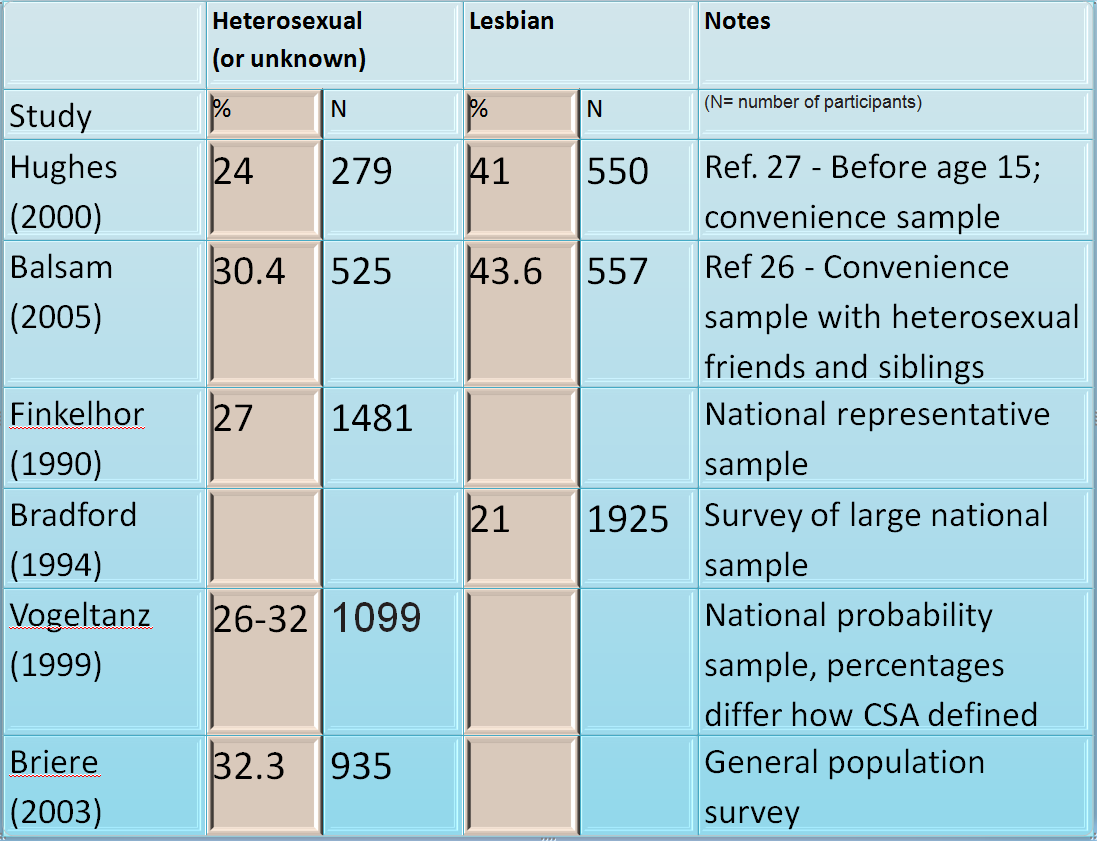
Table CSA

A look at the table demonstrates that most research finds a modest elevation for lesbians but does not demonstrate the 50% figure nor support for the conclusion that prevalences are twice as high for lesbians as straight women. Prevalences are sadly and unacceptably high for all women.

I fear that this fact sheet will become basis for inaccurate information spread by sexual identity and ex-gay ministries. Whatever the reason for the differences, it cannot be helpful to paint a false picture. Sexual abuse is a trauma that often requires therapeutic and spiritual intervention but whether it is involved in the origins of same-sex attractions continues to be an open question.

References:
Balsam, K.F.; Rothblum, E.D., & Beauchaine, T.P. (2005). Victimization over the life span: A comparison of lesbian, gay, bisexual, and heterosexual siblings. Journal of Consulting and Clinical Psychology. 73, 477-487.

Bradford, J., Ryan, C., & Rothblum, E.D. (1994). National lesbian health care survey: Implications for mental health care. Journal of Consulting and Clinical Psychology, 62, 228-242.

Briere, J., & Elliott, D. M. (2003). Prevalence and psychological sequelae of self-reported childhood physical and sexual abuse in a general population sample of men and women. Child Abuse & Neglect. 27, 1205-1222.

Finkelhor, D., Hotaling, G., Lewis, I.A., & Smith, C. (1990). Sexual abuse in a national survey of adult men and women: Prevalence, characteristics, and risk factors. Child Abuse & Neglect. 14, 19-28.

Hughes, T.L., Haas, A.P., Razzano, L., Cassidy, R., & Matthews. A. (2000). Comparing lesbians and heterosexual women’s mental health: Results from a multi-site women’s health survey. Journal of Gay and Lesbian Social Services, 11 (1), 57-76

Peters, D. & Cantrell, P. (1991). Factors distinguishing samples of lesbian and heterosexual women. Journal of Homosexuality, 21, 1-15.

Vogeltanz, N.D., Wilsnack, S.C., Harris, T. R., Wilsnack, R.W., Wonderlich, S.A., & Kristjanson, A.F. (1999). Prevalence and risk factors for childhood sexual abuse in women: National survey findings. Child Abuse & Neglect. 23, 579-592.


Gregarious

13 Comments

  1. Nonetheless, while research is not present I can say in my situation that sexual abuse was the last straw in a series of events that moved me in the direction of lesbianism. It was not the ONLY factor - and I believe others were in place - but it is definitely a factor that contributed to my SSA. Simply, I was tired of having penises forced on me and yet, I wanted intimacy - without penises was my thinking at the time. I was just a girl and had no skills for managing or coping with sexual abuse.

  2. My objections to the NARTH fact sheet has more to do with it not containing many facts, not that CSA is unimportant in the formation in sexuality.

    What NARTH does is to link research studies having nothing to do with homosexuality with their theoretical views and call this fact. If that fact sheet was a paper for a class at GCC, it would get a C-/D+.

  3. I think this paper on female SSA is an improvement for NARTH, but they still have a long way to go.

    I think the premise that CSA among SSA women is higher than OSA women is a reasonable, modest assertion. As well as perhaps a triggering event for some women in ultimately pursuing SSA.

    The article, however, does not note the more obvious fact that OSA and SSA women have more in common: Clear majorities have never been sexually abused.

    MORE IMPORTANT:
    Papers like this are clearly important efforts to present information, but the WEAK Citations coupled with the EXAGGERATION of the weak citations, is very troubling.

    This HAPPENS WITH ADVOCACY! And is prevalent in the advocacy papers submitted in the last generation by HRW and FOTF.

    ADVOCACY tries to talk like science and thereby DECIEVES.

    *capital letters in this post suggest strong feelings of either outrage or disgust.

  4. Warren,

    Understandable and yet, we still hav a small group of people to look at and with the APA in the way with their “doctrine”. People have to sart somewhere. I don’t like the lack of reiable reserch either.

    The reason for putting my personal experience out there is to be a voice and say “Yes, that was my experience.” Many people will read your critique and conclude that sexual abuse is not part of the experience of women with SSA.

    But for this woman it is. I am saying it clearly -it may not be the exerience of all SSA women. I don’t want to diminish in anyway the contribution that so far has been made to the research and evaluation of SSA in women. Women with SSA have been largely overlooked and finding material on the subject is not easy. Especially when some female authors spend too much time on the religious/ theology aspect of SSA.

    Though the data provided come from a convience source - it is a start and worth looking at.

    Yes, this woman was sexually abused and that abuse contributed to SSA. So, that is relevant. Not perfect - but relevant.

  5. Mary - We have data to suggest 60+% of the difference between gay and straight people relate to varied experiences, as CSA would be. And so, I do not doubt that for some, CSA is life altering. What we do not know is how CSA would wire brains to find the same-sex attractive in the same way that straight people find the opposite sex attractive.

    For women, this probably isn’t as difficult since most women can be sexual aroused by both SS and OS triggers. The attachment issue (or detachment from men as another way of saying it) seems more important for women and is consistent with your testimony.

  6. Warre,

    i don’t thnk it does hard wire the brain. I think women see it a viable alternative to get their needs met without more exposure to more male sexual abuse. So, if this is the most contributing factor - women like myself respond better to therapy.

  7. For women, the brain may not have a change but for men, the brain is clearly reacting the same way to different cues.

    If the NARTH theory was true for men, that everybody starts straight and some become gay due to detachment from the same-sex parent then we would need a plausible theory about how that detachment changes the course of brain wiring so that attraction to men is so automatic and natural.

  8. Their hyperbole is worse than might happen in a high school term paper.

  9. Warren,

    We are talking about women, correct? Women re different on this issue - just because we classify homosexuality into one topic does not mean that gay men and women are the same.

  10. Warren,

    Did miss what you were saying?

  11. Warren wrote…. If the NARTH theory was true for men, that everybody starts straight and some become gay due to detachment from the same-sex parent then we would need a plausible theory about how that detachment changes the course of brain wiring so that attraction to men is so automatic and natural.

    Why should it be “wiring” that NARTH has to explain. Is it not simply “thinking” that NARTH is concerned with? I’d think that would be NARTH’s viewpoint, especially a Nicolosi who says that once a guy realizes the problem is with his relationship with his father then the homosexuality goes away. You cannot re-wire a brain that fast, can you? Even easier than my house.

    Which is to say that their whole argument sounds so illogical except to anyone who is desperate for change.

  12. Am I missing the point - is the thread a NARTH bashing or are we discussing women with SSA and sexual abuse and how NARTH has presented the information and what can be gleaned from that?

  13. [...] Given the theme, one would expect a program with research presentations which support their reparative theory positions. Not so. A review of the program reveals no such sessions. NARTH’s approach to research is on display with their new “fact sheet’ on female homosexuality. My review of it is here and here. [...]

Discussion | Share Feedback