More on Martin Ssempa’s “meeting” with gay leaders

Last Thursday, I reported a statement from Martin Ssempa regarding his views of the Hang Them campaign initiated by the Ugandan tabloid, Rolling Stone.  Ssempa said he

…spent three hours with leaders of homosexuals along with Bishop Ssenyonjo-explaining to them his position as a father.

I understood the statement to refer to a meeting specifically set up to meet with gay leaders. However, there is more to this statement according to others who were involved. First, here again is Ssempa’s statement in full:

STATEMENT ON THE ROLLING STONE ARTICLE.

Dr. Martin Ssempa would like to disassociate himself from the “Hang Them” article which appeared in the ‘Rolling Stone’ Newspaper October 02-092010 issue. While he has been opposed to homosexuality as a sin, a cultural taboo, and an act that breaks the laws of Uganda, he does not support violent efforts of “hang them” as indicated in the Rolling Stone-a new sensational tabloid. Being an outspoken preacher on the subject, he was interviewed by a writer from the paper but his language and tone of message was unfortunately not portrayed.

Pastor Ssempa does not believe that outings in Newspapers is an appropriate method. Pastor Ssempa is counselling homosexuals and victims of homosexuality whose confidence he has kept until they have been willing to go public.

At a meeting last week, Dr. Ssempa spent three hours with leaders of homosexuals along with Bishop Ssenyonjo-explaining to them his position as a father. Homosexuality is a sin and God’s grace is there for all who need redemption. He shared how he counsels university boys and girls who are suicidal because they were raped in single sex boarding schools and no one was there to defend them. It is this that drives his passion for educational and legislative reforms to protect Africa’s Youths. The meeting ended on a pleasant note with Pastor Ssempa taking a group photo with the team.

I called Bishop Ssenyonjo to get his perspective on the meeting and he told me that the “meeting” was a series of speeches given by people of various points of view regarding homosexuality sponsored by a research group from Makerere University School of Law. The sessions were held over several days from September 29 through October 2nd. Bishop Ssenyonjo said he spoke about “The God who does not discriminate.” According to the Bishop, there were few gay people in attendance, with most being people invited to speak by those organizing the sessions. Bishop Ssenyonjo heard Martin Ssempa’s session which he said lasted about an hour. In it, Ssempa said he favored the passage of the Anti-Homosexuality Bill but did not want the dealth penalty included. According to the Bishop, Ssempa called for restrictions on free speech, via bans on what he called “promotion” of homosexuality.

In short, the meeting with homosexual leaders turns out to be a series of sessions where many people spoke, many of whom were not homosexual. Apparently, the series of meetings was organized by unnamed researchers from Makerere University.

The Tennessee house fire: The tales of Good and Bad Samaritans

According to this AP report, Gene and Paulette Cranick forgot to pay their $75 fire protection fee and the local fire department let their house burn to the ground.

Paulette Cranick said they had paid the fee in the past, although sometimes late, but it slipped their mind this year.

I have forgotten my yearly car registration before and paid extra for my attention deficit. I have forgotten other things too, but right now I forget what they were. So I can believe the Cranicks forgot to pay the fee.

I have a harder time believing the justifications for failing to extinguish the blaze. Some say the Cranicks didn’t pay the fee so they should accept the consequences. If you do the crime, you have to do the time, the thinking goes. Something just seems wrong about that. At risk of age stereotyping, I will bring in the fact that the Cranicks are in their upper 60s and certain memory functions show some wear and tear years before that time of life. For instance, some days, I have trouble remembering what I had for lunch. I can only imagine trying to remember if I paid a yearly bill for something as basic as fire protection.

So I would have been willing to cut them some slack and put out the fire, perhaps charging them for the real costs of the trip. Their animals might have been saved and the local authorities would have been reimbursed for their actual costs.

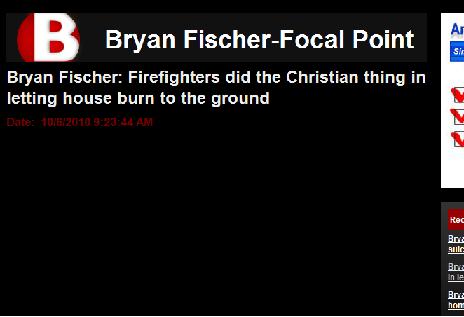
However, other people are not buying it. Bryan Fischer at the American Family Association brought religion into the situation by writing two columns saying Jesus would have let the house burn down. I doubt that, but thinking about Jesus reminded me of the parable of the Good Samaritan. Then I thought that the story might have gone a little differently if Bryan Fischer had been telling the tale. First, the real thing from Luke 25-37.

25On one occasion an expert in the law stood up to test Jesus. “Teacher,” he asked, “what must I do to inherit eternal life?”

 26“What is written in the Law?” he replied. “How do you read it?”

 27He answered: ” ‘Love the Lord your God with all your heart and with all your soul and with all your strength and with all your mind’; and, ‘Love your neighbor as yourself.'”

 28“You have answered correctly,” Jesus replied. “Do this and you will live.”

 29But he wanted to justify himself, so he asked Jesus, “And who is my neighbor?”

 30In reply Jesus said: “A man was going down from Jerusalem to Jericho, when he fell into the hands of robbers. They stripped him of his clothes, beat him and went away, leaving him half dead. 31A priest happened to be going down the same road, and when he saw the man, he passed by on the other side. 32So too, a Levite, when he came to the place and saw him, passed by on the other side. 33But a Samaritan, as he traveled, came where the man was; and when he saw him, he took pity on him. 34He went to him and bandaged his wounds, pouring on oil and wine. Then he put the man on his own donkey, took him to an inn and took care of him. 35The next day he took out two silver coins and gave them to the innkeeper. ‘Look after him,’ he said, ‘and when I return, I will reimburse you for any extra expense you may have.’

 36“Which of these three do you think was a neighbor to the man who fell into the hands of robbers?”

 37The expert in the law replied, “The one who had mercy on him.”  Jesus told him, “Go and do likewise.”

Now, let me break in where the Samaritan finds the hapless fellow on the side of the road and suggest how it might have gone with Fischer’s “muscular Christianity.”

33But a Samaritan, as he traveled, came where the man was; and when he saw him, he called out to him,

“Are you ok?” The Samaritan replied

The man replied, “No, I have been badly hurt by the attack of the robbers.”

Sizing up the situation, the Samaritan man asked “Have you paid your taxes?”

“What?” The wounded man groaned.

“Have you paid your taxes? You know, the ones which help pay for police protection and rescue services?” The Samaritan demanded.

“No, sir, I forgot to pay them. I paid them last year but forgot to pay them this year,” the man whispered, his breathing labored.

“I see. Well, that is too bad. In that case, my advice to you is to man up and accept the situation.” And the Samaritan man went on his way.

And everybody marveled and scratched their head at his teachings.

Which Samaritan was the neighbor?

Bryan Fischer blacked out; Update – Now just fired up

UPDATE: Too good to be true, he’s back.

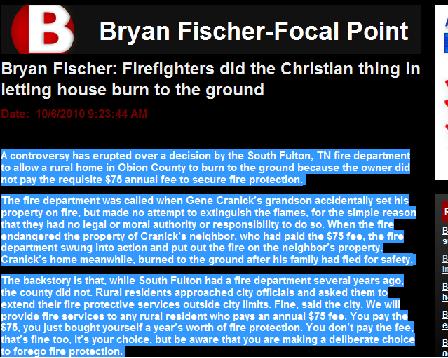
His blog has been blacked out that is. Here is what you see when go there now:

If you highlight the letters, however, you can read the words. Here is one of his latest commending firemen for letting a house burn to the ground over a fee.

Other blogs on the site are not blacked out, like this one where Buster (!) Wilson complains about Richard Land defending Muslims’ right to build a mosque. Imagine that, Richard Land going liberal. Where are the virtual black Sharpies when you need one?

I noticed this earlier in the week, when I went to read the defense of the Bad Samaritans, and the column seemed to be gone. But I checked it out more closely after reading this Christianity Today column by Tobin Grant.

Maybe after awhile, a secret code will be require to read the meanderings of Mr. Fischer. For now, the view looks good to me.

Martin Ssempa reacts to Ugandan tabloid’s “Hang Them” campaign

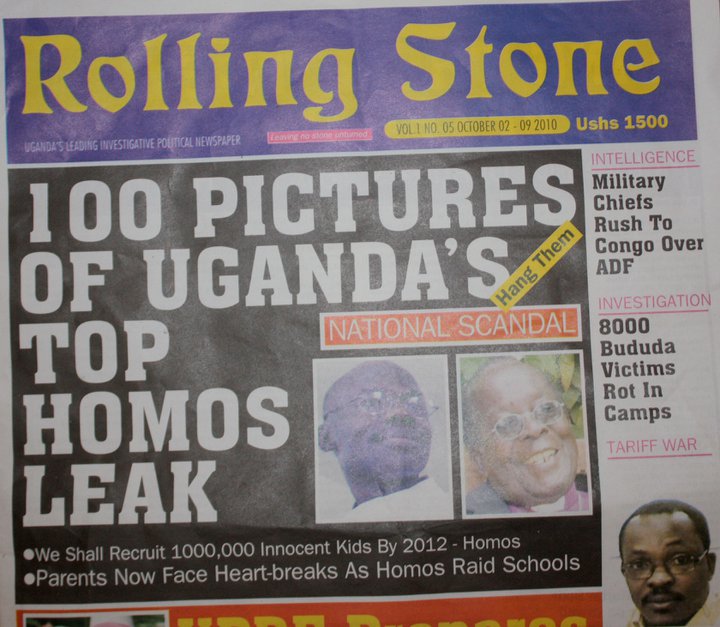
On Monday and Tuesday, I posted screen captures of a new Ugandan tabloid called the Rolling Stone (no relation to the rock and roll magazine) which claimed to out gays and called for their death. Martin Ssempa gave an interview to the magazine and was touted for his anti-gay activism.

 The tabloid claims to have another four parts to the outing campaign, with more pictures, names and addresses to come. Some of the Ugandan contacts I have corresponded with over the last 20 months have not been answering emails. This is concerning.

Since Canyon Ridge Christian Church has taken on an intermediary role with Rev. Ssempa, I asked Mitch Harrison at CRCC if he would determine whether or not Ssempa gave an interview to this magazine and whether he stood for the approach. This evening, Rev. Harrison provided a statement from Martin Ssempa about the tabloid and more. Here it is in full:

STATEMENT ON THE ROLLING STONE ARTICLE.

Dr. Martin Ssempa would like to disassociate himself from the “Hang Them” article which appeared in the ‘Rolling Stone’ Newspaper October 02-092010 issue. While he has been opposed to homosexuality as a sin, a cultural taboo, and an act that breaks the laws of Uganda, he does not support violent efforts of “hang them” as indicated in the Rolling Stone-a new sensational tabloid. Being an outspoken preacher on the subject, he was interviewed by a writer from the paper but his language and tone of message was unfortunately not portrayed.

Pastor Ssempa does not believe that outings in Newspapers is an appropriate method. Pastor Ssempa is counselling homosexuals and victims of homosexuality whose confidence he has kept until they have been willing to go public.

At a meeting last week, Dr. Ssempa spent three hours with leaders of homosexuals along with Bishop Ssenyonjo-explaining to them his position as a father. Homosexuality is a sin and God’s grace is there for all who need redemption. He shared how he counsels university boys and girls who are suicidal because they were raped in single sex boarding schools and no one was there to defend them. It is this that drives his passion for educational and legislative reforms to protect Africa’s Youths. The meeting ended on a pleasant note with Pastor Ssempa taking a group photo with the team.

In that interview, Ssempa is quoted as saying that “the war has just started.” If this is what he said, the tone and language are quite clear. I believe he should ask for a retraction and space in that paper to make his position clear. Telling an American audience is one thing; relating it back home is another.

The disclosure of a meeting with Bishop Ssenyonjo is interesting. I hope to hear from the Bishop about his reactions to it. Martin Ssempa should have found a receptive audience for his concerns about childhood molestation since all the gay advocacy groups issued a statement opposing recruitment and child molestation back in January of this year.

I hope this statement does not mean that Canyon Ridge is going to stick to the story that the Anti-Homosexuality Bill is about the molestation of the boy child. The laws in Uganda already allow for prosecution of those who molest children so if that is what drives him, then he can rest in his campaign since these laws are on the books.

Anti-gay bullying and stereotype threat

We seem to be in the middle of a social conversation about the meaning of the recent teen suicides involving anti-gay bias. Numerous articles are exploring many angles of the stories and there are competing attributions about the nature of the despair experienced by teens who are gay or perceived to be gay. One particularly troubling narrative is being advanced by far right social conservatives essentially suggesting that the teens we are mourning of late died due to factors of their own doing. The thinking goes like this: the gay lifestyle is inherently harmful and distressing and suicide is a possible consequence of that life.

Let me offer three exhibits. First, Linda Harvey told WorldNetDaily readers:

One wonders if any of these kids ever heard a clearly articulated warning against homosexuality. Or were they faced with a continuous onslaught of pro-homosexual diversity lessons, novels and events like the “Day of Silence”? Were they surrounded with liberal teachers as role models and the bad example of a homosexual school club? What part did any of this play in the sad belief that homosexuality was an inevitable destiny, instead of a wayward yet changeable sexual inclination? Under almost continuous pressure to accept a lie – confusion and then despair may be the predictable result.

On top of all this, then, in some young lives come the bullies. They are a part of life, especially for boys. But for the young person with same-sex attractions, this is the final straw where they feel totally trapped, with internal feelings they have been carefully taught “cannot be changed” on the one hand, and harsh peer rejection on the other. Yes, it looks hopeless indeed.

But there’s a solution. First and foremost, kids should be told the truth that no one is born gay. Despite any budding feelings he or she may have, many people who felt similarly at that age went on to change both their feelings and behavior, and to be well-adjusted adult heterosexuals, some married with children. The gay lobbyists actively prevent kids from knowing this option.

Could the stifling political correctness in certain schools be one of the reasons some kids feel utterly hopeless? Think about it. Even in the face of relentless taunts about homosexuality, many if not most kids would be able to survive intact if they saw the perpetrators punished and also knew they had a choice.

Ms. Harvey wonders if warnings against homosexuality would have helped (and links to NARTH’s misrepresentation of Francis Collins’ views). Rather, Harvey perceives schools featuring “stifling political correctness” and a “continuous onslaught of pro-homosexual diversity lessons.” However, friends and families describe regular “warnings against homosexuality” in the form of anti-gay harassment. I suspect these children might have been ok with some political correctness.

On to Exhibit B: Matt Barber, Board member of American for Truth About Homosexuality and administrator at Liberty University. Mr. Barber released a statement about the suicides picked up by the Canada Free Press. Mr. Barber advises:

“God’s message to young people struggling with same sex temptation or to those who feel the shame that naturally accompanies sexual sin is that suicide is never the way out. But there is a way out. It comes first through belief in Jesus Christ, and then through confession of sin; finally, repentance. As Jesus said to the repentant sexual sinner at the well, ‘Neither do I condemn you; go and sin no more.’

Mr. Barber assumes the suicides were escapes for struggling sexual sinners, rather than depressed children struggling mightily with a disparaging social context.

Finally, Tom Prichard of the Minnesota Family Council, makes the most direct link between sexual identity and psychological distress.

I would agree that youth who embrace homosexuality are at greater risk, because they’ve embraced an unhealthy sexual identity and lifestyle. These alternative sexual identifications or lifestyles deny the reality that we are created male and female. To live or try to live in conflict with how we are made will invariably cause problems, e.g. emotional, psychological and social.

These three people are making attributions about the cause of the suicides based not in facts of the cases, but based on their assumptions about homosexual persons. These commentators assert that they have really pegged the problem: these teens were gay and gays are inherently unstable. Therefore one should not be surprised. An additional problem is with the adults who did not warn them or send them to the NARTH website.

It is hard to know what facts would dissuade Harvey, Barber and Pritchard from their views. All three speak of the recent victims as if they were all gay or questioning sexuality. Some were; some were not. The common denominator in these situations was anti-gay bias, not gay identification. In some of these cases, there is no evidence or disclosures of confusion about sexuality at all. The picture of horribly miserable teens who “embraced an unhealthy sexual identity and lifestyle” just doesn’t show up when you read about the students involved. They were miserable alright, but not for the reasons given by these commentators.

This public display of confirmation bias reminded me of another social psychological concept, stereotype threat, i.e., the disruptive concern that one will be evaluated based on a negative stereotype. I believe a plausible case can be made that at least several of victims of suicide experienced regular stereotype threat which indeed was disruptive. Stereotype threat can operate even when one is not actually in the stereotyped social group, as with the young people who were perceived to be gay and suffered regular anti-gay harassment. The threat of negative stereotyping is what is required.

One does not need to look far for the source of negative stereotypes. I provided three links. The threat of being stereotyped as gay looms large to young teens. Bystanders to bullying are often so afraid to intervene because they might be assumed to be gay or a gay sympathizer. In addition to perceptions of being different, could the intensity of the stereotype threat have anything to do with the dire picture painted by churches and professional Christian leaders who may themselves not know any teens who are harassed? Rather than blame the victim, or dismiss this notion out of hand, I believe Christians should reflect on how gays are referred to in our literature and speech. We can make a difference in the climate by virtue of civil speech and self-reflection. If I don’t like being stereotyped as a Christian, then I shouldn’t do it to someone else.

I am thinking out loud with this post and welcome comments and suggestions. Some Christians are stepping up and out toward solutions but other seem to be defensive. I seek as clear an understanding of the situation as possible.