AFA removes article at odds with Bryan Fischer on Native Americans; Update: Original article also removed

I have written a couple of posts about Bryan Fischer’s supremacist views relating to Native Americans. As far as I can tell, I am only one of two conservatives to respond negatively to it. The other one, however, is noteworthy in that he did so on the website of the American Family Association.

One of AFA’s other columnists, 17 year old Elijah Friedeman posted a column criticizing Fischer’s views.  However, you’ll have to read it on Friedeman’s blog since it has been removed from AFA’s. Here is how he started it:

Native Americans were so immoral that they deserved what happened to them? I find the idea repulsive.

Yesterday, Bryan Fischer posted a blog about how American indians disqualified themselves from any claim to land in America by their sexual immorality and violence. I want to officially reject and distance myself from that viewpoint.

His other columns are still available and you can find the link to his rebuttal in the search engine but when you click the link, it fails to appear.

UPDATE: Bryan Fischer’s article has now been removed from the AFA website. However, you can read it in the Google cache for now and here permanently. I wonder if he will explain why it was taken down.

Native American group: Bryan Fischer’s article “not worth dignifying”

Curious to learn how some Native American groups viewed the anti-Native American article penned Tuesday (now here) by the American Family Association’s Bryan Fischer, I contacted the Native American Rights Fund.  NARF advocates for Native American interests and is described on their website as

…the oldest and largest nonprofit law firm dedicated to asserting and defending the rights of Indian tribes, organizations and individuals nationwide.

In his article, Fischer suggested that Native Americans were “morally disqualified” from maintaining their land due to depravity and failure to convert to Christianity. After reviewing the article, NARF’s spokesman, Ray Ramirez, sent this response.

NARF declines to comment because the article is not worth dignifying with a reply.

Of course, this is more than a “no comment.” On one hand it is not worth dignifying with a reply. Fischer’s article is historically challenged and uber-offensive. One of AFA’s other columnists, 17 year old Elijah Friedeman posted a column criticizing Fischer’s views (you’ll have to read it on Friedeman’s blog since it has been removed from AFA’s).

Native Americans were so immoral that they deserved what happened to them? I find the idea repulsive.

Yesterday, Bryan Fischer posted a blog about how American indians disqualified themselves from any claim to land in America by their sexual immorality and violence. I want to officially reject and distance myself from that viewpoint.

On the other hand, the source of these views is what has raised the profile. Another Native American leader who did not want to be quoted expressed hope that Mr. Fischer’s views are not true of most Christians. However, what is stunning is that we are here dealing with an organization in the AFA that is considered mainstream by so many GOP politicians and which is making a serious bid to split the conservative world.

You can watch Fischer in action here appealing to Jefferson, Washington and the Old Testament for his supremacist views. Obviously, the Founders got a lot right, but they were fallible men and were wrong at times.

UPDATE: Fischer’s article has been removed from the AFA website (2/10) and another website where he blogs. However, you can read it in the Google cache for now and here permanently. I wonder if he will explain why it was taken down.

The response even on the AFA website was intense and negative. I did not get a copy of all of the comments, but this blogger did. AFA must have taken the column down quietly with hope it would all go away. Taking it down just looks like damage control unless they actually say something about it.

1984 Press Conference: Ronald Reagan opposed discrimination against gays

In a post earlier today, I referenced a Baltimore Sun article where Democrat Presidential nominee Walter Mondale said he heard President Ronald Reagan speak against discrimination against gays. I found a transcript of that June 14, 1984 press conference in the Reagan archives which supports Mondale’s statement. Here is the brief answer to a reporter’s question about gay rights in employment:

Employment Rights for Homosexuals

Q. Mr. President, there is a move afoot in the Congress that has the support of many of the Democratic Presidential candidates to change the Federal civil rights law to prohibit job discrimination against homosexuals. Is that something that you would favor?

The President. Now, I was so — you’re going to have to start again here for — first few words. I missed them. I was so confused about three of you — —

Q. There’s a measure before the Congress to change the Federal civil rights law to specifically prohibit job discrimination against homosexuals. Is that something that you would favor?

The President. Well, I just have to say I am opposed to discrimination, period. Now — —

Q. Well, would you support the measure, Mr. President?

The President. What?

Q. Will you support that measure, putting it into — —

The President. I want to see — I want to see what else they have there.

A few months later, Mondale told a Tupelo, MS crowd that he held essentially the same position as Reagan.

But the issue arose last Thursday when Mondale was asked at a Tupelo, Miss., appearance, why he supported “perversions” such as “gay rights.”

He answered: “I saw Reagan on a news conference a couple of months ago and someone said that about homosexuals.

He said, I wouldn’t discriminate against them.

That’s my position.

Does that draw a distinction between us?”

Reagan’s words in 1984 are consistent with his actions in 1978, opposing discrimination in CA by campaigning against the Briggs Initiative. When Reagan said that he wanted to see what else was in the bill referenced by the reporter, it seems clear that he was unfamiliar with the specific piece of legislation. However, on the broader question, Reagan expressed opposition to discrimination based on sexual orientation. Will those who now seek congruence with Reagan’s policies follow his lead?

Was Ronald Reagan anti-gay? Part 2 – The CPAC boycott

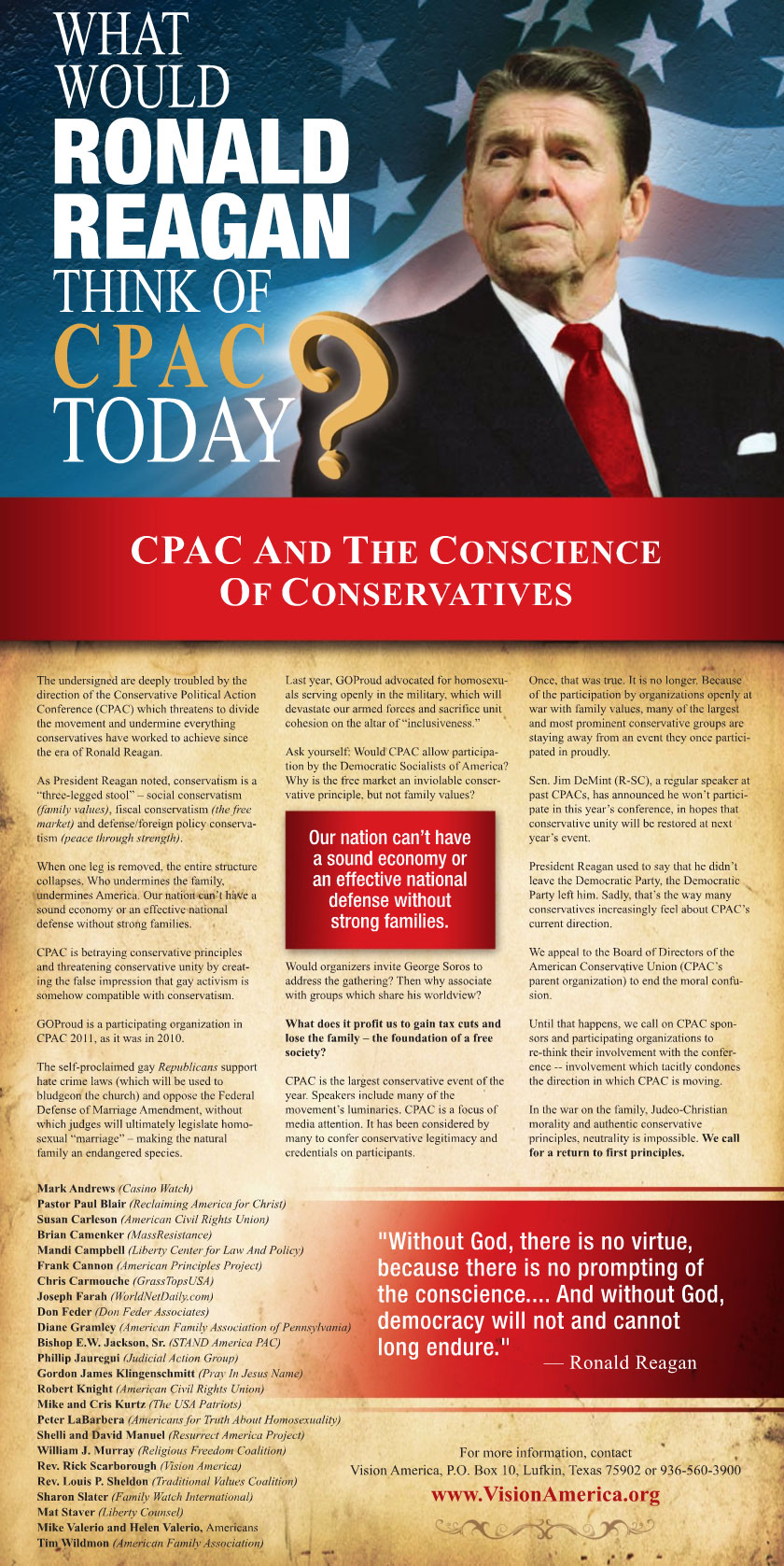
Yesterday, a group of groups boycotting the Conservative Political Action Committee convention ran this full page ad in the Washington Times.
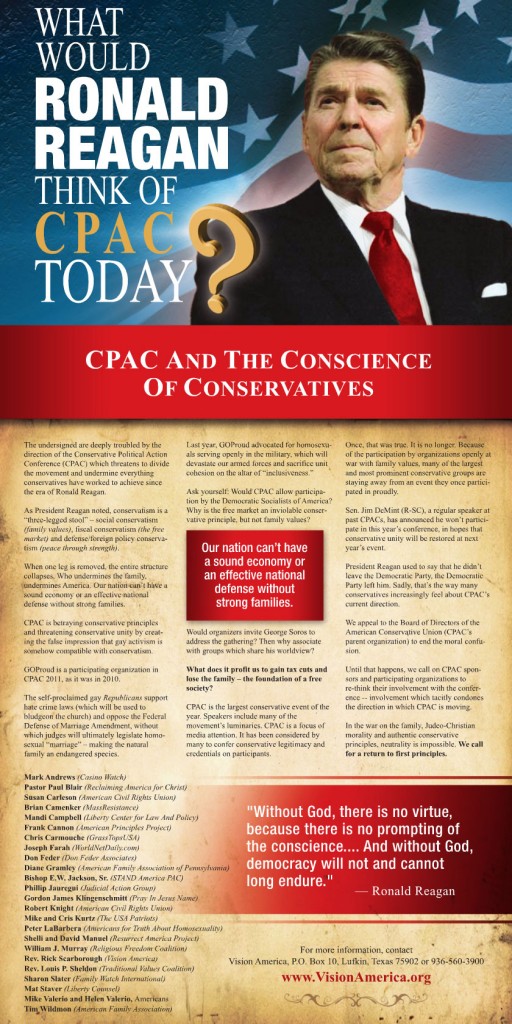
Reagan is incredibly popular among conservatives and the current fight is over whether or not Reagan would support the social conservatives in their dispute with CPAC over the inclusion of GOProud at the convention. In an earlier post on this topic, I noted that Reagan was clearly pro-life but he did not have much to say on gay issues.

In that post, I examined one statement attributed to Reagan that seems to indicate his willingness to discriminate against gays. Here is what I wrote then:

About gay issues, Coulter provided an unsourced quote attributed to Reagan:

“Society has always regarded marital love as a sacred expression of the bond between a man and a woman. It is the means by which families are created and society itself is extended into the future. … We will resist the efforts of some to obtain government endorsement of homosexuality.”

Looking for a source, all references to the quote I can find point to a 1984 edition of Presidential Biblical Scorecard, a publication from the Biblical News Service. I can’t find any current website for this publication, but have contacted some people for leads about the accuracy of the quote. It may be that the quote is a paraphrase of Reagan’s perceived position.

One reason I wonder if the quote reflects what Reagan’s views were at the time is because he was instrumental in helping to defeat a California anti-gay ballot measure in 1978. Proposition 6, also called the Briggs Initiative after GOP state Senator John Briggs, would have forbidden schools from hiring gay teachers and allowed schools to dismiss teachers who promoted homosexuality.

I contacted David Balsiger, who ran the Presidential Biblical Scorecard at the time, and asked him if the quote came directly from Reagan, the campaign or was derived in some other fashion. Mr. Balsiger wrote back to say, “I do not seem to be able to find the quote” and then he asked me where it was in the publication. Since I don’t have it, I don’t know. And apparently, he doesn’t know either.

On August 17, 1984, the publishers of the Scorecard put out a press release that made a definite claim about the quote.

On homosexuality, a subject many had thought Reagan was intentionally avoiding since taking office, the president told the Scoreboard:

“In the Judeo-Christian tradition it (marital love) is the means by which husband and wife participate with God in the creation of a new human life.  In part, the erosion of these values has given way to a celebration of forms of sexual expression most reject.  We will resist the efforts of some to obtain government endorsement of homosexuality.”

Reagan’s position on homosexuality clearly distinguishes him from Walter Mondale, who is a frequent speaker at gay funding events and an endorser of the Gay Rights bill (S.430) before the U.S. Senate. The Democratic Party platform also incorporates a number of gay activist planks calling for federal legislation to legitimize homosexuality as an alternative lifestyle.

Now, the publisher cannot find the source of the quote.

Of course, I don’t know for certain what happened. However, there is some reason to doubt that Reagan made the quote or even knew it was being circulated. According to a September 20, 1984 report in the Baltimore Sun, Reagan’s campaign used the statement but Reagan might not have seen it.

WASHINGTON — In a new departure for a presidential candidate, Walter Mondale is making a strong but quiet effort to win the votes of homosexuals, a minority group that has become increasingly politicized in recent years. Mondale has appointed a member of his campaign staff, Sandra Gillis, as a full-time liaison to homosexual groups.

She says she’s the first aide to a presidential candidate ever assigned to deal with homosexuals — and that there are enough homosexuals in the country to ensure a Mondale victory. The Mondale effort contrasts sharply with that of President Reagan’s. Reagan and Bush do not have a liaison to homosexuals, and John Buckley, a campaign spokesman, said no consideration was ever given to such a position. Instead, the Reagan campaign has been circulating a statement by the president that is critical of homosexuals.

“We will resist the efforts of some to obtain government endorsement of homosexuality,” Reagan is quoted as saying. Actually, Reagan never said exactly that.

The statement was drafted by campaign officials in response to a questionnaire from a conservative Christian group.

Then, it was submitted to the White House, where it was approved as Reagan’s position. Gillis criticized the Reagan statement as irrelevant.

“If the issue was endorsement of a life style, we’d speak to it,” she said in an interview yesterday.

“But that’s not the issue … the position we maintain is one in favor of civil rights for all Americans.” Mondale backs a Senate bill that would ban discrimination against homosexuals in employment.

Even Mondale’s gay liaison did not want to talk morality at the time (“If the issue was endorsement of a life style, we’d speak to it…”), but she wanted to clarify that Mondale endorsed civil recognition of gays. And, according this article, Mondale believed his position was about the same as Reagan’s.

We are in the process of talking to every gay activist in the country.” Mondale, however, has emphasized his support for gay rights while campaigning, and Gillis said she did not know of “any specific events that are planned” to appeal to homosexuals. But the issue arose last Thursday when Mondale was asked at a Tupelo, Miss., appearance, why he supported “perversions” such as “gay rights.”

He answered: “I saw Reagan on a news conference a couple of months ago and someone said that about homosexuals.

He said, I wouldn’t discriminate against them.

That’s my position.

Does that draw a distinction between us?”

I have been unable to find any record of the Reagan news conference to which Mondale referred. Clearly, though, Mondale thought Reagan would not discriminate against gays. As I noted in my prior post on this subject, Reagan did not believe in discrimination, at least as it related to teaching jobs. Reagan was a pivotal figure in the 1978 defeat of the Briggs Initiative (Proposition 6) in CA. That ballot initiative would have forbid gays from holding teaching positions in public schools. Reagan opposed it and helped secure defeat of the proposition.

That the Baltimore Sun article reported on the quote indicates that it was circulated at the time but it is not clear at all to me that Reagan was aware of it. It doesn’t really sound like Reagan and his actions as California governor and even some as President (e.g., the gay couple to spend the night in the White House did so during the Reagan Presidency) seem to run counter to it.

So what would Ronald Reagan think of CPAC today? Not being a Reagan scholar, I can only guess, but I doubt he would boycott it.

Thanks to Kyle Mantyla for the Baltimore Sun reference.

Note: I just noticed that the question about gay rights put to Mondale came in Tupelo, MS, the home of the American Family Association. Not much has changed in Tupelo.
Bryan Fischer prefers European depravity to the native kind

I don’t know where to start, or even if I should, on this op-ed from Bryan Fischer.

Native Americans Morally Disqualified Themselves From the Land (now removed from the AFA website, but archived here.)

In all the discussions about the European settlement of the New World, one feature has been conspicuously absent: the role that the superstition, savagery and sexual immorality of native Americans played in making them morally disqualified from sovereign control of American soil. 

International legal scholars have always recognized that sovereign control of land is legitimately transferred in at least three ways: settlement, purchase, and conquest. Europeans have to this day a legitimate claim on American soil for all three of those reasons.  

They established permanent settlements on the land, moving gradually from east to west, while Indian tribes remained relentlessly nomadic.

Much of the early territory in North American that came into possession of the Europeans came into their possession when the land was purchased from local tribes, Peter Minuit’s purchase of Manhattan being merely the first.

And the Europeans proved superior in battle, taking possession of contested lands through right of conquest. So in all respects, Europeans gained rightful and legal sovereign control of American soil. 

But another factor has rarely been discussed, and that is the moral factor.

Apparently, given Fischer’s analogy to “the Canaanites,” he believes Native Americans deserved their fate at the hands of the Europeans. This is absurd, of course, which even Fischer has to explain later in his rant.

Here is a moral factor for Mr. Fischer to expound upon: The Trail of Tears.

What happened on the Trail of Tears?

Federal Indian Removal Policy

Early in the 19th century, the United States felt threatened by England and Spain, who held land in the western continent. At the same time, American settlers clamored for more land. Thomas Jefferson proposed the creation of a buffer zone between U.S. and European holdings, to be inhabited by eastern American Indians. This plan would also allow for American expansion westward from the original colonies to the Mississippi River.

Between 1816 and 1840, tribes located between the original states and the Mississippi River, including Cherokees, Chickasaws, Choctaws, Creeks, and Seminoles, signed more than 40 treaties ceding their lands to the U.S. In his 1829 inaugural address, President Andrew Jackson set a policy to relocate eastern Indians. In 1830 it was endorsed, when Congress passed the Indian Removal Act to force those remaining to move west of the Mississippi. Between 1830 and 1850, about 100,000 American Indians living between Michigan, Louisiana, and Florida moved west after the U.S. government coerced treaties or used the U.S. Army against those resisting. Many were treated brutally. An estimated 3,500 Creeks died in Alabama and on their westward journey. Some were transported in chains.

Those Native Americans who could pass for white did so to avoid the nearly 1000 mile trek across country. Many had to walk the entire distance. Families were uprooted from their homes. Many Native Americans had roots throughout the targeted areas and were not nomadic as Fischer claims. More from the Trail of Tears site:

In December 1835, the U.S. sought out this minority to effect a treaty at New Echota, Georgia. Only 300 to 500 Cherokees were there; none were elected officials of the Cherokee Nation. Twenty signed the treaty, ceding all Cherokee territory east of the Mississippi to the U.S., in exchange for $5 million and new homelands in Indian Territory.

More than 15,000 Cherokees protested the illegal treaty. Yet, on May 23, 1836, the Treaty of New Echota was ratified by the U.S. Senate – by just one vote.

“Many Days Pass and People Die Very Much”

Most Cherokees, including Chief John Ross, did not believe that they would be forced to move. In May 1838, Federal troops and state militias began the roundup of the Cherokees into stockades. In spite of warnings to troops to treat the Cherokees kindly, the roundup proved harrowing.

Families were separated-the elderly and ill forced out at gunpoint – people given only moments to collect cherished possessions. White looters followed, ransacking homesteads as Cherokees were led away.

Three groups left in the summer, traveling from present-day Chattanooga by rail, boat, and wagon, primarily on the Water Route. But river levels were too low for navigation; one group, traveling overland in Arkansas, suffered three to five deaths each day due to illness and drought.

Fifteen thousand captives still awaited removal. Crowding, poor sanitation, and drought made them miserable. Many died. The Cherokees asked to postpone removal until the fall, and to voluntarily remove themselves. The delay was granted, provided they remain in internment camps until travel resumed.

By November, 12 groups of 1,000 each were trudging 800 miles overland to the west. The last party, including Chief Ross, went by water. Now, heavy autumn rains and hundreds of wagons on the muddy route made roads impassable; little grazing and game could be found to supplement meager rations.

Two-thirds of the ill-equipped Cherokees were trapped between the ice-bound Ohio and Mississippi Rivers during January. As one survivor recalled, ” Long time we travel on way to new land. People feel bad when they leave Old Nation. Womens cry and make sad wails. Children cry and many men cry…but they say nothing and just put heads down and keep on go towards West. Many days pass and people die very much.”

Some drank stagnant water and succumbed to disease. One survivor told how his father got sick and died; then, his mother; then, one by one, his five brothers and sisters. “One each day. Then all are gone.”

By March 1839, all survivors had arrived in the west. No one knows how many died throughout the ordeal, but the trip was especially hard on infants, children, and the elderly. Missionary doctor Elizur Butler, who accompanied the Cherokees, estimated that over 4,000 died-nearly a fifth of the Cherokee population.

Is this moral? How Christian was this?

Many Christians opposed this policy and treatment at the time and yet here is a high profile christian celebrating the subjugation of native people. It appears that Mr. Fischer of the American Straight White Christian Family Association prefers the European-American depravity to the native kind.

UPDATE: As of 2/10, the Fischer article has been removed from the AFA website. He also removed it from another website but you can read it here in the Google cache and here permanently.