I’ll Be Home for Easter

Literally, I will be home for Easter. My wife and I will be watching our church service on the television in our living room. I’ll miss seeing my brothers and sisters at church, but Easter will happen and God will be fine with it.

Some Christian pastors are not happy about this, and some Christians are stirring up a ruckus. For example, the president of the Claremont (CA) Institute, Ryan Williams, appears to be calling for civil disobedience.

I don’t understand the problem. I am naturally a skeptic and don’t like being ordered around, but I really like breathing. Taking rational precautions to avoid COVID-19 just seems smart. I can tell the difference between an arbitrary usurpation of my natural rights and a situational one in a crisis.

The Common Good 1918 Style

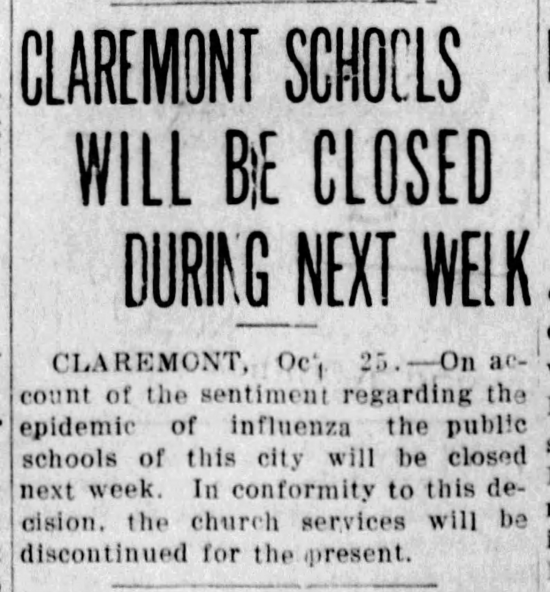
In 1918, the people of Claremont, CA apparently didn’t mind putting the common good ahead of their rights. With just a little bit of searching, I found this clipping from the October 26 edition of the Pomona Bulletin Sun.

During the Spanish Flu pandemic, churches all over the U.S. closed. There were some clergy who complained but here is a truth: closing churches didn’t lead to a loss of religious rights. It was temporary and a benefit to all citizens. Christianity survived; some might say it thrived.

Some might protest, “But Easter?” Well, Easter is an important day in Christianity to be sure. But Christians aren’t supposed to worry about how we keep “holy days.” The book of Colossians tells us, “Therefore do not let anyone judge you by what you eat or drink, or with regard to a religious festival, a New Moon celebration or a Sabbath day.” (2:16).

In my tradition, I get no more grace or credit for going to church on Easter than any other day. The first Easter the grave was empty. This year our church will be pretty empty too. But that’s okay. If He is taking attendance, God can keep track of where we all are.

On the Constitutional question, legal scholar Jonathan Turley opined today that the state has the right to halt church gatherings temporarily. I agree that the state has a compelling interest in stopping the spread of the virus and has not singled out religion or any particular church. The edicts are temporary, impose no permanent harm on churches, and do not prevent other means of worship (e.g., online). Although untested, I agree with Turley that the courts would likely uphold the orders to close.

But I really cringe to hear about churches taking things to that extreme. Christians are not of this world, but we are in it. And if we are going to do any good in it, we shouldn’t put our desire to meet for a church service over the good of our neighbors.

Addendum:

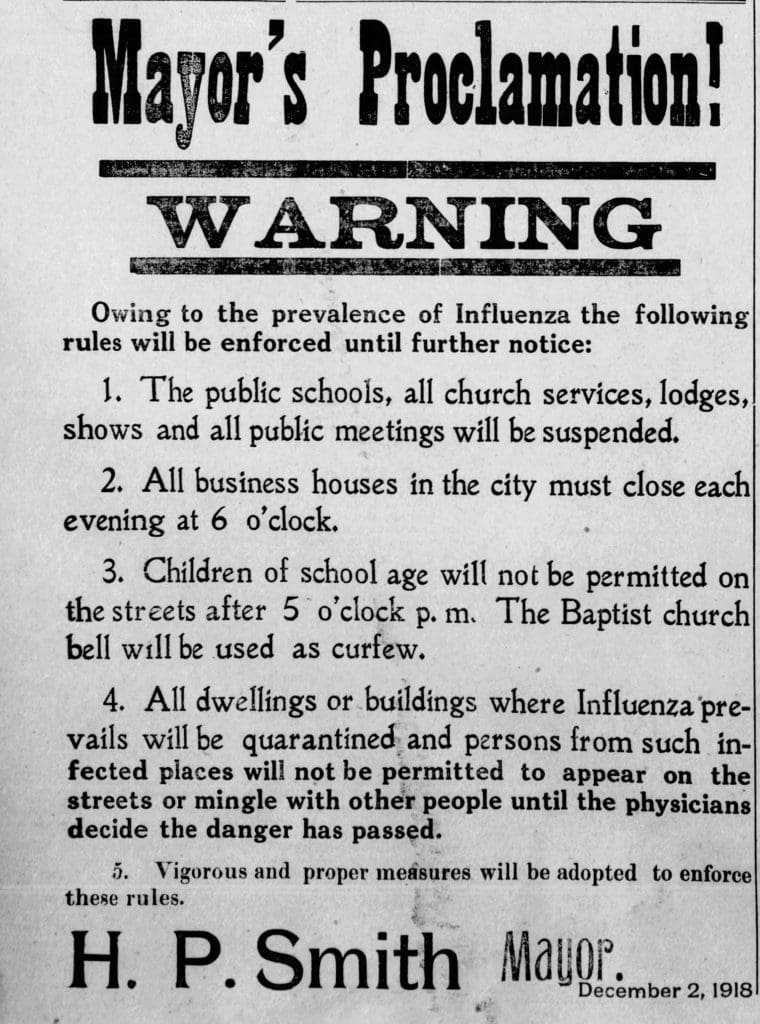
The technology of 1918 was the local newspaper and pastors used the papers to communicate with their congregations. The Pomona Bulletin Sun (11/3/1918) gave local pastors space to give greetings to their flock at home.

I appreciate this winsome word from Methodist preacher Walter Buckner:


Fascist Architecture – Bruce Cockburn

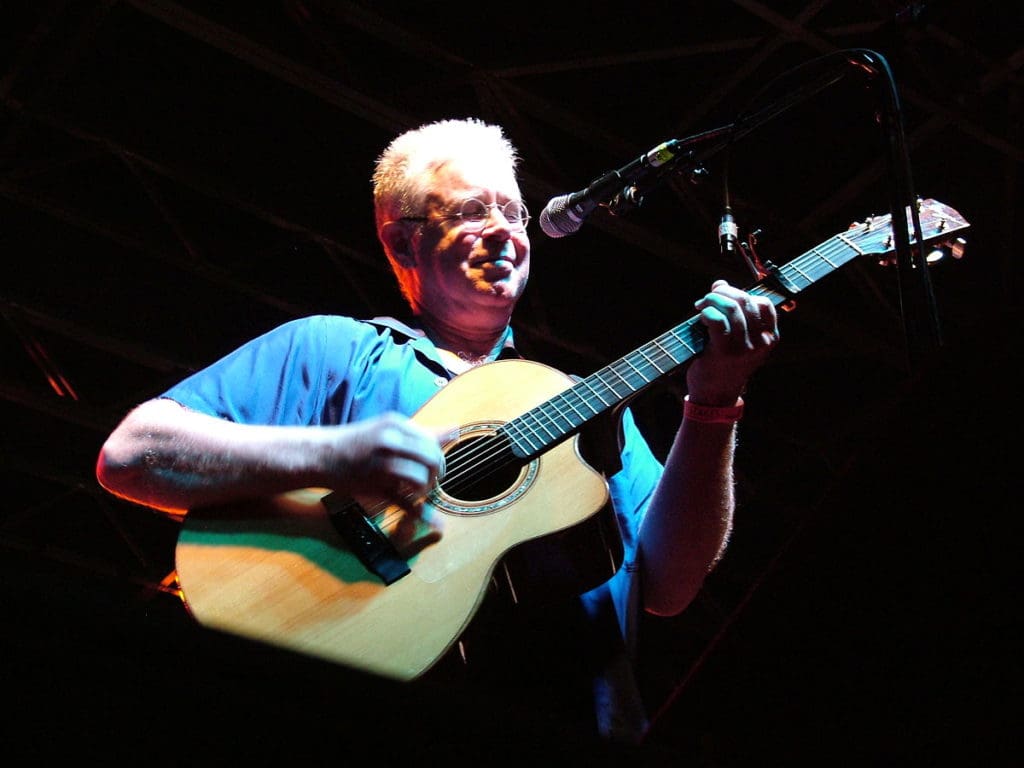
Writing briefly about John Prine yesterday made me think of other singer-songwriters I have enjoyed. Canadian artist Bruce Cockburn immediately came to mind. There are many songs by Cockburn I could choose to highlight but I picked this one – Fascist Architecture from the Humans album.

I have always felt calmed by this verse:

Bloody nose and burning eyes
Raised in laughter to the skies
I’ve been in trouble but I’m okay
Been through the wringer but I’m okay
Walls are falling and I’m okay
Under the mercy and I’m okay

I have a diverse group of readers. Any Cockburn fans out there? If so, post favored songs in the comments.

Image: Bruce Cockburn performing at the City Stages festival in Birmingham, Alabama, United States. Janet Spinas Dancer – Author.

You’re So Vain, I Bet You Think This Crisis is About You
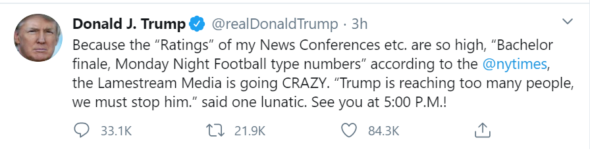
Just when I think there is a bottom, there isn’t. Today Donald Trump tweeted the following:

As I write this, 137,025 people have tested positive for COVID-19 and 2418 Americans have died. Trump brags about his ratings as if the crisis was about him. Narcissism was named after the myth of Narcissus who was smitten with his own image. Perhaps it is time for a new term derived from Trump. He is so sure that he is the center of everything and that it is him we are tuning in to see.

At the least, I have some additional illustrations of how narcissists operate. Many narcissists know enough to hide their self-absorption. A wise and discrete narcissist would realize how self-centered it would seem to appropriated one of the most catastrophic events of a generation and make it about how great his television ratings are. But not Donald Trump. He is just out with weapons-grade narcissism. He doesn’t see the issue. He is a star and everybody who matters will admit it. If they don’t see it, they are lame and don’t matter anyway.

For those who don’t get the title of this post:

Carly Simon – You’re So Vain

On R.R. Reno’s Faulty History

In a widely criticized essay on current state imposed social distancing, First Things editor R.R. Reno said the following about social reaction to the 1918 Spanish Flu epidemic:

More than one hundred years ago, Americans were struck by a terrible flu pandemic that affected the entire world. Their reaction was vastly different from ours. They continued to worship, go to musical performances, clash on football fields, and gather with friends.

After insisting that Americans of 1918 understood methods of quarantine, Reno suggests they just didn’t care.

Unlike us, however, that generation did not want to live under Satan’s rule, not even for a season. They insisted that man was made for life, not death. They bowed their head before the storm of disease and endured its punishing blows, but they otherwise stood firm and continued to work, worship, and play, insisting that fear of death would not govern their societies or their lives.

Although surely some churches worshiped, some games were played and some gatherings were held, these paragraphs and the contrast between now and then is grossly inaccurate. It is so irresponsibly misleading that Reno and First Things should retract the piece or at the least issue a public correction.

The Spanish Flu Pandemic

The Spanish Flu pandemic claimed 50+million lives world-wide in 1918. It was highly contagious and was particularly hard on young people. It is well documented that Philadelphia was particularly hard hit because city leaders did not quarantine their citizens whereas other towns around the country (e.g., St; Louis, Columbus) did so and experienced a much lower death rate.

However, is Reno correct that outside of those famous cases, life went on as normal? Did citizens bow their heads “before the storm of disease?” The definitive book on the pandemic is John Barry’s The Great Influenza, but it is relatively easy to find evidence that Reno is wrong on all counts. Below is some of that evidence.

Worship

Today some churches are meeting. Would Reno say that we are bowing our heads against the storm of disease? Obviously not, his problem is that are cancellations at all.

In 1918, church services were canceled in cities large and small due to the virus. For instance, Evanston, IL closed just about everything in October, 1918 in response to a growing number of flu cases.

Little Urich, MO closed everything including churches during the second wave of the epidemic.

In Columbus, OH, a minister’s council advised churches to close in response to the orders from the State Board of Health.

On Oct. 11, 1918, the State Board of Health ordered all theaters, schools and churches closed and banned public funerals.

The Columbus Citizen reported that “Columbus Ministerial Council has requested of all churches that they close doors and not debate whether or not the order applies.”

From Nashville, to Dallas, to Worcester churches closed even though some pastors didn’t like it.

Football

Reno is also wrong about football. There was no professional football league yet. In fact, one can make a case that the flu pandemic delayed the development of a professional league until 1920. There was interest in forming a league and people played professionally, but games were postponed due to the flu. For instance, this article in the October 15, 1918 edition of the Akron Evening Times shows that pro football had to be put aside for awhile.

High school and college football also suffered due to bans on crowds and playing in games. Far fewer college games were played (704 in 1917 v. 394 in 1918) on account of WWI and the Spanish flu pandemic). While it is true that the season was not completely canceled, it is not true that the people of the time plugged on as if death and illness was inevitable. A sports columnist from the Baltimore Sun lamented the impact of the flu on the gridiron.

High school games were also canceled due to the quarantine as in Wichita, KS.

Social Distancing

I hope it is apparent that the people of 1918 are a lot like the people of 202o. Some now don’t see the need to socially distance and some then didn’t either. However, that doesn’t mean the people of 1918 didn’t do so. Just a few more examples should demonstrate how Reno’s history is so far off.

All over the nation, social gatherings, churches, sporting events, etc. were canceled. Health officials took their responsibilities seriously and issued warnings and orders, just like now, and hoped their fellow citizens would have the good sense to do what was right. Just like now.

Reno and First Things have abused their platform in a very significant way. Of course, Reno is entitled to his view of life and death. However, using faulty history is beneath First Things and it should be corrected.

Additional information:

Many other cities closed schools, churches, and various social gatherings during the pandemic. For reference, I am going to list links to additional resources describing contradictions to Reno’s claims.

Minneapolis-St. Paul closed schools, churches, and businesses off and on throughout the pandemic.

Also in MN, Bemidji’s mayor ordered all public gatherings, including churches, to close during October of 1918.

Los Angeles shut down schools, churches, and other public gatherings for seven weeks.

Winston-Salem, NC shut down schools, churches, and theaters in October, 1918.

Tacoma and Pullyup, WA closed public gatherings from early October through November.

Nebraska’s state government ordered the closure of “schools, churches, places of entertainment, and public gatherings” in early October.

Other cities that closed down various public meetings spaces include: Houston, Chicago, Aspen COBaltimore.

The House and Senate closed their public galleries during October 1918.