Kenneth Copeland is one lucky dude. It seems pretty obvious to me that his ministry is about him and how much stuff he can accumulate.
Kenneth Copeland is one lucky dude. It seems pretty obvious to me that his ministry is about him and how much stuff he can accumulate. In this video, he can barely contain his gleeful pride in his latest acquisition: a $36-million jet. Watch:
Why does Copeland need another jet? According to him, flying commercial would require him to rub elbows with “a long tube of demons” and real people who might want him to pray for them. Watch this video done before he acquired this recent jet:
These rich preachers justify their jets to themselves and to their sheep with the most outrageous stories. The men of God need to concentrate on God and being bothered by people and demons would just mess things up. They couldn’t do ministry without them. Pity the poor local church pastor who can barely keep his used car running.
These preachers think they are so important that they must go to a different city everyday to preach their gospel as if there are no other Christian churches or preachers in these cities. There is an arrogance and narcissism in these “explanations” that is astounding.
I feel a mix of sadness and anger when I think of what $36-million could do for the truly needy. In addition, I suspect someone is getting a tax write off for the donation(s) to Kenneth Copeland “Minitries” which went to the purchase of the plane. It may be that a rich donor simply gave the plane to Copeland as a year end donation. If owned by the nonprofit, the plane is supposed to somehow provide for the public good. Since Copeland won’t disclose how he spends his nonprofit funds, we may never know.
For more on Copeland, see the following: Taxpayers Pay for Televangelists’ Lavish Lifestyles Churches Damaged by Lack of Oversight and Disclosures Televangelist’s Family Profits from Ministry News 8 Investigates Kenneth Copeland
UPDATE: Copeland also has his own airport, provided by the sheep.
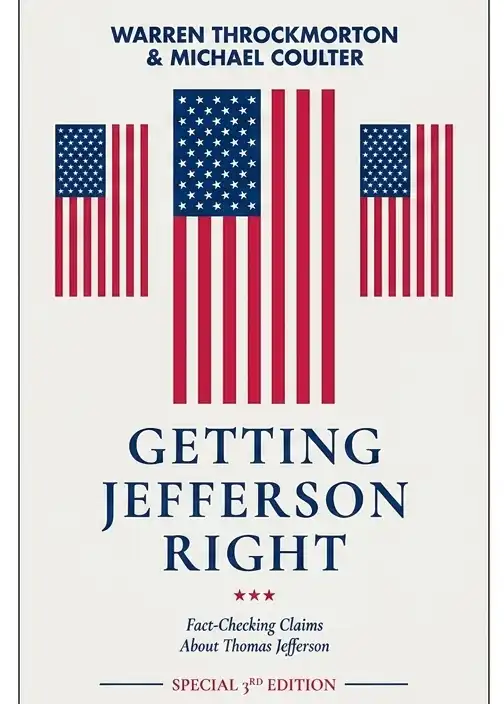
Yesterday, like presidents before him, President Trump issued a proclamation commemorating Thomas Jefferson’s work in writing Virginia’s Cover of Getting Jefferson Right, used by permission
Statute for Religious Freedom (full text here) which was adopted by the Virginia legislature on January 16, 1786. The law ended the establishment of the Anglican church in Virginia and recognized freedom of conscience in the state.
Jefferson meant for that freedom of conscience to extend beyond Christian denominations to all religions or none. However, ultra-conservative Liberty Counsel does not appear to recognize the breadth of Jefferson’s work. In their press release, the Statute on Religious Freedom is described as follows:
Religious Freedom Day is celebrated in America each year on January 16 to commemorate the 232nd anniversary of the passing of the 1786 passage of Thomas Jefferson’s Virginia Statute of Religious Freedom that ended the state-established church in Virginia, finally protecting religious rights for all denominations. The Anglicans had fined, persecuted, jailed and murdered Christians who were not part of the state-established church. However, Jefferson, a lifelong fervent advocate for the rights of religious liberty and religious conscience, worked hard to protect and defend those Christians. (emphasis added)
Liberty Counsel’s presser refers to denominations of Christianity and to Jefferson’s work to defend Christians. In the past, Liberty Counsel chairman Mat Staver has questioned the status of Islam as a religious worthy of First Amendment protection. Staver is also of the David Barton school of thought regarding the First Amendment — that the purpose of it was to prevent a Christian denomination from being established. In other words, when the First Amendment says religion, it means Christianity.
What Did Jefferson Mean?
In fact, there was an effort in the Virginia legislature to limit the scope of Virginia’s statute to Christians during debate on the bill. Jefferson wrote about it in his autobiography:
The bill for establishing religious freedom, the principles of which had, to a certain degree, been enacted before, I had drawn in all the latitude of reason & right. It still met with opposition; but, with some mutilations in the preamble, it was finally past; and a singular proposition proved that it’s protection of opinion was meant to be universal. Where the preamble declares that coercion is a departure from the plan of the holy author of our religion, an amendment was proposed, by inserting the word “Jesus Christ,” so that it should read “departure from the plan of Jesus Christ, the holy author of our religion” the insertion was rejected by a great majority, in proof that they meant to comprehend, within the mantle of it’s protection, the Jew and the Gentile, the Christian and Mahometan [Islam], the Hindoo, and infidel of every denomination.
According to Jefferson, the effort did not succeed. He meant his religious freedom bill to cover all people, of all religious ideas or no religious ideas.
What Religious Freedom Really Means Now
Ultimately, religious freedom at this particular time for this particular group means the freedom to discriminate against people, usually GLBT people in providing public services. In general, I think those who provide services to the public should provide them to GLBT people, even if they personally disagree with some aspect of those they serve.
But that’s just me and my beliefs. I know others believe differently, and the beauty of this nation is that they are free to believe it. What we will find out over the next few years is if they are free to discriminate based on that belief.
Live via webcast from noon to 8pm is a Christian nationalist celebration called Keep Faith in America. Hosted by former Congressman Randy Forbes and self-styled historian David Barton, the event is sponsored by the Congressional Prayer Caucus Foundation, a non-profit organization aligned with the Congressional Prayer Caucus. You can watch various state legislature events and guest speakers via live stream here.
Keep Conservative Christianity in America
I watched it for over an hour and saw three state events. The first one I couldn’t identify because I tuned in too late and then later on I heard Kansas and Delaware politicians talk about keeping faith in America. Several of the speakers talked about faith and mentioned people of all faiths but the only representative of any faith besides Christianity was a rabbi (I didn’t catch his name). All other people featured during the event were Christian. It became obvious the longer I listened that the event should have been named: Keep Conservative Christianity in America.
These conservative Christians seemed to feel that their faith was under attack. They spoke as if their freedom to practice their religion was in jeopardy. How strange a sight it was to see elected officials standing in places of power praying in the name of Jesus, invoking their specific religion without restriction, and complaining about limitations on their religious liberty. They quoted the Bible as if all religions and people of no religion should respect those teachings. Remember these are legislators who are proclaiming that they, as legislators, need to keep faith in America, but when they say faith, the only faith they are talking about is Christianity.
Bad History
In the Delaware session, bad history was evident. The final speaker of the session (I couldn’t hear his name) told the story of Ben Franklin’s call to prayer as if the Constitutional Convention delegates actually heeded Franklin’s call and prayed daily during the Convention (they didn’t).
Unfortunately, this looks like another concerted effort to confuse Christians about the actual events of the founding era and church-state relations. This can only continue to lead many churches into a false mission of political activism, aligning themselves with Republican candidates who speak Christianese.
Another Idea
Better campaign than Keeping Faith in America: Keeping Christ in Christianity.
In honor of Martin Luther King, Jr. today, I link to MLK’s “I Have a Dream” speech delivered August 28, 1963 in Washington, D.C. during the March on Washington for Jobs and Freedom.
Be inspired.
For a transcript of the speech, you can consult the National Archives at this link. It is fascinating to examine the draft of the speech. In particular, the phrase “I have a dream today” isn’t in the draft. He improvised the phrase. He had used it before but it wasn’t in the prepared remarks. In the moment, inspiration came to him and he took the speech to another level. See this interview with Clarence Jones for more on that story.
Trying to defend President Donald Trump’s comments preferring immigrants from Norway over Haiti, El Salvador and Africa, First Baptist Church of Dallas pastor Robert Jeffress told the Washington Post that race is an acceptable reason for the government to discriminate in immigration.
According to reporter Sarah Pulliam Bailey, Jeffress told her that the U.S. has the right “to restrict immigration according to whatever criteria it establishes, including race or other qualifications.” He claimed that there isn’t anything racist about such restrictions.* I would like to hear an explanation for that. What else besides racial prejudice would lead the U.S. to prefer whites over non-whites? I would like to hear Rev. Jeffress’ answer to that question.
Jeffress’ blatant defense of racial discrimination is reminiscent of opposition by other Southern white men to the 1965 Immigration and Nationality Act. INA struck down immigration quotas and increased immigration from Africa, Latin America and Asia. INA was opposed by those who wanted to maintain discrimination in immigration policy. Essentially, the policy prior to 1965 favored European immigration with limits on people coming in from elsewhere in the world. Now in 2018, Trump’s preference for white Norwegians over dark skinned Africans and Jeffress’ defense of his position sound like the same rhetoric used by opponents of the INA in 1965.
One of the most vocal opponents of INA was Senator Sam Ervin (D-NC). During Senate hearings on the bill, Ervin expressed that race and country of origin should be used in immigration discrimination. Ervin said:
The people of Ethiopia have the same right to come to the United States under this bill as the people from England, the people of France, the people of Germany, the people of Holland. With all due respect to Ethiopia, I don’t know of any contributions that Ethiopia has made to the making of America.
He wasn’t alone in his views.
As Tom Gjelten documents in his book A Nation of Nations, Spessard Hollard (D-FL) asked during debate on the bill:
Why, for the first time, are the emerging nations of Africa, to be placed on the same basis as are our mother countries – Britain, Germany, Scandinavian nations, France, and the other nations from which most Americans have come?
Without the profanity, Ervin and Spessard raised the same questions in 1965 as Trump and Jeffress are raising now. Why do we want these people from Africa? We should have more people from Europe.
Blinded by the White
A sign of white privilege is the distortion of reality it promotes. Ervin and Spessard seemed oblivious to the fact that citizens in their states had African heritage. As Gjelten points out in his book, “In the 1960 census, Americans of African descent out-numbered Scandinavian Americans by a margin of two and a half to one, and there were more African-Americans in the United States than there were Americans whose origins lay in Italy, France, Netherlands, Belgium, Austria, and Switzerland combined.”
Apparently, as Gjelten notes, Ervin and Spessard didn’t consider African nations as “mother countries.” Of course, that is absurd. One would have to look at U.S. history through the lens of white privilege to think people with African heritage have made no contributions to American life and culture.
Some of Trump’s defenders have said Trump just said what some people are thinking when he expressed his preference for Norwegians over people Robert Jeffress – from Twitter page
from “shithole” countries. Perhaps some white people are thinking those things, but a look at the history of the Civil Rights struggle shows that some people always have. In the 1960s, those views were shown the door legislatively. Now they are front and center in the White House, with evangelical religious leaders to defend them.
As a religious advisor to the president, Jeffress claims that the United States has the right to engage in racial discrimination in immigration policy. His evangelical peers should not let that stand without condemnation. Racial discrimination was evil in 1965 and it is evil now, wherever it occurs. There is no national interest in that kind of evil.
Tomorrow we remember Martin Luther King, Jr.’s legacy. King, Jr. lamented the silence of the white church during the fight for civil rights. The church should not be silent now.
*I confirmed this conversation with Washington Post reporter Sarah Pulliam Bailey. Jeffress told Bailey that the United States has the right to restrict immigration according to whatever criteria it establishes. She then asked him, “Would you include race?” He said, “Whatever criteria we deem necessary.” She asked him a direct question about race which he agreed to.