Monumental: Shouldn’t a movie about history be historically correct?

Crosswalk published my commentary today on the revisionism of the movie Monumental.

In it, I look at three claims made in the clips released in advance of the movie. Specifically, did Thomas Jefferson and a dozen founders financed the Thompson Hot Press Bible of 1798? Did Congress print the Aitken Bible and recommend it as a “neat edition of the Holy Scriptures for use in schools?” Was the Jefferson Bible just a devotional book and not an extraction of miracles and divinity?

I hope you will go read, tweet and like it.

Kirk Cameron’s Monumental Revision of Thomas Jefferson

Kirk Cameron is giving some in the media advanced looks at Monumental (which premieres tonight), including Christianity Today. In a follow up interview, Cameron extends his revision of Thomas Jefferson to a discussion of Jefferson’s faith and the Jefferson Bible.

Interviewer Andrew Thompson gets credit for asking a couple of hard questions about Jefferson’s faith. Cameron dodges them with historical fiction. Thompson asked:

The documentary mentions that the founding fathers were Christians, even implying that Jefferson was a Christian. But most scholarship would say he was a deist who hardly held evangelical views.

Cameron directs Thompson to someone who Cameron says has studied Jefferson’s life and faith, Stephen McDowell, who is involved i the Providence Foundation, another revisionist history organization. It is no wonder that he then spins a yarn about Jefferson’s extraction of miracles and the deity of Christ twice, first in his 1804 Philosophy of Jesus and then again sometime between 1820 and 1824, in order to form what Jefferson considered to be Jesus’ real moral teachings. Cameron answered:

For that, I would direct you to other people who have studied his life and his faith for thirty years—like Stephen McDowell [author of America’s Providential History], who’s at the end of the film. We’ve all heard about The Jefferson Bible that Jefferson edited by taking scissors and cutting out the parts didn’t like—removing the miracles, and only keeping the moral teachings of Jesus. Well, that actually is not true. The story is that Jefferson was so enamored with the teachings of Jesus that he wanted to have a personal devotional book. And he cut those sections out of several of his Bibles and glued them into a personal handbook that he could keep in his back pocket for his own devotional reading. He was opposed to the idea of calling it a Jefferson Bible.

Thompson is ready with a pretty good reply (although with an incorrect quote) to that story:

In a 1787 letter to Peter Carr, Jefferson wrote that “trying to find the truth in the Bible is like picking diamonds out of dunghills.” Sounds like a pretty low view of Scripture, doesn’t it?

In fact, the phrase — diamonds from a dunghill — although quoted incorrectly here by Thompson, is very relevant to what Jefferson said he did with the Gospels. In 1813, Jefferson told Adams that he had edited the Gospels with this description:

I have performed this operation for my own use, by cutting verse by verse out of the printed book, and arranging the matter which is evidently his, and which is as easily distinguishable as diamonds in a dunghill.

Jefferson extracted the diamonds from the Gospels and left in the dunghill. For Jefferson, diamonds included the Golden Rule, and the Sermon on the Mount, and dunghill included the virgin birth, John 3:16 and the resurrection. Viewers of Monumental might find that surprising. Sounds like Cameron might find that surprising. Cameron’s answer to Thompson dodges the central problem with what I have seen of Monumental:

Yeah, it sure does. I’m not running around waving the Thomas Jefferson flag. Even if Jefferson is a complete infidel—and I’m not saying that he is—he certainly promoted the basic principles of Christianity and funded major Christian efforts to get the principles of Christianity deep into the hearts and minds of people. He understood that it was only those principles that could provide the basis and foundation for a free and just society.

What are the basic principles of Christianity? This is a pretty important question since he said Jefferson promoted these principles. Jefferson believes you get to heaven by doing good works, and sure did many of them. He believed in treating others the way you want to be treated. He also believed that one’s life of virtue is proof enough that one’s religion is personally valuable, no matter what that religion was. Are those the basic principles of Christianity?

Jefferson is a fascinating figure who remains at the center of conversation after all these years. Pity for viewers that Monumental does not appear to get Jefferson right.

**Regarding the quote attributed to Peter Carr, I cannot find that exact quote. Jefferson did tell young Carr to “Read the Bible, then, as you would read Livy, or Tacitus. The facts which are within ordinary course of nature you will believe on the authority of the writer, as you do those of the same kind in Livy and Tacitus. But those facts in the bible which contradict the laws of nature, must be examined with more care, and under a variety of faces.” He added that Carr should question Joshua’s story of the sun standing still because it violates the laws of nature. Regarding the New Testament, Jefferson advised reading extra-biblical literature to contrast with the canon of Scripture. However, I think CT’s Thompson has blended a couple of quotes together incorrectly.
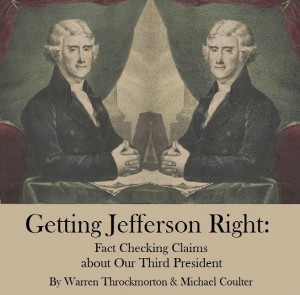
Getting Jefferson Right: Fact Checking Claims About Our Third President

That is the title of an upcoming eBook I am publishing on Amazon.com along with fellow Grove City College professor of political science, Michael Coulter. We are greatly expanding the posts I did here examining and debunking claims by David Barton and others about Thomas Jefferson. Most of the book is new material and examines claims about Jefferson in the areas of church and state relations, education, the Bible, his religious views and current politics. There is an extensive section on the Jefferson Bible and other claims related to the Bible rarely included in any resource on Jefferson. We are including an annotated bibliography of accurate and helpful resources as well.

One book that won’t be on that list but we discuss frequently is David Barton’s new book, The Jefferson Lies, which is now available on Amazon. I’ve read it and we include substantial rebuttals to claims made in the book. In fact, one of the claims I responded to when I wrote about Kirk Cameron’s new movie Monumental which comes out tomorrow. In that post, I noted that Barton misled viewers about a Family Bible and indeed in his book, he identifies it as the Thompson hot press

Bible. In the advanced copy I have, Barton claims that Bible was funded by a dozen signers of the Declaration and Constitution, including Jefferson. Barton says Jefferson “personally helped finance the printing of one of America’s groundbreaking editions of the Bible.” (p. 68). In truth, he bought a Bible from Thompson and Small along with over 1270 other people.  In fact, Jefferson didn’t finish paying for it until after the Bible was printed. It was completed in 1798 and Jefferson didn’t pay his final $10 until early 1799.

A website is in the works and it will be available as an eBook on Amazon in mid-April. Ebooks can be read on any smart phone, IPad, IPod, computer, Kindle or reading device. For now, go Like our Facebook page and and answer a question we deal with in the book. More questions will be added between now and mid-April.

Must Be Spring, Day of Silence Derangement Syndrome is Breaking Out

On April 20, thousands of students will remain silent for part of the school day to call attention to anti-gay bullying and harassment. Called the Day of Silence, the event is sponsored by the Gay, Lesbian & Straight Education Network.

In 2008, some Christian right organizations called on parents to keep their kids home on the Day of Silence. This is happening again this year.

The Day of Silence brings out some really odd statements from those opposed to it. One would think that sending your kids to school on that day is sinful. Take for instance this exchange, reported on Right Wing Watch, between Linda Harvey and Laurie Higgins:

Higgins: What the Day of Silence does is ask kids to refuse to speak during instructional time in class, that they have no legal right to do and no school has to accommodate that, and so that’s what we’re doing is asking parents to call their school, ask if students are allowed to refuse to speak in instructional time, and if they are, to keep their kids home in protest about the disruption of instructional time for a political purpose.

Harvey: You can keep your kids home that day if you suspect or you find out that teachers are going to accommodate this protest silence in order to honor homosexuality, let’s be clear about what this is, this is a God-dishonoring day that honors sin, sinful, immoral behavior that most parents don’t want their children involved in.

Higgins: Christian teachers out there and if you’re working in a public school plan activities that involve student communications so students are not allowed to do this.

Laurie Higgins says the Day of Silence people promote kids remaining silent in class. While the organizers are fine with teachers who allow this response, GLSEN is clear that students do not have the right to remain silent if the class activities call on them to speak. Here is what the Day of Silence blog says about students and class room communication.

1. You DO have a right to participate in Day of Silence and other expressions of your opinion at a public school during non-instructional time: the breaks between classes, before and after the school day, lunchtime, and any other free times during your day. If your principal or a teacher tells you otherwise, you should contact our office or the Gay, Lesbian and Straight Education Network.

2. You do NOT have a right to remain silent during class time if a teacher asks you to speak. If you want to stay quiet during class on Day of Silence, we recommend that you talk with your teachers ahead of time, tell them that you plan to participate in Day of Silence and why it’s important to you, and ask them if it would be okay for you to communicate in class on that day in writing. Most teachers will probably say yes.

3. Your school is NOT required to “sponsor” Day of Silence. But Day of Silence is rarely a school-sponsored activity to begin with – it’s almost always an activity led by students. So don’t be confused – just because your school isn’t officially sponsoring or participating in Day of Silence doesn’t mean that you can’t participate.

4. Students who oppose Day of Silence DO have the right to express their views, too. Like you, they must do so in a civil, peaceful way and they only have a right to do so during non-instructional time. For example, they don’t have a right to skip school on Day of Silence without any consequences, just as you don’t have a right to skip school just because you don’t like what they think or say.

The irony is that Higgins and Harvey accuse the Day of Silence participants of violating school rules by remaining silent, and then turn around and urge truancy. Higgins and Harvey are fine with skipping an entire day of school, but become unhinged when those opposed to anti-gay bullying want to remain silent during non-instructional times.

I urge parents to resist Day of Silence Derangement Syndrome and send their kids to school on the Day of Silence (and even the misguided Day of Dialogue the day before). Send them to school and encourage them to become part of the solution via opposition to bullying. Students may want to remain silent, or take part in the Golden Rule Pledge which can take place any day of the year.