The Founders’ Bible – Really?

Rolling over in their grave, they are…

I wonder if Thomas Jefferson provides commentary on some of the books. Prior to the book of Revelation, Jefferson could enlighten readers with this little gem:

It is between fifty and sixty years since I read it [the book of Revelation] and I then considered it as merely the ravings of a maniac no more worthy nor capable of explanation than the incoherences of our own nightly dreams. I was therefore well pleased to see in your first proof sheet that it was said to be not the production of St John but of Cerinthus a century after the death of that apostle. Yet the change of the author’s name does not lessen the extravagances of the composition and come they from whomsoever they may I cannot so far respect them as to consider them as an allegorical narrative of events past or subsequent. There is not coherence enough in them to countenance any suite of rational ideas. You will judge therefore from this how impossible I think it that either your explanation or that of any man in the heavens above or on the earth beneath can be a correct one. What has no meaning admits no explanation and pardon me if I say with the candor of friendship that I think your time too valuable and your understanding of too high an order to be wasted on these paralogisms. You will perceive I hope also that I do not consider them as revelations of the Supreme Being whom I would not so far blaspheme as to impute to Him a pretension of revelation couched at the same time in terms which He would know were never to be understood by those to whom they were addressed. In the candor of these observations I hope you will see proofs of the confidence esteem and which I entertain for you.


More Evidence David Barton is Wrong About Jefferson and Slavery: Robert Carter’s Emancipation Deed

I talked about Robert Carter in a prior post. Carter set in motion a plan to free his slaves beginning on August 1, 1791. Fresh from the Northumberland District Court in Heathsville, Virginia, I have copies of the Deed of Gift which Carter filed on August 1, 1791. I will pull out a couple of pieces of it and then provide links to all the pages which you can click through to review.

David Barton wrote in The Jefferson Lies that Thomas Jefferson was unable to free his slaves due to Virginia law. However, in Getting Jefferson Right, we demonstrate that Virginia law changed in 1782 to allow emancipation both during an owner’s life and at his death. The law was in effect for 24 years until it was modified in 1806 to make manumission more complicated for the slaves.

It is one thing to examine the law, but it is another thing to see the law in application. Robert Carter, a wealthy plantation owner who also sat on the Governor’s Council, submitted a deed, in accord with the law, on September 5, 1791. The process would take years and involve other people Carter appointed when he left Virginia.

Carter wrote the Deed of Gift on August 1, 1791 and included a list of 452 of his slaves covering all or part of five pages. Slaves over age 45 would be handled in another manner. Page one is here so you can see the format of the deed:
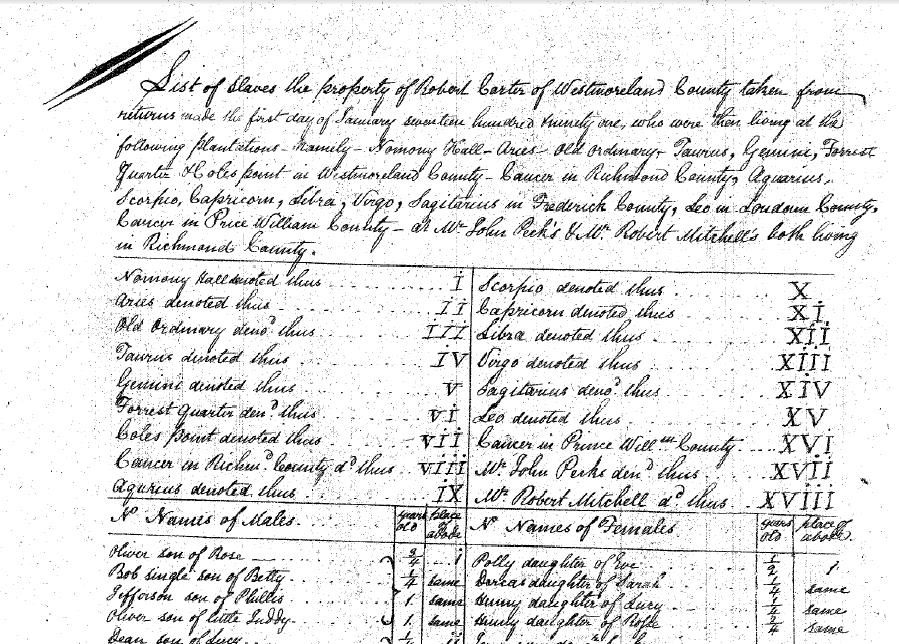
First, Carter introduced the list, then provided a listing of his plantations and finally a list of his slaves by name, age and location.

The next three pages contained an inventory of human beings and then on the fifth page of the deed, Carter provided his rationale and legal basis for the emancipation.
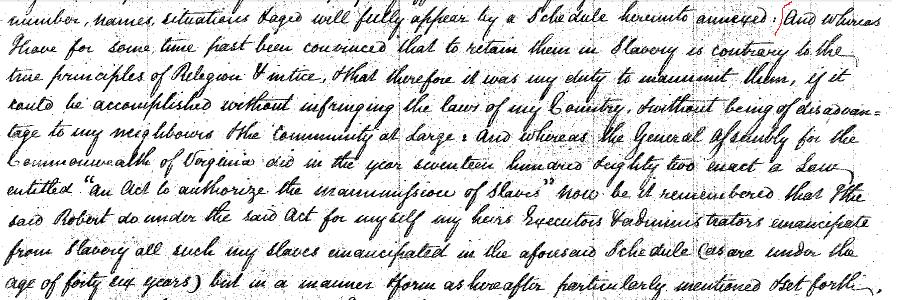
This section is quite important so I type it out here for easier reading (start at the red slash at the end of the first line):

And whereas I have for some time past been convinced that to retain them [slaves] in slavery is contrary to the true principles of Religion & Justice, that therefore it was my Duty to manumit them, if it could be accomplished without infringing the laws of my Country, without being of disadvantage to my neighbors & the Community at large: And whereas the General Assembly for the Commonwealth of Virginia did in the year seventeen hundred eighty two enact a Law entitled “an Act to authorize the manumission of slaves” now be it remembered that the said Robert do under the said Act for myself my heirs my Executors & administrators emancipate from slavery all such my slaves in the aforesaid Schedule (as are under the age of forty-six years) but in a manner & form as hereafter particularly mentioned & set forth.

Virginia law set age restrictions on manumissions and the older slaves would be handled differently. However, this document provides clear reference to the Virginia law passed in 1782 which allowed Carter to do what he listed here.

As recently as last week, David Barton told a radio audience that Jefferson could not free his slaves due to Virginia law. I don’t know how long it will take for someone in the Christian community to hold him accountable for this but the evidence is here that he is wrong.

Some have asked me why this matters. First of all, I would like to think that Christian leaders would not want to put out falsehoods. Second, I recently spoke to an African American pastor who told me that Barton’s whitewash of Jefferson’s record is offensive to him and his colleagues. According to this pastor, lifting up Jefferson as an abolitionist and civil rights champion hinders racial reconciliation within the greater Christian community.

Robert Carter’s entire Deed of Gift (click the links)

Page one, two, three, four, five, & six.


For more on Jefferson and slavery as well as other matters covered in David Barton’s recent book, see Getting Jefferson Right.

Exodus Publicly Backs Away From Reparative Therapy

If you’ve been reading here, you would know this.

An AP story is all over the place yesterday and today with the headline that Exodus has removed reparative therapy books from the website, and is no longer promoting change therapy. According to Alan Chambers, Exodus President, “the ministry’s emphasis should be simply helping Christians who want to reconcile their own particular religious beliefs with sexual feelings they consider an affront to scripture.”

Again, no surprise to anyone who reads here regularly, I think he is on target.

I must admit, this is satisfying. When I first dropped my article in 2005 questioning reparative therapy, I was beaten up pretty badly by those in what was the ex-gay movement at the time. Things have changed. Focus on the Family is out of the reparative business for the most part. Exodus is now working on congruence as a goal, and NARTH is fighting for its life. And the APA has taken a position that congruence as an objective is acceptable.

Speaking of NARTH, the AP article says is “a professional association made up of about 2,000 therapists and others who still espouse such treatments.”

Wait, what? 2,000?

Did they gain 1,000 members in less than a year? In October, 2011, I asked David Pruden at NARTH how many professional members were on the rolls. He told me the number was at 250, with the remaining 750 or so being advocates and laypeople.  Is this puffery or have they gained 1,000 names since last October?

UPDATE: David Pruden just wrote to say that he did not tell the reporter 2k so perhaps it was a misunderstanding.


David Barton Continues the Whitewash of Jefferson as Slave Owner on the Bill Martinez Show

In prior posts, I have demonstrated that Thomas Jefferson was allowed by Virginia law to emancipate his slaves. Barton says he couldn’t do it, but we demonstrate in Getting Jefferson Right that Barton omitted from The Jefferson Lies the citation to Virginia law that proves Jefferson could have done so.

In a June 14 podcast of The Bill Martinez radio show, Barton compounds the problem by distorting the situation even more. About Jefferson and his slaves, Barton tells Martinez starting at 11:10 –

…he [Jefferson] inherited 187 slaves when he was back at 13 years old. Guess what? Virginia state law makes it illegal to free your slaves, period. So Jefferson  has 187 slaves he’s inherited, he cannot free them. Now George Washington found a loophole and freed his slaves on his death and the legislature said, ‘would you look at that, we missed that’ and they came back and fixed the loophole so you could not free your slaves on your death. So a lot of Thomas Jefferson’s neighbors moved out of Virginia, took their slaves with them, cause they wanted to free slaves and you couldn’t do it in Virginia, and Jefferson choose not to leave Virginia, so he stayed with family, he stayed there. What he did was he had these slaves working for, he paid them, if they caught fish, if they hunted game, he paid them, which is one of the reasons he died broke. Find me another slave owner who paid slaves.

Nearly everything said there is wrong. Jefferson inherited 20 slaves at age 14 when his father died. He acquired the remainder of his slaves via inheritance from his father-in-law and additional purchases and births throughout the remainder of his life. By 1822, Jefferson had 267 slaves. We have all the details in Getting Jefferson Right.

The loophole Barton refers to is the 1782 law on manumission which allowed owners to free slaves while the owner was alive and at death. As we have pointed out, Barton omitted from The Jefferson Lies the section which allowed owners to free slaves, but on the Martinez show, he says the rest of the law was a “loophole.” The Virginia legislature knew what was in the law, and they encountered many petitions from slave owners to revoke the law over the years it was in effect. However, the law was used by owners like George Washington at death and Robert Carter while alive to free their slaves. Even in 1806 when the law was tightened, emancipation was still possible. However, freed slaves were required to leave the state within a year after their freedom. With that restriction, some slaves preferred to remain near family rather than become emancipated.

Barton says Jefferson was broke because he paid his slaves. I just returned from Monticello and agree with the many historians who point out that Jefferson’s lifestyle was most likely the reason he was chronically in debt. Jefferson bought and sold slaves during the period of time when he could have freed them. While he was a kinder master than many, he certainly viewed his slaves as property.

Rather than expose a myth, Barton elaborated one that he first told in his book.