Daily Monitor: GLBT conference raided by Uganda’s Ethics Minister

From Uganda’s Daily Monitor earlier today:

There was drama at Imperial Resort Beach Hotel in Entebbe today when State Minister for Ethics and Integrity Simon Lokodo broke up a secret gay rights activists conference.

The two week conference organised by Freedom and Roam Uganda, an association that lobbies for the recognition of same sex relationships in Uganda ended prematurely when the minister ordered them to disperse.

“I have closed this conference because it’s illegal. We do not accept homosexuality in Uganda. So go back home,” Minister Lokodo told the participants.

If the authorities can raid a conference before it becomes against the law to have a conference, then what will happen if the Anti-Homosexuality Bill becomes law?

Apparently, the authorities attempted to arrest the leader of the conference.

Committee Chair: No Plans Set for Uganda’s Anti-Homosexuality Bill

Stephen Tashobya, chair of the Legal and Parliamentary Affairs Committee of the Ugandan Parliament, told me yesterday that he had not scheduled consideration for the Anti-Homosexuality Bill.  Asked if his committee would write a new report, or stick with the report issued during the last Parliament, Tashobya declined to say. “The committee will have a say on that and we will meet soon to decide how to proceed with all of the bills returned to the committee,” Tashobya explained.

When asked if he planned to have the anti-gay bill back to the floor of the Parliament within the required 45 day period, Tashobya expressed some reservations that he could guarantee that time table. He noted, “We have many bills which have a high priority, such as the Marriage and Divorce bill and other bills on commerce.”

Parliament rules require bills sent to committee to be acted on and returned for consideration within 45 days. Last year, Speaker Rebecca Kadaga warned committee chairs that they could face unspecified sanctions if this rule was not kept.

According to Parliament’s rules (see below), Tashobya could ask Parliament for more time if the committee has not prepared the necessary report within 45 days. At that point, Parliament could grant or decline the request. If the request is declined, Parliament could act on the bill at that point. If an extension is granted, the bill will be considered at the end of that period whether or not the committee’s work is complete.

When asked if he had been pressured by the Executive branch to go slow on the  anti-gay bill, Tashobya said he was unable to comment.

Tashobya, who was not at Parliament the day the bill was tabled, said he is aware that the bill has wide support among the MPs.


From Uganda’s Rules of Parliamentary Procedures

125. Delays with Bills

(1) Subject to the Constitution, no Bill introduced in the House shall be with the Committee for consideration for more than forty-five days.

(2) If a Committee finds itself unable to complete consideration of any Bill referred to it in sub-rule (1), the Committee may seek extra time from Parliament.

(3) Where extra time is not granted or upon expiry of the extra time granted under subrule (2), the House shall proceed to deal with the Bill without any further delay.

Anoka-Hennepin School District Ends Silence Policy Toward Sexual Orientation

UPDATE – 2/14/12: The school board placed this information on their website about the change (scroll down to see the approved policy):

The Anoka-Hennepin School District has a new policy designed to promote a respectful learning environment in which teachers facilitate student discussions of contentious topics in a balanced and impartial manner that encourages development of critical thinking and decision-making skills.

“I believe this policy is the best thing for Anoka-Hennepin and for all students,” said Board Chair Tom Heidemann, who went on to say it “takes away some of the confusion that existed in the previous policy.”

The School Board approved the Respectful Learning Environment – Curriculum Policy Feb. 13 following more than two months of discussion and hours of public input regarding replacement of the Sexual Orientation Curriculum Policy (SOCP). Some teachers felt that the SOCP was confusing. Board members asked the administration to bring forward a new policy that would eliminate the confusion.

The board sought a policy that would address any issues that may be contentious instead of focusing on specific topics. (The new policy replaces the Religious Activities Policy as well as the SOCP.) They also wanted to ensure that staff would not attempt to persuade students to adopt a particular viewpoint, and to clarify that the board-adopted curriculum is the basis for education in district schools.

After rejecting an earlier proposal in December when public input revealed little support for it, staff developed the Respectful Learning Environment-Curriculum Policy and presented it to the board Jan. 23. According to Paul Cady, district general counsel, the new policy meets the intent of the board, responds to public input, and reflects academic research on how to best deal with issues of public controversy that may arise in the classroom.

“It’s not the district’s role to take a position on these issues and it’s not acceptable for professional staff to persuade students to adopt or reject any particular viewpoint,” said Chair Heidemann. This was one of several elements he felt were missing in the previous policy.

He also stressed that the district’s curriculum will not change as the result of adopting the Respectful Learning Environment – Curriculum Policy. “Curriculum changes only if there are four votes on this School Board,” Heidemann said.

Board member John Hoffman noted that the district has a transparent process for adopting curriculum and community members have the right to participate in that process.

Board members also stressed that the new policy emphasizes a safe and respectful learning environment for all students. “It gets to the intent of our founding fathers of this great state and ensures all are welcome to participate in this wonderful experience of free, public education,” said Hoffman

Board member Scott Wenzel stressed that by adopting the Respectful Learning Environment-Curriculum Policy the board removes a policy that singles out one minority group and establishes the dignity and self-worth of all students. “I believe our teachers always have the best interests of students at heart. [This policy] provides the reassurance that our teachers will continue to do that.”

The proposed policy opens with a commitment to a safe and respectful learning environment for all students and an education that respects all students and their families. It stresses that teachers must follow the board-adopted curriculum, which is based on state standards, and it acknowledges that political, religious, social or economic issues may be contentious in a learning environment “in which conflicting views are held by a broad segment of people in our schools, our community and our nation.”

The policy states that the district does not take positions on these issues and that staff shall not attempt to “persuade students to adopt or reject any particular viewpoint with respect to these issues.” When contentious issues are discussed in classrooms, it states that the discussions must be appropriate for the developmental level of students, related to the course content, and presented in a balanced manner with varying points of view. They should be designed to help students “think critically and develop decision-making skills and techniques for examining and understanding differing opinions.”

It closes by stating that in these discussions, staff “shall affirm the dignity and self-worth of all students.”

………

Earlier tonight, various news sources reported that the Anoka-Hennepin School Board was considering a replacement for their gag policy on teacher discussions of sexual orientation. The old policy forbid teachers from discussing with students aspects of sexual orientation as a reality.
(Read policy after the break)

Continue reading “Anoka-Hennepin School District Ends Silence Policy Toward Sexual Orientation”

What’s Next for Uganda’s Anti-Homosexuality Bill?

Click here for the current official text of the Anti-Homosexuality Bill.

This morning AFP news service has an article that correctly reports the story about the bill, amendments and the process involved.

Parliament officials said Thursday that the bill — which US President Barack Obama has described as “odious” — had been reintroduced in its original format, which included the death penalty clause.

Bahati continues to say he will recommend the removal of the death sentence for aggravated homosexuality.

A Ugandan lawmaker behind a proposed draconian anti-gay bill that sparked an international outcry said Friday he wanted to drop clauses that would see the death penalty introduced for certain homosexual acts.

“There will be no death penalty at all…that will go,” David Bahati, the legislator who formulated the bill, told AFP.

As expected, Bahati will recommend the removal of the requirement to report known gay people. However, he wants to zero in on “promotion.”

Bahati said the bill was now focused on stopping the promotion of gay rights, and retains a proposal to criminalise public discussion of homosexuality with a heavy prison sentence.

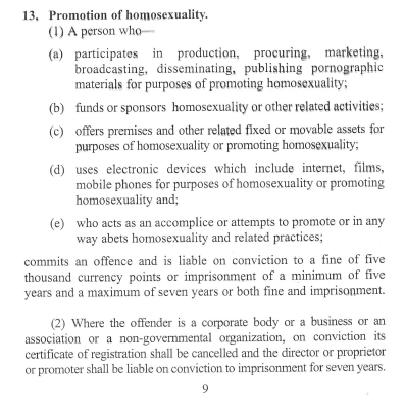
Here is the section in the existing bill on promotion of homosexuality:

The way this is worded, landlords will not be able to rent to gays, most public establishments will be reluctant to serve more than one gay person at a time, if at all. Gay people using cell phones or the internet (bloggers, emailing, etc.) will be in jeopardy. The potential for use of police power to snoop on private citizens is heightened and the potential to use this law to accuse enemies of promoting homosexuality seems clear. While this seems to be intended to put GLB rights groups out of business, the reach goes far beyond those groups.

Although the reporting requirement has been dropped, I don’t think health care professionals are in the clear. If they give advice to a GLBT person that affirms them, then I believe the way this aspect of the bill is worded, then they might violate the very broad language here.

This clearly violates freedom of conscience for those who are gay and those who are not. If a religious leader is convinced that GLBT persons should be treated with respect and dignity, then they could be viewed as engaging in promotion.

I hope the watching world is not thrown off by the possible removal of the death sentence. This effort remains sinister and has the effect of violation of freedom of conscience and other basic human rights.

Related:


Current Official Text of Uganda’s Anti-Homosexuality Bill 2009

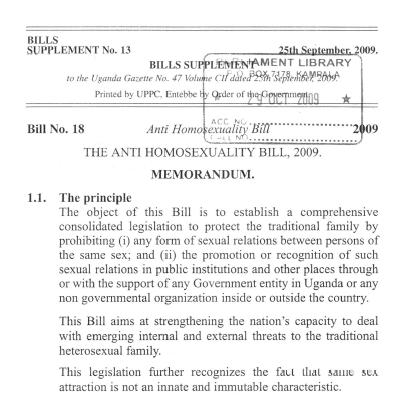
This morning Helen Kawesa, Public Relations Manager for the Uganda Parliament provided this copy of the Anti-Homosexuality Bill which was introduced on Tuesday. As you will see, it is the same bill as was printed in Uganda Gazette on September 25, 2009 and then first tabled on October 14, 2009. Click the screen capture to go to the Gazette copy.

To date, the bill has not been amended and this is the version re-introduced on February 7, 2012.

This morning AFP news service has an article that correctly reports the story about the bill, amendments and the process involved.

Parliament officials said Thursday that the bill — which US President Barack Obama has described as “odious” — had been reintroduced in its original format, which included the death penalty clause.

Bahati continues to say he will recommend the removal of the death sentence for aggravated homosexuality.

A Ugandan lawmaker behind a proposed draconian anti-gay bill that sparked an international outcry said Friday he wanted to drop clauses that would see the death penalty introduced for certain homosexual acts.

“There will be no death penalty at all…that will go,” David Bahati, the legislator who formulated the bill, told AFP.

However, it remains to be seen whether or not the Parliament will alter the bill in the way Bahati now proposes. Two sources within Parliament have informed me that the MPs will be inclined to agree with recommendations made by Bahati and the Legal and Parliamentary Affairs committee. If he can be believed, Bahati’s strategy seems to have shifted to making it dangerous for GLBT people communicate or gather. More on this in the next post…