NARTH features leader of international efforts to keep homosexuality illegal

This coming weekend, Sharon Slater will speak at the annual conference of the National Association for the Research and Therapy of Homosexuality (NARTH). Slater is the President of Family Watch International, an organization that lobbies the United Nations for pro-life and anti-gay causes. In January of 2011, Slater hosted a conference of over 30 United Nations delegates to promote her policy objectives. During the conference, the ex-gay message was prominent with a “the personal testimony of a patient who is successfully reorienting from homosexuality to heterosexuality” and a speech from an expert Slater refused to name.
Earlier this year, Slater claimed that she stopped using Martin Ssempa as a liaison in Africa after she learned about Ssempa’s support for the Anti-Homosexuality Bill. Slater correctly understands that the bill requires the death penalty for HIV positive gays and she opposes that. However, she refused to condemn prison terms for gays in Uganda or any other country. In essence, her position is the same as Scott Lively’s view – oppose the death penalty but support the stance of African nations who maintain harsh prison terms for GLBT people. The Anti-Homosexuality Bill is once again before Uganda’s Parliament and may be considered on the floor within the next month.
Slater has traveled to Africa several times to speak against relaxing laws on homosexuality. At a Nigerian conference in 2009 – the same year the Anti-Homosexuality Bill was introduced – Slater praised Uganda for refusing to decriminalize homosexuality. Earlier this year, also in Nigeria, Slater commended Nigeria for resisting the UN’s call for decriminalization.
Like Lively, Slater uses NARTH materials as a foundation for her policy positions. On the FWI website, Slater twice refers readers to a 2009 paper by NARTH which reviews studies of sexual orientation change efforts. She uses their materials to support her view that GLB people are not entitled to human rights because sexual orientation is not a fixed trait.
In this context, it is striking that NARTH has refused to declare opposition to criminalization of homosexuality. In December, 2009, I asked NARTH’s leadership about the organization’s position on Uganda’s Anti-Homosexuality Bill. At that time, Scott Lively advocated that forced therapy for gays should be included in the bill. NARTH’s operations director, David Pruden, rejected the forced therapy as ineffective. However, NARTH past-president Dean Byrd declined to take a position on criminalization saying,

We are aware of the situation in Uganda but thank you for bringing this to our attention. I am sure that you are aware that as a scientific organization, NARTH does not take political positions; however, we are happy to provide a summary of what science can and cannot say about homosexuality for those who do.

In contrast, NARTH has taken a position on a few political issues. For instance, the organization opposes “gay advocacy in schools” and “same-sex marriage.” Since NARTH has taken a stance on some political issues, it is puzzling that the organization will not on criminalization of homosexuality. Such laws harm affirming and non-affirming GLB people alike.
In light of NARTH’s failure to oppose criminalization, it is troubling that the group invited Slater to speak at their conference.  Ms. Slater is not trained as a clinician, scientist or a researcher; she is an advocate of policies which restrict the basic liberties of GLB people around the world and would do the same in the US if possible. In absence of an official policy on decriminalization, it appears that NARTH’s invitation of Ms. Slater signals the posture of the organization on the matter.
Senator Jim Inhofe condemns Uganda's Anti-Homosexuality Bill

In response to a reporter’s request for comment, Senator Jim Inhofe, known to be affiliated with the Fellowship Foundation, condemned the Anti-Homosexuality Bill, now active again in the Ugandan Parliament.
According Red Dirt Report:

OKLAHOMA CITY — Responding to Red Dirt Report’s October 27, 2011 story “Uganda, The Family and the reintroduction of ‘loving punishments,” U.S. Sen. Jim Inhofe, R-Okla., offered the following statement, sent to this reporter on Friday:
“I do not, nor have I ever, supported or condoned this legislation. It is my hope that Uganda will abandon this unjust and extraordinarily harsh legislation,” Inhofe said.

Bryan Fischer: Changing sexual orientation like scoring 100 points in a single NBA game

I bet Bryan Fischer would like to take this one back. Says the incomparable Mr. Fischer today comparing the change from gay to straight:

We know that it’s possible to bat .400 over the course of a major league season, because one man, Ted Williams, did it in 1941. We know that it’s possible to hit 73 home runs in a single season, because one man, Barry Bonds, did it in 2001. We know that it’s possible to score 100 points in an NBA game, because one man, Wilt Chamberlain, did it in 1962.

So what are the odds of your typical basketball enthusiast scoring 100 points in game? Of an NBA player? How about hitting over .400 in a baseball season? This analysis calculated somewhere between a 2.4 and 4.7% chance.
Of course, Fischer shows just how far he is willing to stretch the Jones and Yarhouse study by his title: Study proves gays aren’t born that way. The study says nothing of the kind and does not address causes in any way.
Fischer misuses the Jones and Yarhouse study to mislead his audience. Except that he may be closer than he realizes to getting the odds about right.

The Jones and Yarhouse study: What does it mean?

Let me begin by saying that I endorsed the book, Ex-Gays, A Longitudinal Study of Religiously Mediated Change in Sexual Orientation, by Stanton Jones and Mark Yarhouse which contained the first report of their longitudinal study. Since the publication of the book, Jones and Yarhouse have released results of their final follow up, first in 2009 at the annual convention of the American Psychological Association, and then most recently in the Journal of Sex and Marital Therapy. With the follow up, I believe the study remains an important investigation into the interplay of religion, sexual orientation and personal identity. I give them credit for the perseverance required to explore a topic which is highly controversial and to report their findings in detail.

Since the release of the peer-reviewed article, socially conservative groups have described the study as proof that gays can change orientation. For instance, the American Family Association’s Bryan Fischer, one of the worst offenders, claims that the study proves gays can change and that they weren’t born gay. Also, Citizenlink, an affiliate of Focus on the Family reported:

Of the 98 subjects, more than half were reported as successful; 23 percent reported a complete change in orientation after six years. Also, 20 percent reported giving up the struggle to change.

This claim is misleading. Jones and Yarhouse did not report “complete change in orientation.” Instead they cautioned against misinterpreting their findings by saying

These results do not prove that categorical change in sexual orientation is possible for everyone or anyone, but rather that meaningful shifts along a continuum that constitute real changes appear possible for some. The results do not prove that no one is harmed by the attempt to change, but rather that the attempt does not appear to be harmful on average or inherently harmful. The authors urge caution in projecting success rates from these findings, as they are likely overly optimistic estimates of anticipated success. Further, it was clear that “conversion” to heterosexual adaptation was a complex phenomenon.

Regarding the changes reported by their participants, the authors offer two related explanations. One is that some of the participants changed sexual orientation to some degree and the other is that the participants changed their sexual identity. Sexual identity involves placing more emphasis on behavioral conformity to prohibitions on homosexual behavior as a means of self definition. For the Exodus participants, less temptation to engage in homosexual behavior might be taken as a signal that orientation has changed, thus allowing a different attribution about their sexuality than once believed. The authors raise these two possibilities in the abstract for the most recent paper:

The authors conducted a quasi-experimental longitudinal study spanning 6–7 years examining attempted religiously mediated sexual orientation change from homosexual orientation to heterosexual orientation. An initial sample was formed of 72 men and 26 women who were involved in a variety of Christian ministries, with measures of sexual attraction, infatuation and fantasy, and composite measures of sexual orientation and psychological distress, administered longitudinally. Evidence from the study suggested that change of homosexual orientation appears possible for some and that psychological distress did not increase on average as a result of the involvement in the change process. The authors explore methodological limitations circumscribing generalizability of the findings and alternative explanations of the findings, such as sexual identity change or adjustment.

As I read all of the literature, including my own work, I first want to disagree with the way that Citizenlink characterized the results as “complete change.” That is not at all what Jones and Yarhouse reported. Considering the dichotomy proposed by Jones and Yarhouse — change in orientation or identity – I lean toward their alternative explanation – “sexual identity change or adjustment.”  However, I believe the discussion of what their results mean needs to be broadened beyond those two possibilities. In addition to considering orientation and identity as important constructs, I believe there are other ways to account for the changes Jones and Yarhouse report which are not sufficiently addressed in their published accounts.  First, I want to make some observations about the study which influence my opinions about what the results mean.

First, and most basically, the Jones and Yarhouse study did not examine in any systematic way the efficacy of reparative therapy or any other kind of psychological therapy as a means of altering sexual orientation. The participants in the study were involved in religiously based support groups which primarily had as a goal to reinforce a traditional moral view of sexuality. Clearly, the participants hoped they would change and engaged in various religious interventions to assist that end. However, the study did not assess the role of professional therapy and cannot legitimately be used to say such therapies work.

Second, there were quite a few dropouts six to seven years into the study. While true of all longitudinal studies, the final percentages being reported should also take into account the distinct possibility that many if not most of the drop outs were not successful in their efforts to change. The study began with 98 participants and ended up with 65 who were followed up for six to seven years. Some reported that they were healed of homosexuality and just didn’t want to participate, while others said they were gay and stopped trying to change. I don’t know for sure what the dropouts mean but the fact that so many failed to complete the study needs to be a part of any discussion.

Third, ratings from men and women were combined. Given the low number of people involved I understand why this was done but the practice may inflate the assessments of change for the group. It has become well accepted that the sexuality of women is more fluid than for men. A few women experiencing large shifts could influence the group averages. Continue reading “The Jones and Yarhouse study: What does it mean?”

Psychoanalyst disavows study of lesbians; questions the Bieber study

Reparative therapists consider the 1962 Bieber study to be a landmark investigation of the psychodynamics of male homosexuality. The study authors claimed to find evidence for the role of weak, distant fathers and overly protective mothers in the development of homosexuality in their patients. They also claimed that 27% of the patients in the study were cured of their homosexuality.

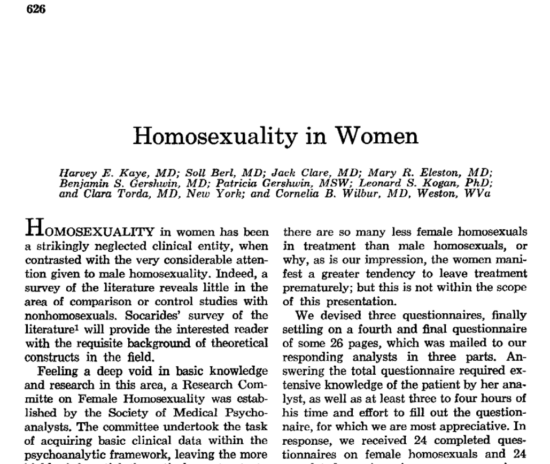
Four years later, in 1967, a companion study on lesbians was published in the Archives of General Psychiatry. Using the same methodology and one of the same co-authors (Cornelia Wilbur), the Society for Medical Psychoanalysis sought to explore the factors involved in the causing and curing lesbians. The lead author of that study was psychoanalyst Harvey Kaye.

Today, I talked to Dr. Kaye and asked him about his study and what he thought about his findings now. At the time, Kaye’s team reported that the fathers of lesbians were puritanical and discouraged sex play with boys (sounds like evangelical dads). Generally, Kaye’s team put the spotlight on the fathers rather than mothers. Kaye’s group also reported that 50% of the lesbian clients were significantly changed via psychoanalysis.

Today, in conversation with me, Dr. Kaye discredited his results.

“I disavow the validity of the study,” Kaye said. “I don’t agree now with what we wrote.”

He added, “Frankly, I haven’t the vaguest idea what causes homosexuality in men or women, although I lean toward intrauterine events.”

Kaye explained that he has treated numerous gays and lesbians and that his experiences had influenced his current views.

About Irving Bieber’s views on the origins of male homosexuality, Kaye said, “I disagree with Bieber’s views violently. He was one of the last ones to hold on to the idea of the role of the mother and father.” Referring to Bieber’s methodology of relying on the reports of psychoanalysts, Kaye said, “He knew what he wanted to find before he did his study.”

The Kaye study is one of the psychoanalytic reports referenced in NARTH’s review of past research on change of orientation. The introduction to the review says:

In the clinical and scholarly literature over the past 125 years, mental health professionals document many different ways to assist men and women to successfully change from a homosexual to a heterosexual orientation. (NARTH, 2009, p. 19)

The NARTH report then briefly describes Kaye’s 1967 article:

Kaye et al. (1967) sent 26-page surveys to more than 150 psychoanalysts who saw homosexual women in their practice, and received back 24 completed surveys. Eight of the 15 cases that were reported to be in the “homosexual range” (Kinsey scores of 4-6) at the onset of treatment had shifted to a Kinsey score of 0 (exclusively heterosexual) either at termination of treatment or when the analyst filled out the survey. Kaye et al. concluded, “Apparently at least 50% of them can be helped by psychoanalytic treatment” (p. 633). (NARTH, 2009, 23)

Or not.

Dr. Kaye’s current evaluation throws more doubt on NARTH’s methodology of reporting old research as “historically state of the art” (NARTH, 2009, 37). There is reason to question that allowing psychoanalysts to fulfill their own prophecies was ever state of the art. In any case, Dr. Kaye’s candor is one of many reasons to remain skeptical of the 125 years of research trusted by NARTH.