Yesterday, I reported that the Parliament of Uganda voted to return unfinished bills from the Eighth Session to business in the current session. One of those bills specifically referenced was the Anti-Homosexuality Bill.
This morning I spoke with Parliament Spokeswoman, Helen Kawesa, who told me that no date had been set for debate on the anti-gay measure. “The Business Committee will meet to decide what bills are considered. Then they will be listed on the daily Order Paper,” Kawesa explained. The Business Committee is chaired by Speaker of the House Rebecca Kadaga and made up of all other committee chairs. Currently, no date has been set for this committee to consider a schedule for the bills returned from the Eighth Parliament.
I also spoke briefly to Stephen Tashobya, chair of the Legal and Parliamentary Affairs committee. His committee prepared a report on the Anti-Homosexuality Bill in May and recommended passage with some minor changes. He had no comment on the status of the anti-gay bill since he has been traveling.
According to Kawesa, the Business committee could recommend that the anti-gay bill go back to committee or it could recommend that the former committee report become the basis for debate in the Parliament. Apparently, the return of the bill to the floor is not automatic. The Speaker has some ability to delay it or expedite it. The decision of the Business committee may signal how quickly the bill will move.
The committee report from Tashobya’s committee left the severe aspects of the bill intact, including the death penalty and life in prison (see an analysis here).
Year: 2011
Uganda's Parliament continues Anti-Homosexuality Bill
Here it is. I thought it would be back, just didn’t know when.
Here is a little more from Melanie Nathan.
Today’s Order Paper contained the motion:
7. MOTION TO SAVE AND RETAIN BILLS THAT WERE TABLED IN THE 8TH PARLIAMENT.
Mover: Hon. Sarah Mpabwa, UPDF Representative
Seconder: Hon. Ayena Krispus, MP Oyam North (UPC)
I will have an update later today or tomorrow.
What if NARTH was a scientific organization?
Yesterday, I pointed out that most members of the National Association for the Research and Therapy of Homosexuality (NARTH) are not mental health professionals or scientists. Even though the name of the organization promotes research and therapy, three-fourths of the members are not trained or credentialed to do either activity.
Despite the constituency of the group, NARTH is promoted by religiously conservative groups as a scientific organization. One example of this is an appearance in July of this year by NARTH President Julie Hamilton on Washington Watch Weekly, a radio program of the Family Research Council. FRC has taken a lot of heat, from me included, about the information they disseminate about sexual orientation. Some of that criticism should also be directed at the sources of their misinformation. As this interview illustrates, one such source is NARTH.
Tony Perkins sets up the interview by referring to the then current controversy over Marcus Bachmann’s counseling clinic and the allegations that he provides reparative therapy. Then he gets to the interview:
There’s a bigger agenda here. They [gay advocates] want to discredit anything that has to do with Christianity. But there’s something even more troubling here. And what they are doing is that they are trying to discredit a type of therapy that’s based on scientific research and that’s why I’ve invited my next guest to join me. Dr. Julie Hamilton is the President of the National Association for the Research and Therapy of Homosexuality, or NARTH. NARTH is a professional scientific organization that offers hope to those who struggle with unwanted same-sex attraction. They’re not a Christian organization per se, they are focused on the science to help people who want to escape the lifestyle of homosexuality. Dr. Hamilton is also featured by the FRC’s new documentary, The Problem with Same-Sex Marriage and you can find out more about that at FRCRadio.org.
After the introduction, he gets to the bottom line:
Perkins: It’s no surprise to us that faith based counseling is under attack but what does the scientific research say about sexual orientation and an individual’s ability to change it?
Hamilton: The research is clear that people are not simply born gay and that people can change in the area of their sexual orientation.
After some conversation about client self-determination, the interview returns to what research says about change therapy.
Perkins: Now in the wake of this attack on Congresswoman Bachmann and her husband Marcus, we see a number of quote-unquote experts, counselors parade out on cable networks, and I’ve not seen, it’s certainly not a debate, it’s one-sided and they’ve all said, ‘well, all of this type of counseling, the reparative therapy, the idea that people can come out of the lifestyle, that’s been disproven, it’s been rejected and that is harmful and should not be allowed.’
Hamilton: Ok, that’s simply not true. What’s missing from the discussion is what research really reveals. Recently, NARTH releases a landscape survey and an analysis of 125 years of data. So basically we looked back 125 years of case studies, reports and research studies looking to answer the question, is change possible? And what we found is that over the last 125 years, change of sexual orientation has been documented in the scientific literature. And so we know looking at that that for years it has been clear, and even in the recent studies it has been very clear, that people can and do change in the area of behavior as well as attraction. So, and the other thing that we looked at in our landscape review was whether or not change attempts were harmful. And we found very clearly that there is no established report of harm to individuals that therapy tends to be more helpful to people and that it is not a harmful thing. There’s no, and even the American Psychological Association did admit in a report in 2009 that there is not enough evidence to claim that it’s harmful.
There is a lot wrong with Hamilton’s defense of change therapy. First, she glosses over the fact that even the most charitable reading of studies of orientation change find that most participants aren’t successful. Second, she cites the NARTH review which dismisses the flaws in the studies conducted over those 125 years of research. In the NARTH review, George Rekers is cited and we now know the rest of the story about his failed research on gender variance and his own personal issues. The work of William Masters and Virginia Johnson is cited despite the fact that none of Masters’ co-workers have come forward to say they ever saw any of the conversion therapy clients claimed by Masters. Even Masters’ wife and co-author, Virginia Johnson had questions about the existence of the conversion cases.
Some therapists who produced case studies of cure simply made up the cases (e.g., Cornelia Wilbur in collaboration with journalist Flora Schreiber). Many of those old studies were aversive therapy studies where electric shock was used to provide pain in association with same-sex attraction. While some people reported changes, there is very little follow up to find out if they remained changed or simply adapted to the shocks. These methods were discontinued for ethical reasons. NARTH continues to tout studies of approaches no one uses now to bolster their claims. I could go on, but I’ll stop after I note that Hamilton did not mention the studies that find minimal or no change, like the Edification study where the same-sex attracted member of mixed orientation marriages reported no change in attraction on average.
What if NARTH’s representatives disclosed the problems with the research in their public statements? What if they were candid and reported that some of the old studies are flawed to the degree that they cannot be used? What if these representatives disclosed that many of those who report change continue to be attracted to the same sex? Or also mentioned that some studies find no change? What if the differences in results for men and women were disclosed? Or the existence of bisexuality was included in the discussion of what the reported changes mean? What if they reported data from studies discrediting reparative therapy?
Can you imagine a 125-year landscape review of autism or childhood schizophrenia produced in the manner NARTH touts its survey? NARTH reps would be on the radio bringing back cold, distant refrigerator mothers as the cause.
It is possible that groups like the Parents Action League, ACPEDS, and Defend the Family International (Scott Lively) could find some other way to promote their views, but if NARTH was a scientific organization it wouldn’t be NARTH.
NARTH is not primarily composed of mental health professionals
Last week, the Family Research Council promoted the annual conference of the National Association for the Research and Therapy of Homosexuality, touting the group as “one of the best sources of information about homosexuality.” In the description of NARTH, the FRC claimed that NARTH is “primarily composed of psychiatrists, psychologists, and other professional therapists and counselors who offer ‘sexual reorientation therapy’ to help people overcome unwanted same-sex attractions.”
However, this is not accurate. NARTH is not composed primarily of mental health professionals. Actually, according to NARTH’s operations director, David Pruden, only about 250 of NARTH’s approximately 1000 members are mental health professionals. Furthermore, some of those 250 members who have mental health degrees are academics who write about sexuality but do not provide sexual reorientation therapy. Thus, the lion’s share of NARTH’s members consist of lay people, ministers, and activists who have an interest in the materials provided by NARTH but are not scientists or therapists.
By comparison, the American Psychological Association has 150,000 members. All mental health groups are by far much larger than NARTH. I suspect most, if not all, state chapters of these groups are larger than NARTH.
The influence of NARTH comes from the fact that religiously conservative groups like FRC recommend the organization and refer to it as a counterpart to the established organizations. However, in the mental health marketplace, NARTH is not attracting members or supporters. Given the fact that 75% of the members have no professional or scientific credentials, it seems more accurate to consider NARTH to be an advocacy group with some like-minded mental health professionals as members, rather than a scientific group.
This impression is reinforced by the fact that two prime speakers at next week’s convention in Phoenix are not scientists at all, but anti-gay activists. Sharon Slater will speak in a session about her work with United Nations’ countries, especially in Africa and the Middle East, which aims to keep laws on the books criminalizing homosexuality. Then, following Slater, will be Michael Brown who is a minister. Read this post for more about these individuals.
RELATED: What if NARTH was a scientific organization?
Marketing the Bieber Study: Cornelia Wilbur’s Other Scandal
Monday, I wrote about a new book by Debbie Nathan which examines the famous multiple personality case of Sybil, a young woman who claimed 16 personalities. For her book Nathan reviewed the notes of Flora Rheta Schreiber, the journalist who collaborated with Sybil’s psychiatrist Cornelia Wilbur in order to turn the case of Shirley Ardell Mason (Sybil’s real name) into a media sensation. Nathan’s findings debunk the claims of Wilbur and expose the distortions and fabrications which led to the famous case. In looking into Sybil’s history, Nathan also takes a long look at psychoanalyst Wilbur. It turns out that multiple personality was not the only controversial diagnosis Wilbur treated.
While Wilbur was discovering Sybil’s personalities, she also collaborated with Irving Bieber on his study of male homosexuality. Wilbur was one of nine co-authors of Homosexuality: A Psychoanalytic Study, published in 1962. Wilbur also had the distinction of being involved as co-author of the other study of homosexuality conducted by the Society of Medical Psychoanalysts published in the 1960s. Wilbur worked with psychoanalyst Harvey Kaye on a team to research female homosexuality, at the time reporting that half of subjects changed orientation.
With the publication of Sybil by author Flora Schreiber, Wilbur became famous. However, the book about Wilbur’s patient Shirley Mason was not the first collaboration between Wilbur and Schreiber. According to Sybil Exposed, Wilbur and Schreiber met when Wilbur was pitching the findings of the 1962 Bieber study. According to Nathan, Wilbur claimed that the Bieber study reported the causes of male homosexuality and boasted of the 27% cure rate as the result of work with analysts like Wilbur.
Schreiber, a free lance writer, was interested in the research and pitched the idea of a story on the subject to several magazines. Cosmopolitan accepted the pitch and assigned her to write a story about a mother with a gay son “eager to help him go straight.” Schreiber then asked Wilbur for a case which could be turned into an article.
According to Nathan, Wilbur turned over information about Case 129 from the Bieber study. You can read about this case on pages 54-58 of Bieber’s 1962 book (click the links to read it – A, B, C). The case is important for two reasons. One, Schreiber did not like it because the main character was an adult and she was assigned to write about a mother and teen son. Two, according Nathan’s research, the case may have been a thinly veiled reference to Wilbur’s work with actor Roddy McDowall.
After summarizing Case 129 from Bieber’s book, Nathan connects the dots,
The public knew that Roddy McDowall’s father had worked on ships. They knew his mother had pushed him into voice lessons and Hollywood, and that he’d later moved to New York and found success in show business. What McDowall never talked about openly was that he was gay and that after arriving in New York he’d begun an affair with the charismatic, bisexual actor Montgomery Clift, who was eight years his senior and a raging alcoholic. When Clift called off the affair, McDowall tried to kill himself. These facts did not become widely known until after McDowall died in 1998.
Indeed, McDowall’s homosexuality was considered an open secret and one Clift biographer, Patricia Boswell, said that McDowall was suicidal after a breakup with Clift.
However, since Schreiber needed a teen-aged homosexual, the case, no matter how interesting, had to be altered. So, according to her own notes, Schreiber changed the subject of case 129 into an adolescent, Don, who tearfully confessed his homosexuality to his mother, Eve, in a fit of desperation. In the first draft of the article, according to Nathan, Schreiber used many of the details from Wilbur’s case 129 except for the age of the young man. The adolescent boy attended psychoanalysis with Wilbur, who explained the causes of homosexuality right from the Bieber study. Unfortunately for Schreiber, this clinical tale did not suit the Cosmo editor who insisted on changes just before going to press. Nathan writes:
One afternoon just before press time, Flora was summoned to Cosmopolitan’s offices on Fifty-seventh Street. When she got there she was informed that her piece was not acceptable. Eve, the homosexual boy’s mother, was overly intelligent, and her son, Don, seemed too sophisticated. The editors and printers ordered Flora to do an immediate rewrite. She sat down and worked as fast as she could.
The result was an article which was published in January, 1963 under the title, “I Was Raising a Homosexual Child” (click the link to read it on Google books). In this fabrication, Don’s homosexuality was revealed to his parents by means of a phone call from police. Don had been arrested for cuddling with another man in Central Park. However, Schreiber maintained the same causal narrative about smother-mothers and distant fathers advanced by the Bieber book. In the story, the fictional Don saw Dr. Wilbur for psychoanalysis and eventually decided that he didn’t really like guys after all. The Cosmo piece reads like a promotional piece for Bieber and Wilbur’s book, which is apparently what Wilbur hoped for. According to a letter from Wilbur, referred to by Nathan, Wilbur said Schreiber “had gotten things right” in the Cosmo article. Wilbur then thought of Schreiber when it came time to pitch the book about her multiple personality patient, Shirley.
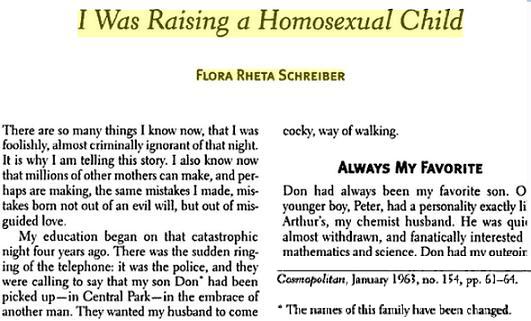
(Note that the article says the names have been changed, implying that the case was real.)
There are many other shocking details about Wilbur’s work with Sybil detailed in the book. For instance, Wilbur supplied Shirley/Sybil with money and hired her for a variety of projects. One of the projects was typing up the manuscript for Bieber’s book on the study of male homosexuality. Although not mentioned in her book, Nathan told me in an interview that Shirley/Sybil was hired to type the book manuscript and even submitted an idea for the cover art.
So before Wilbur pitched the case of Sybil to Flora Schreiber, there was the pitch to Schreiber about the Bieber study. As it turns out, Sybil was a fictional tale only loosely tied to Shirley Mason. However, Don, the allegedly “cured” homosexual, was a complete fabrication.
The Bieber study is at the heart of the reparative narrative about the cause of homosexuality. Many articles on The National Association for the Research and Treatment of Homosexuality website refer to Bieber’s findings as authoritative. Most observers outside of NARTH dismiss the study as hopelessly subjective and flawed. However, for those inclined to give it weight, the study rises and falls on the credibility of the reports from the psychoanalysts who contributed cases since the patients were never surveyed. With the publication of Sybil Exposed, it is now reasonable to call into question the credibility of those reports.
“Sybil Exposed: The Extraordinary Story Behind the Famous Multiple Personality Case,” by Debbie Nathan, is published by the Free Press and went on sale this week.
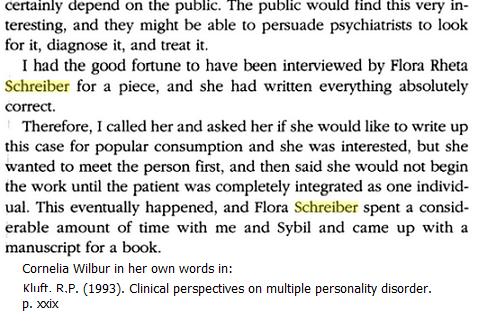
Additional note: After Wilbur died, Richard Kluft edited a book on multiple personality disorder and included a tribute to Cornelia Wilbur. Wilbur’s work with Sybil and other patients changed the way dissociative states were treated. An interview with Wilbur is included in the opening pages of the book. Here she notes the connection of the Cosmo article on Don, the fictional cured homosexual, and her decision to use Schreiber to write Sybil.
Note Wilbur says that Schreiber got everything right.