Duke lab maps silenced genes

Understanding genetics is difficult enough, but now comes new information about gene copies that get switched off leading to vulnerabilities and unanticipated pathways in development.

This AP article describes a paper regarding “silenced” genes and raises many questions about how the environment might turn on and off copies of genes. Here is the introduction:

Duke scientists map ‘silenced genes’

By LAURAN NEERGAARD, AP Medical Writer Fri Nov 30, 6:49 AM ET

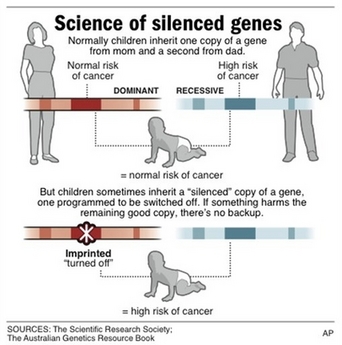
WASHINGTON – Remember biology class where you learned that children inherit one copy of a gene from mom and a second from dad? There’s a twist: Some of those genes arrive switched off, so there is no backup if the other copy goes bad, making you more vulnerable to disorders from obesity to cancer. if(window.yzq_d==null)window.yzq_d=new Object(); window.yzq_d[‘o.OVcULEYrE-‘]=’&U=13brmd2ke%2fN%3do.OVcULEYrE-%2fC%3d629244.11793224.12324303.1442997%2fD%3dLREC%2fB%3d5063146’;

Duke University scientists now have identified these “silenced genes,” creating the first map of this unique group of about 200 genes believed to play a profound role in people’s health.

More intriguing, the work marks an important step in studying how our environment — food, stress, pollution — interacts with genes to help determine why some people get sick and others do not.

capt_d3dacc1fb4ac45928b810a25a64b0576_silenced_genes_gfx639.jpg

Mankind Project position statements on therapy

In response to my request, Mankind Project Executive Director, Carl Griesser yesterday emailed the MKP’s position statement on reparative therapy. He also confirmed the accuracy of a position paper I found online which addresses the question of whether New Warriors is therapy. You can read each statement by clicking the links below.

Reparative therapy and MKP

New Warriors and therapy

Clearly, the Mankind Project does not want to give any impression that what they do in the NWTA is therapy. This is understandable since staff would need to demonstrate training and credentials to conduct group therapy. The NWTA claims to address fears and wounds from the past and help a person become a better person. I recognize that therapy is hard to define but resolving unwanted states and trauma is generally considered an aspect of treatment. Here is a statement from the Mankind Project’s website regarding what the NWTA aims to accomplish:

The New Warrior Training Adventure is an invitation to step forward and look in the mirror. What do you see? Are you the leader that you are looking for? Are you living on the edge of your life? What stands between you and taking action in your world? What is the risk for you to take full responsibility for your life, for living it from the inside out? Do you have the courage to face your own fears and insecurities and discover the tremendous power and beauty that lies within you? Are you willing to step into the fullness of who you really are? Are you willing to discover the real joy and terror of being a man? If so, this training may be for you.

We do not recommend this training for every man. To participate in this training, you must be highly committed to your life, and ready to take a hard look at yourself, your deepest fears, your wounds from the past, and the specific ways your life is not working for you. We choose to work only with men who are ready and willing to do this initiatory work with us.

Facing “insecurities,” “your deepest fears,” “your wounds from the past,” and “the specific ways your life is not working for you” sounds like an active attempt to address dysfunction and trauma. However, I remain open to dialogue on this point and intend to speak further with MKP, perhaps yet today.  

Psychoanalytic theory and the etiology of homosexuality: What does research say?

Does research support psychoanalytic explanations for homosexuality? In one recent exchange at the blog, Ex-Gay Watch, NARTH Scientific Advisory Board member, Jim Phelan advanced psychoanalytic theory with reference to a book entitled, Freud Scientifically Reappraised: Testing the theories and therapy, by Seymour Fisher and Roger Greenberg (1996). The 1996 edition is an update of their initial report in 1977. Specifically Dr. Phelan said that Fisher and Greenberg concluded that empirical research supported the Oedipally based Freudian conception of male homosexuality being derived from a distant or negative father and an overprotective mother – the so-called “classic triadic relationship.” 

I have expressed reservations about the psychoanalytic model before on this blog. Rereading Fisher and Greenberg refreshed my memory about why I do not believe the evidence for the theory is strong.

Regarding male homosexuality, Fisher and Greenberg said on page 139,

The post-1977 material we have reviewed concerning male homosexuality has narrowed the apparent support for Freud’s formulation in this area. Previously, we regarded the empirical data to be congruent with with Freud’s theory that male homosexuality derives from too much closeness to mother and a distant negative relationship with father. As noted, the increased pool of data available reinforces the concept of the negative father but fails to support the idea of the overly close, seductive mother…So we are left with only one of the major elements in Freud’s original formula concerning the parental vectors that are involved in moving a male child toward homosexuality. This reduction in confirmed points on the graph makes it all too easy to conjure up alternative theories of homosexuality that could incorporate the “negative father” data…There would be no need to appeal to the Oedipal image of a son competing with his father for mother’s love.

And so Fisher and Greenberg suggest that the evidence they reviewed supported a correlation between negative fathering and adult homosexuality but not the Oedipal drama surrounding mother. In addition to this limitation of psychoanalytic theory, there is no need to limit theorizing to thinking that poor fathering causes homosexual attractions in some general way for all same-sex attracted men. The empirical work is not able to specify well where the father-son relationship may have faltered. When sons recollect poor relationships with father, the questionnaires infrequently capture when the bad relationship occurred. For many men, I have spoken to and worked with, the bad relationships that are reported came after the emergence of homosexual interests, often in young adolescence. Furthermore, a sizable number of homosexual men report no such disruptions ever.

Fisher and Greenberg acknowledge the deficits in the research. Regarding early research (pre-1977), they noted:

…this entire body of literature is based on a strategy of asking adult homosexual subjects (and the adult heterosexual controls) to remember how their parents treated them during childhood. The questionnaires made such inquiries as, “Was your mother overly close to you?” “Was she intrusive?” “Was your father cold?” “Was he weak?” “Was he distant?” (p. 136).

The authors are skeptical that this strategy is sufficient to address the theoretical formulations that fathers were in fact all of the traits described. Furthermore, the authors pointed out four major methodological problems with the early research.

1. Some of the studies were based on highly selective samples (e.g., homosexuals in treatment or institutionalized for some reason).

2. The definitions of “homosexual” were in some instances so vague that one cannot distinguish whether subjects were possibly bisexual or had simply experimented on a limited basis with homosexual acts.

3. Bias was introduced into responses because some subjects were in psychoanalytic therapy and therefore had already been indoctrinated with Freud’s theory of homosexuality.

4. Few attempts were made to differentiate subjects with reference to mediating variables such as degree of integration into the homosexual community, age at which consistent homosexual behavior began, or degree of masculinity-femininity.

For me, these are crucial research issues that should make anyone very cautious in describing the body of research as supporting a conclusion. Even so, Fisher and Greenberg lent support to the observation of significant deficits in father-son relationships with male homosexual sons. Unaddressed is the issue of direction of causal relationship. Did the research identify the cause of homosexuality being poor fathering or on the other hand, can we tell whether fathers and sons were disrupted due to the emerging behavioral and sexual differences of the sons? The answer to both sides of that question is no, we can’t tell. And as Fisher and Greenberg note, with the mother dimension in serious question, the reparative/Oedipal explanation involving father is weakened. It may be that fathers are involved in cause but in some other more peripheral way (e.g., they do not support traditional heterosexual norms) or it may be that father-son relationships are strained but not with causal implications at all.

As for research regarding lesbians, the psychoanalytic notion is similar. Conflicted mother-daughter relationships are implicated, along with negative fathers. However, Fisher and Greenberg did not find support for the mother-daughter dynamic but did find a weak relationship between lesbianism and negative fathers. The same research cautions mentioned with regards to gay males applies here.

What can we conclude? Very little, in my opinion. It is inconsistent with the most charitable reading of what is not very good research to say psychoanlysis is supported as to etiology of homosexuality. In a future post, I hope to look at research since 1996.
Ex-gay history: Richard Cohen’s 2000 Exodus Conference presentation

Exgaywatch has posted a letter from Alan Chambers from earlier this year, describing Alan’s account of a presentation by Richard Cohen at the 2000 Exodus Conference. The letter was provided anonymously and was addressed to an Exodus parents’ group. Here is the entire letter which I have also verified.

Dear Parents Group,

Many of us within Exodus initially read Coming Out Straight, as we do most new books on the topic of overcoming homosexuality. Those of us who read the book began to talk amongst ourselves about the legitimacy of holding therapy, a practice Richard both uses and endorses.

At the time this discussion began (2000) I was not the President of Exodus nor was I even a board member. However, as the leader of an Exodus Member Ministry, I was deeply concerned about the implications this would have on Exodus as a whole if we endorsed such a controversial technique. Too, I worried about the possibility of leaders exposing themselves to temptation via the practice of “holding” a client.

That year (2000) at the Exodus Annual Freedom Conference Richard Cohen was invited by the Leadership at the time to teach a workshop on holding therapy. During that class, which I attended, he asked for a volunteer to demonstrate on.

****PLEASE NOTE THE FOLLOWING IS SOMEWHAT GRAPHIC****

His volunteer was a seasoned Exodus leader. This leader was instructed by Mr. Cohen to lay on the floor and spread his legs wide open. Dr. Cohen then laid down on top of this other man face to face and embraced him.

Mr. Cohen made the comment, “This might cause some stimulation. However, what goes up must come down, I always say.” He made other vulgar comments of this nature.

Mr. Cohen came out of homosexuality as did the leader that he violated. This leader was so taken back and embarrassed by the event that he wondered if his ministry status was at stake.

I joined the board of directors of Exodus that year and I made it very clear that I wanted to ensure that Dr. Cohen was taken to task for this breach of trust. A letter was sent to him and to my knowledge he had some  conversations with Bob Davies, my predecessor. The tapes of his workshop were pulled and he was told that he could not teach at any future conferences.

However, his book continued to be sold by the Exodus office until I was hired and I stopped that, as well.

It is because of all that I have shared and more that Exodus International does not and will not endorse or work with Mr. Cohen. His recent lack of judgment in the area of media interviews has only served to reinforce my belief that he is not someone Exodus should highlight as a valuable resource to the people that look to us.

As for the practice of holding therapy, under my leadership we decided to adopt the NARTH (www.narth.com) position banning our ministries from practicing this technique. Regardless of any benefits that this therapy is purported to have, I firmly believe that it is a stumbling block for all parties involved.

I appreciate each one of you and as someone who battled homosexuality myself, I believe it is my obligation to only promote the ministries and resources that will bring forth life long term and not simply every resource out there.

God bless each and every one of you,

Alan

Alan Chambers

President

Exodus International

The incident has become a part of ex-gay lore, although this may be the first mention of it in a public forum. I first heard about it at a Narth conference, when I asked an Exodus old-timer why Richard Cohen and Exodus did not seem to collaborate. My informant told this story as an eyewitness and indicated that the Exodus leadership had wrestled with how to handle it. And as the letter above notes, Exodus leaders determined that such methods were at odds with their views of how Christian ministry should operate and led to this Exodus statement on their website:

Statement on Richard Cohen

Exodus International does not endorse the work of Richard Cohen or the methods utilized in his practice. Some of the techniques Mr. Cohen employs could be detrimental to an individual’s understanding of healthy relational boundaries and disruptive to the psychological and emotional development of men and women seeking clinical counsel and aid.

For his part, Richard has said that he no longer does counseling but rather focuses on counselor training such as a recent one in Ireland and one to come in Mexico in early December.

New Warriors Integration group activities

A anonymous Mankind Project member mailed me what was labeled a handbook for leaders of Integration groups. Integration groups follow up the New Warriors Training Adventure. According to the manual, these exercises are

for the use of I-Groups that have reached a proficient level of self-facilitation. The value in many of them will be realized only by a deep commitment on behalf of the group to process the feelings evoked.

There are some which seem innocuous enough such as writing oneself a letter, volunteering for charities and staffing a NW training.

Others seem more provocative and sound a lot like Gestalt inspired group therapy techniques. Here is one that would likely be close to Richard Cohen’s heart.

I.2. Fathering

One of the powerful scenes we set up on the weekend is based on being held in the arms of the good father. Have men on their own write the things they wanted to hear from their fathers but never did. Have men bring the letters to the next meeting. If at all possible arrange to have elders or men from your community show up the next week to hold these men and read the letters to them. If men from outside the I-Group are not available use the men from the group. This basically is a re-play of the set up we use on the weekend. The difference is that men may have more difficulty dropping into a similar place not having just completed a piece of work. Try not to put weekend expectations on this process but simply see it for what is presented in the moment. Work with men to increase their awareness of body response. Resistance, grief or passive acceptance are all felt in the body. Another option is to have men choose the man they want to role-play from the community at large, then bring him along to the I-Group. This also has the potential to identify the men in the community most admired for their fathering abilities.

I suppose if I allowed myself to be held, I might experience a sense of dependency. However, I submit this could happen to almost anyone, whether the man had fathering issues or not. The situation makes it more likely that such feelings would be elicited. It is more likely that I would feel tense and uncomfortable. A person trained to look for these reactions as a defense might then say I was defensive and thus clearly had father issues that need resolved. Only those in the NMTA can speak to this. I have been around the therapy world long enough to know counselors who look at all client reactions as theory-guided indications of pathology.

Here are a couple of others that would be a bit more intimate:

I.3. Massage

Pair up the men in the group and announce that this evening we will give massages. After the first half of the men have received a massage tell the men no more massages will be given. Lead a feeling check, first with the men who gave the massage and then with the men who received.

1. Would you have given knowing you would not receive?

2. Is there a sense of betrayal, and with whom?

3. The men who received. Do you feel you got away with something? Or do you feel like you are beholden to the man you received from? If so why?

4. Let this check in progress wherever it goes. How does this reflect our expectations when we offer some gift of service?

I.4. Changing Clothes

This exercise may also belong in the play section, but it’s definitely a stretch when it comes to intimacy. The set up goes like this. Have all the men remove their clothing and then have each man choose someone else’s clothes and put them on. Once everyone is dressed assume the characteristics of the man whose clothes you wear. Check in with one another and decide on an exercise that will give an opportunity for interaction with one another. Stay in role through the entire evening. Leave time at the end to process the feelings that have come up.

1. How accurate was the role-playing?

2. Did men see a different side of themselves as a result of seeing other men portray them?

Don’t neglect the hurt feelings. Exaggeration will cause a certain amount of misunderstanding. Give one another feedback on projection and shadow, how it appeared and how it was dealt with.

I suppose there is no law against people getting together and doing this sort of thing, but these exercises sound like they would be at home in a Gestalt and/or Jungian psychodrama paradigm. The creators of these exercises probably feel they are eliciting something buried or hidden in each man. However, I wonder if the demand characteristics set up by the exercises cannot help but bring predictable reactions.

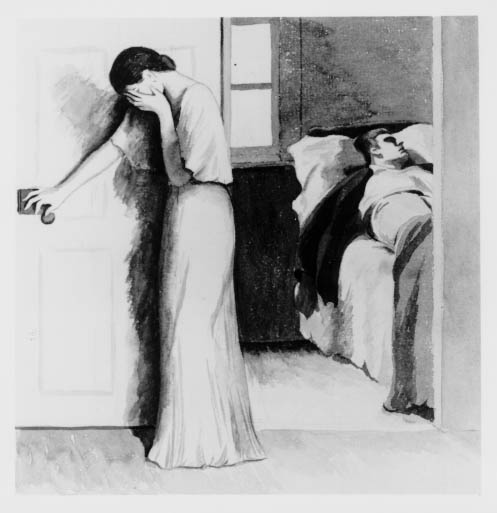
As a probably weak illustration, consider this picture. If you had to tell a story about it, what feelings would you say it would elicit?

tat_kaartc.jpg

I would not be at all surprised if a depressing story was told in response to this adaptation of a picture from the Thematic Apperception Test. Would this mean the story teller was a depressed person? Perhaps, but there is no way to know since the stimulus here naturally elicits depression. Similarly, I think the I-group exercises may elicit a variety of emotions and reactions which may or may not be reflective of underlying issues or problems. My thinking here is influenced by the classic social psychology experiments such as the Stanford Prison Experiment and the Milgram studies on obedience. At this point, I am not making a solidified judgment, rather I am clumsily attempting to articulate a social psychological perspective on the NWTA and related activities.

I have not even started on the Jungian shadow thing; more to come on that topic.

Keep the dialogue going…