Is Barack Obama so anti-god that he refuses to thank God even on Thanksgiving? This is a theme popular among some on the religious right. David Barton issued a document before the election calling Obama the most biblically hostile president ever. I have not examined all of Barton’s claims in that document but, based on his track record, I am skeptical. Furthermore, Barton repeats obviously false claims regarding Obama including the one that Obama hasn’t mentioned God in his Thanksgiving resolutions during his four years as president. Here is Barton’s tweet:
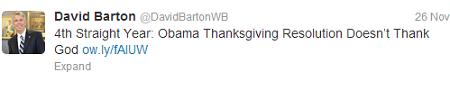
The link in this tweet goes to an article by Steven Ertelt and the pro-life news source, LifeNews. To his credit, Steve modified his article after I pointed out the facts about Obama’s proclamations to him. Will Barton retract his irresponsible endorsement of the false story? Don’t hold your breath.
In fact, this generalization simply is not true. I have no way of knowing Obama’s real religious sentiments, but fair is fair. Even though I did not support Obama in the election, I feel it is right to demonstrate that his official actions as president do not support this particular religious right stereotype. As the Texas Freedom Network pointed out, Obama mentioned God favorably in each one of his Thanksgiving proclamations. An easy place to read all presidential proclamations is at the American Presidency Project of the University of Santa California at Santa Barbara. There one can enter a year and then read all proclamations during the year.
To demonstrate that Obama does mention and give thanks to God, here are portions of his Thanksgiving proclamation made during each year in office.
Proclamation 8458 – Thanksgiving Day, 2009 – November 20, 2009
Today, we recall President George Washington, who proclaimed our first national day of public thanksgiving to be observed “by acknowledging with grateful hearts the many and signal favors of Almighty God,” and President Abraham Lincoln, who established our annual Thanksgiving Day to help mend a fractured Nation in the midst of civil war.
Proclamation 8606 – Thanksgiving Day, 2010 – November 23, 2010
Amidst the uncertainty of a fledgling experiment in democracy, President George Washington declared the first Thanksgiving in America, recounting the blessings of tranquility, union, and plenty that shined upon our young country. In the dark days of the Civil War when the fate of our Union was in doubt, President Abraham Lincoln proclaimed a Thanksgiving Day, calling for “the Almighty hand” to heal and restore our Nation.
As we stand at the close of one year and look to the promise of the next, we lift up our hearts in gratitude to God for our many blessings, for one another, and for our Nation.
As Americans gather for the time-honored Thanksgiving Day meal, let us rejoice in the abundance that graces our tables, in the simple gifts that mark our days, in the loved ones who enrich our lives, and in the gifts of a gracious God.
Proclamation 8755 – Thanksgiving Day, 2011 – November 16, 2011
When President George Washington proclaimed our country’s first Thanksgiving, he praised a generous and knowing God for shepherding our young Republic through its uncertain beginnings.
As we gather in our communities and in our homes, around the table or near the hearth, we give thanks to each other and to God for the many kindnesses and comforts that grace our lives. Let us pause to recount the simple gifts that sustain us, and resolve to pay them forward in the year to come.
Proclamation – Thanksgiving Day, 2012 – November 20, 2012
On Thanksgiving Day, Americans everywhere gather with family and friends to recount the joys and blessings of the past year. This day is a time to take stock of the fortune we have known and the kindnesses we have shared, grateful for the God-given bounty that enriches our lives.
When President George Washington marked our democracy’s first Thanksgiving, he prayed to our Creator for peace, union, and plenty through the trials that would surely come.
Let us spend this day by lifting up those we love, mindful of the grace bestowed upon us by God and by all who have made our lives richer with their presence.
In addition to his Thanksgiving proclamations, Obama issued three prayer related proclamations each year he has been president. From 2009 through the present, Obama officially recognized the National Day of Prayer, the Memorial Day Prayer for Peace and the National Days of Prayers and Remembrance in September. His language in these proclamations is enough to make atheists cringe. For instance, in his 2009 proclamation on the Day of Prayer, Obama said:
Now, Therefore, I, Barack Obama, President of the United States of America, do hereby proclaim May 7, 2009, as a National Day of Prayer. I call upon Americans to pray in thanksgiving for our freedoms and blessings and to ask for God’s continued guidance, grace, and protection for this land that we love.
In his 2010 Day of Prayer proclamation, Obama said:
On this day, let us give thanks for the many blessings God has bestowed upon our Nation. Let us rejoice for the blessing of freedom both to believe and to live our beliefs, and for the many other freedoms and opportunities that bring us together as one Nation. Let us ask for wisdom, compassion, and discernment of justice as we address the great challenges of our time.
In his 2012 Day of Prayer proclamation, Obama declared:
Let us pray for all the citizens of our great Nation, particularly those who are sick, mourning, or without hope, and ask God for the sustenance to meet the challenges we face as a Nation.
Perhaps these references are not enough for some religious people, but it is wrong to say that Obama does not acknowledge thanks to God in his official statements. In his other public statements (the ones highlighted by religious right pundits), Obama sometimes leans away from obvious religious references but one cannot say that Obama’s official acts as President have omitted God. Indeed, he has maintained the pattern of his predecessors when it comes to presidential acknowledgement of God.